1099 contractor income is inconsistent by design — no employer pay stub, no W-2, and monthly deposits that swing 40-60% between low and high months. Verifying it for underwriting means reconciling three documents against real bank activity, not just accepting a number on an application.
- Verify 1099 contractor income for underwriting by cross-checking Schedule C or 1099-NEC totals against 12 months of bank deposits.
- ClearStaq parses bank statements and tax returns in under 5 seconds with 99.5% accuracy across 900+ formats.
- Flag any month where deposits exceed reported 1099 income by more than 15% — that's a common income-smoothing signal.
- Doctored 1099s and pay stubs remain a top fraud vector; 27+ signals catch tampering manual review misses.
- Verdict: bank statement cross-verification, not self-reported 1099 totals alone, is the underwriting standard for 2026.
Why this matters
1099 contractors don't get a payroll department confirming their income. They self-report, and self-reported numbers on loan applications get inflated far more often than W-2 figures do. A borrower claiming $8,500/month in 1099 income with bank deposits averaging $5,900 is a debt-to-income calculation waiting to blow up post-close.
Manual review of this — pulling 12 months of statements, matching them against a Schedule C, checking for gaps — runs 45 minutes to over an hour per file when done by hand. That's the review time ClearStaq is built to cut, using the same parsing engine underwriting teams already use for self-employed income verification.
The stakes are higher in 2026 than they were even two years back — gig and freelance income now shows up in mortgage, auto, and personal loan files at a rate underwriting teams weren't built to handle at this volume.
What you'll need
- 12 months of business or personal bank statements (whichever account receives the 1099 deposits)
- Most recent 1099-NEC or 1099-MISC forms from each paying client
- Schedule C (or Schedule 1 for other income types) from the most recent filed tax return
- IRS tax transcript, ordered directly or via a transcript verification service
- A parsing tool that can extract deposit-level detail — manual line-by-line review doesn't scale past a handful of files a day
- A documented threshold for acceptable variance between reported and verified income (most underwriting teams use 10-15%)
The steps
1. Pull 12 months of bank statements, not 3
Three months hides seasonality. A contractor who does 70% of their annual revenue in Q4 will look underqualified in a spring snapshot and overqualified in a winter one. Twelve months of statements smooths that out and gives you a real average monthly deposit figure.
Expected outcome: a month-by-month deposit ledger you can compare line-by-line against reported income. Common mistake: accepting statements the applicant selects themselves instead of requesting a continuous 12-month PDF or online export.
2. Isolate 1099-source deposits from personal transfers
Not every deposit into the account is contractor income — some are transfers from savings, gifts, or a spouse's paycheck. Tag deposits by source: recurring client names, ACH descriptors, or payment processor labels (Stripe, PayPal, DoorDash, Upwork) are the fastest tell.
Expected outcome: a clean total of verified 1099-source cash flow per month. Common mistake: counting a single large one-time deposit as recurring income when it's a one-off client payment or loan.
3. Cross-check against the 1099-NEC totals
Add up every 1099-NEC the applicant provided and compare that annual total against 12 months of verified bank deposits. A gap under 10% is normal — clients pay late, invoices lag. A gap over 20% needs an explanation before you move forward.
Expected outcome: a variance percentage you can document in the file. Common mistake: only checking the largest 1099 and ignoring smaller clients that add up to real income.
4. Reconcile against Schedule C net profit
Schedule C shows gross receipts minus expenses — net profit is what actually matters for debt-to-income, not gross deposits. A contractor with $120,000 in deposits but $35,000 in claimed business expenses only has $85,000 in usable income for most lending programs.
Expected outcome: a net income figure aligned with tax filings, not a gross deposit number that overstates capacity. Common mistake: using gross bank deposits as the qualifying income figure without subtracting documented business expenses.
5. Verify the tax transcript against the return
Applicants sometimes submit a return that was never filed, or one that differs from what the IRS has on record. Order a transcript and match it line-by-line against the Schedule C the applicant provided. This step catches doctored or unfiled returns before they become a file-level liability. It's the same discipline used for tax transcript verification in mortgage underwriting, applied to 1099 files.
Expected outcome: a transcript-to-return match, or a flagged discrepancy. Common mistake: skipping transcript verification for smaller loan amounts where the process feels like overkill — fabricated returns don't correlate with loan size.
6. Check for income smoothing across the 12 months
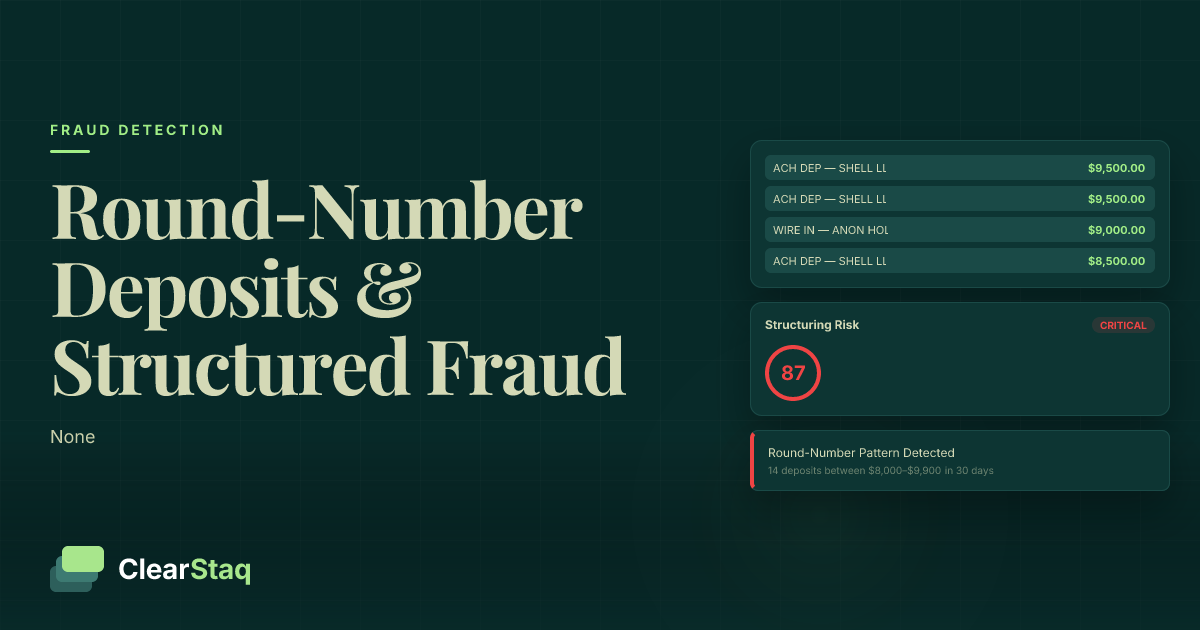
Applicants sometimes move money between personal and business accounts right before submitting statements, flattening what would otherwise look like a volatile deposit pattern. Look for round-number transfers that appear only in the months closest to application, or intercompany transfers with no invoice trail.
Expected outcome: confidence that the deposit pattern reflects real client payments, not manufactured stability. Common mistake: treating a suspiciously smooth deposit pattern as a positive signal instead of a red flag worth a second look.
7. Flag gig-platform payouts separately
Marketplace and gig-platform income (Uber, DoorDash, Upwork, Fiverr) settles differently than traditional 1099 client payments — batched, sometimes weekly, sometimes with platform fees already deducted. Treat these payouts as their own category rather than folding them into general deposit totals, since the payout schedule itself can mask a decline in actual work volume.
Expected outcome: an accurate view of gig income trend, not just total dollars. Common mistake: averaging 12 months of gig payouts without checking whether the trend is flat, growing, or declining month-over-month.
Verify 1099 income in seconds, not hours
Parse bank statements and tax returns with 99.5% accuracy and 27+ fraud signals.
Troubleshooting
- 1099 total and bank deposits don't match at all. Check for a second bank account — many contractors split business and personal banking, and the file may be missing statements from one account entirely.
- Schedule C shows a loss despite steady deposits. This usually means aggressive expense deductions for tax purposes, not fraud. Confirm with the applicant which expenses were one-time (equipment purchases) versus recurring, since one-time deductions shouldn't depress the usable income figure.
- Tax transcript won't match the submitted return. Order a fresh transcript — IRS processing delays sometimes mean the transcript reflects an older filing. If the mismatch persists, treat it as a document fraud flag consistent with patterns covered in doctored pay stub detection.
- Deposits spike suspiciously in the two months before application. This is the classic income-smoothing pattern — verify the source of each large deposit individually rather than accepting the aggregate total.
- Gig platform payouts look inconsistent month-to-month. Pull the platform's own earnings dashboard if the applicant can provide it — payout timing lag (weekly batches crossing month boundaries) explains most apparent volatility.
- 1099 forms look altered or inconsistent in font/formatting. Request the payer's own copy directly or verify against the transcript — visual inconsistency in a submitted 1099 is a document fraud signal worth escalating.
Tools and resources
- Bank statement parser with deposit-level categorization — manual spreadsheet reconciliation doesn't scale past a few files per underwriter per day
- IRS transcript ordering system (4506-C or direct online request)
- Working capital and marketplace payout verification guidance for platform-based contractors
- Income verification software built for personal loan lenders processing high volumes of 1099 files
- A documented variance threshold policy so every underwriter applies the same 10-15% tolerance consistently
What to do next
Once deposits, 1099 totals, Schedule C, and transcript all reconcile, the file moves to a defensible qualifying-income figure. If gig-economy income specifically is a growing share of your pipeline, the deeper breakdown on verifying gig economy driver income for auto financing covers payout-specific patterns this guide only touches on.
FAQ
What's the best way to verify 1099 contractor income for underwriting?
Cross-check 12 months of bank deposits against 1099-NEC totals, Schedule C net profit, and an IRS tax transcript. A variance under 10-15% between reported and verified income is generally acceptable in 2026 underwriting practice.
Is Schedule C net profit better than gross bank deposits for qualifying income?
Yes. Gross deposits overstate income because they don't account for business expenses. Schedule C net profit reflects what the contractor actually keeps, which is what most lending programs require for debt-to-income calculations.
How much does 1099 income verification cost lenders in review time?
Manual reconciliation of 12 months of statements against a 1099 and tax return typically runs 45 minutes to over an hour per file. Automated parsing tools cut that to a fraction of the time by extracting deposit-level detail in under 5 seconds per document.
What's a red flag for fabricated 1099 income?
A large, round-number deposit appearing only in the two months closest to application, with no matching client invoice or recurring pattern, is a common income-smoothing signal. Tax transcript mismatches are another strong indicator.
Do gig economy payouts count the same as traditional 1099 income?
They're verified the same way but tracked separately, since gig platforms batch payouts on their own schedule and often deduct fees before the deposit hits the bank account. Trend direction matters more than total dollars for these accounts.
How many months of bank statements should underwriting require for 1099 income?
Twelve months, not three. Contractor income is seasonal for many trades, and a shorter window misrepresents true average monthly cash flow in either direction.
What's an acceptable variance between reported and verified 1099 income?
Most underwriting teams set the threshold at 10-15%. Anything above that requires a documented explanation before the file moves forward.
Can tax transcripts catch a fabricated 1099 return?
Yes. Ordering a transcript and matching it line-by-line against the submitted Schedule C catches unfiled or altered returns that wouldn't be visible from the bank statements or 1099 forms alone.
One last thing
The single highest-leverage check in this whole process is the transcript-to-return match in step 5 — it's the one step that catches a fabricated document rather than just an optimistic self-reported number, and it's also the step underwriting teams skip most often on smaller loan files where fraud risk doesn't correlate with dollar amount at all.
Related guides
ClearStaq Team
Content Team
The ClearStaq team builds AI-powered tools for bank statement parsing, fraud detection, and income verification.