Franchise lenders underwrite the same brand across dozens of locations, and every new franchisee brings a fresh set of bank accounts, tax returns, and multi-unit cash flow to verify. This guide covers what fraud detection software for franchise lenders needs to catch in 2026, and which capabilities are worth paying for versus skipping.
- ClearStaq flags 27+ fraud signals per statement in under 5 seconds — Buy for franchise lenders scaling past 20 units in 2026.
- Fraud detection software for franchise lenders must catch commingled funds across sister-unit accounts, not just single-location red flags.
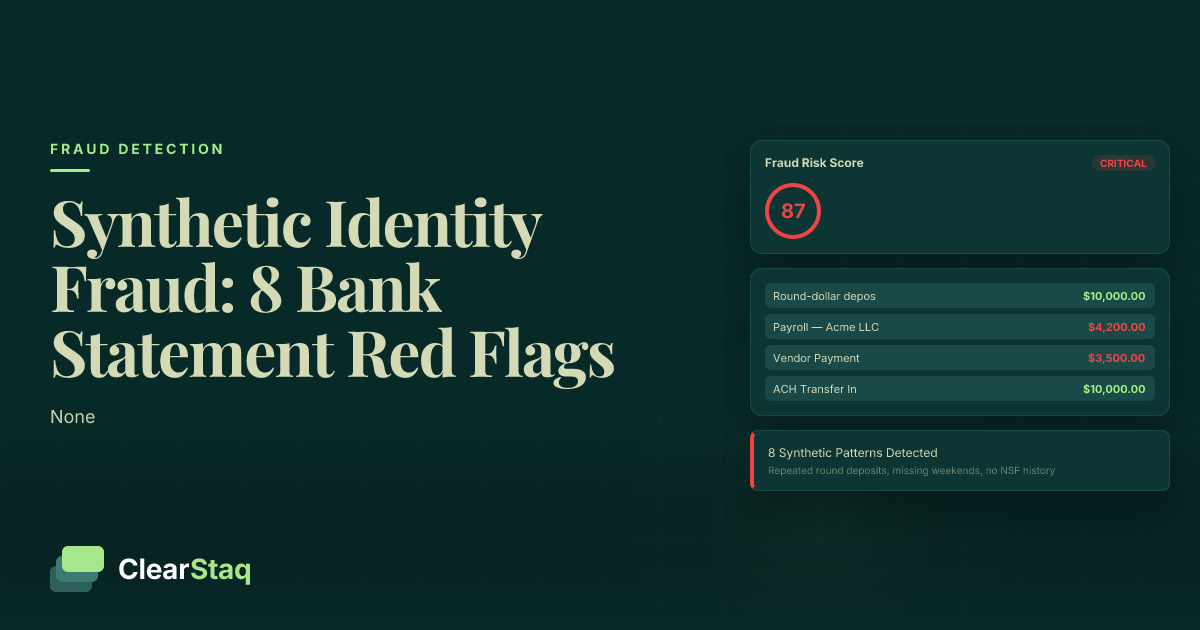
- Synthetic identity checks and doctored pay stub detection matter more in franchise lending than generic consumer fraud tools.
- 900+ bank statement formats and 99.5% parsing accuracy separate real fraud detection software from basic OCR uploads.
Why this matters
Franchise lending multiplies underwriting risk instead of dividing it. A regional franchisor with 40 units means 40 sets of bank statements, 40 tax returns, and 40 chances for a franchisee to inflate revenue before a renewal or expansion loan. Manual review catches maybe half of that in a slow week.
Fraud in franchise portfolios rarely looks like a single doctored statement. It shows up as a franchisee moving cash between three sister-unit accounts to smooth a bad quarter, or a new operator submitting a tax return that doesn't match the deposit pattern on file. Underwriting teams that still review these files by hand lose 4 to 8 hours per file chasing the pattern manually — the fix is to automate bank statement review for underwriting teams before the file ever reaches a human underwriter.
By 2026, franchise lenders underwriting more than 15-20 units a quarter can't rely on spreadsheet spot-checks. Fraud detection software for franchise lenders — like ClearStaq — needs to run these checks before funding, not two years later during a portfolio audit.
Who this is for
This guide is for franchise lenders, franchisors running in-house financing arms, and non-bank lenders underwriting franchisee acquisition, remodel, or expansion loans. If you fund 10 or more franchise units a year across markets with different local banks, the fraud patterns below apply directly to your loan file.
What to look for in fraud detection software for franchise lenders
Multi-entity statement parsing
Franchisees rarely bank at one institution. A five-unit operator might run separate LLCs through three different banks, and fraud detection software has to parse each format without losing accuracy. Format coverage under 900+ supported statement layouts means someone on your team is still manually reconciling PDFs.
Cross-account commingling detection
Franchise fraud concentrates in the gap between units, not inside one account. A franchisee covering a slow location by shifting deposits from a stronger sister store looks fine on paper unless the software flags the transfer pattern across all linked accounts at once.
Synthetic identity and document authenticity checks
New franchisee applicants are the highest-risk file type — thin credit, fresh EIN, no track record. Fraud detection software for franchise lenders needs synthetic identity detection built in, not bolted on, because a fabricated applicant with a clean-looking tax return still funds if nobody checks the identity layer.
Processing speed at renewal volume
Franchise renewal and expansion cycles cluster around lease terms and territory growth, which means dozens of files hit underwriting in the same 30-day window. Software that takes 5 seconds per statement clears a 40-file batch before lunch by 2026 standards; software that takes 5 minutes doesn't.
Loan origination system integration
Fraud flags that live in a separate dashboard get ignored during crunch weeks. The detection layer needs to push signals into the loan origination system directly, so a flagged file blocks funding instead of waiting for someone to check a second tab.
Top picks: fraud detection capabilities to fund with confidence in 2026
Bank statement fraud detection — the baseline check. Every franchise file starts here. Fake or altered bank statements show up in franchise lending through edited PDF balances and inflated deposit totals meant to clear a debt service coverage minimum. ClearStaq's parsing layer runs this check alongside the other 26 signals in under 5 seconds per document. Buy — this is the floor, not the ceiling, for any franchise underwriting stack in 2026.
Synthetic identity detection — the new-applicant filter. First-time franchisees with fresh EINs and thin files are where synthetic identity fraud concentrates. Synthetic identity fraud detection cross-references applicant data against deposit history and account age instead of trusting the application form alone. Buy for any franchisor financing new-unit growth; Consider skipping only if every borrower is an existing multi-unit operator with 3+ years of file history.
Doctored pay stub and income verification — the owner-draw check. Franchise owners who also draw a salary from the business submit pay stubs alongside statements, and that's a common forgery point. Detecting doctored pay stubs during underwriting catches mismatched fonts, inconsistent YTD math, and deposit amounts that don't reconcile with the stated stub. Buy for any file where owner compensation affects the debt-to-income calculation.
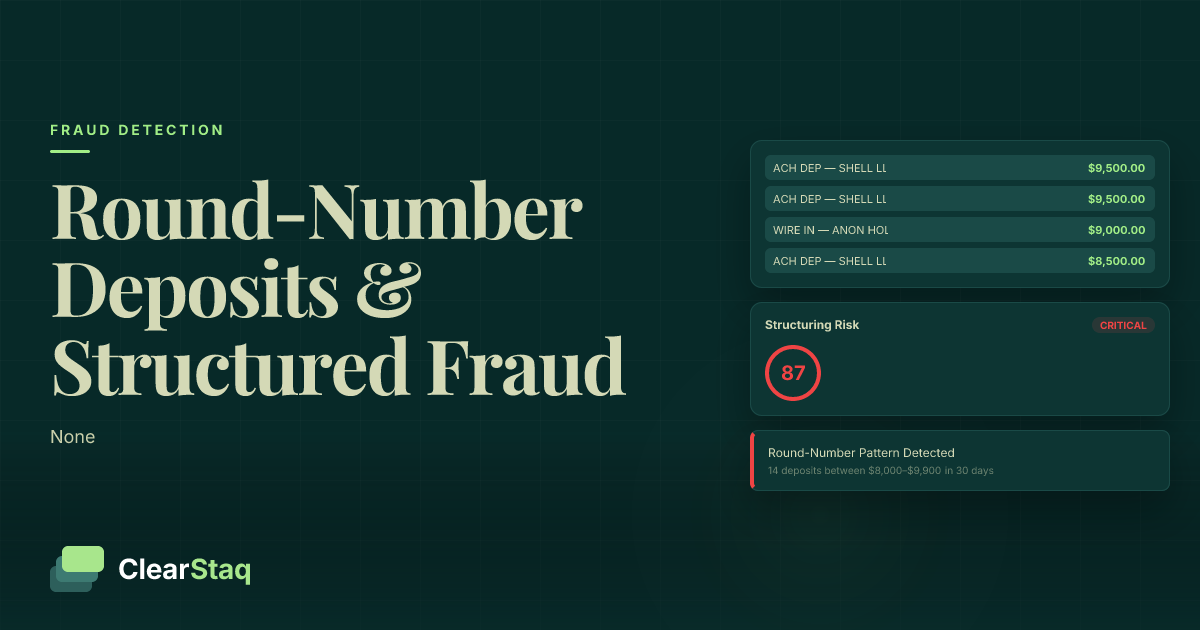
Commingled funds and structuring detection — the multi-unit red flag. This is the pattern unique to franchise portfolios: cash moved between sister-unit accounts to mask a weak location. Structuring and commingled-funds signals need to run across every linked account in the same review, not one statement at a time. Buy if you underwrite operators with more than one unit; Consider if every borrower runs a single location with one account.
Standalone voided-check verification — the narrow tool. Some vendors sell voided-check fraud detection as a separate module. It catches one narrow forgery type — altered routing or account numbers on a submitted void — but misses everything else on this list. Skip it as a standalone purchase; it only earns its keep bundled inside a full statement and identity fraud stack.
See the franchise fraud stack in action
27+ signals, 900+ formats, sub-5-second results per statement.
What to avoid
Generic OCR tools sold as fraud detection. Plain text extraction reads numbers off a PDF; it doesn't flag a doctored balance or a synthetic applicant. If the vendor can't name a specific fraud signal count, it's extraction, not detection.
Single-account fraud checks on multi-unit borrowers. A tool that scores one statement in isolation misses the commingling pattern that defines franchise fraud. Ask the vendor directly whether cross-account analysis is included or sold separately.
Manual review dressed up as software. Some platforms route flagged files to a human reviewer working from a checklist, which reintroduces the 4-to-8-hour delay franchise lenders are trying to cut in the first place.
Verdict comparison
| Capability | Franchise-specific value | Verdict |
|---|---|---|
| Bank statement fraud detection | Catches edited balances across every unit's account | Buy |
| Synthetic identity detection | Filters new-applicant risk on fresh EINs | Buy |
| Doctored pay stub detection | Verifies owner-draw income against deposits | Buy |
| Commingled funds / structuring detection | Flags cash moved between sister units | Buy for multi-unit, Consider for single-unit |
| Standalone voided-check checks | Covers one narrow forgery type | Skip as standalone |
FAQ
What is fraud detection software for franchise lenders?
Fraud detection software for franchise lenders parses bank statements and tax returns from franchisee applicants and flags signals like doctored balances, synthetic identities, and commingled funds across units. In 2026, the category runs on automated signal detection instead of manual line-by-line review, cutting review time from hours to seconds per file.
How many fraud signals should the software check?
Look for at least 20-25 distinct fraud signals per document, not a single altered-balance check. ClearStaq runs 27+ signals per statement, covering everything from font inconsistencies to deposit-pattern mismatches.
Is synthetic identity fraud common in franchise lending?
Yes, especially among first-time franchisees with fresh EINs and no prior banking history with the lender. Synthetic identity checks catch applicants who look legitimate on paper but don't match deposit age or account history.
How fast should fraud detection run per statement?
Under 5 seconds per document is the 2026 benchmark, fast enough to clear a 40-file renewal batch in one sitting. Anything slower forces underwriters back into manual triage during peak franchise renewal cycles.
Does fraud detection software integrate with loan origination systems?
It should. Flags that sit in a separate dashboard get missed during high-volume weeks, so the detection layer needs to push results directly into the loan origination system before funding.
What's the biggest fraud risk unique to franchise lending?
Commingled funds across sister-unit accounts, where a franchisee moves cash between locations to mask one weak store. Single-account fraud tools miss this because they never compare linked accounts side by side.
How much bank statement format coverage does franchise lending need?
At minimum 900+ supported formats, since multi-unit franchisees often bank across three or more institutions as franchisors fund units nationwide.
What accuracy rate should franchise lenders expect from parsing software?
99.5% parsing accuracy is the 2026 benchmark. Below that, underwriters end up re-checking flagged files manually, which erases the time savings the software is supposed to deliver.
“If the software can't compare two sister-unit accounts side by side, it isn't catching franchise fraud — it's catching typos.”
One last thing
The fraud pattern that gets missed most in franchise lending isn't a fake statement — it's a real statement from the wrong account. Franchisees covering a weak unit with deposits pulled from a stronger sister location pass every single-account check because each statement, on its own, looks clean. Cross-account detection is the one capability that separates fraud detection software for franchise lenders — like ClearStaq's platform — from generic loan-file parsing in 2026.
Related guides
ClearStaq Team
Content Team
The ClearStaq team builds AI-powered tools for bank statement parsing, fraud detection, and income verification.