Income verification for gig economy platforms confirms actual driver and freelancer earnings by parsing bank statements, 1099s, and marketplace payout summaries instead of relying on pay stubs that don't exist for 1099 workers. Multi-platform income (Uber plus DoorDash plus Instacart, all in one bank account) and seasonal swings make this segment harder to verify than a salaried W-2 applicant, and manual review of that mess is where underwriting teams lose the most time in 2026.
- Income verification software for gig economy platforms works by parsing bank deposits and 1099s, not pay stubs, since gig workers rarely have either.
- ClearStaq processes bank statements in under 5 seconds with 99.5% accuracy across 900+ statement formats.
- Manual review of multi-platform gig income across Uber, DoorDash and Instacart deposits takes hours per file without a parser.
- 27+ fraud signals catch doctored statements and duplicate deposit patterns common in gig applicant fraud.
- Best fit: platforms and lenders extending credit, leasing, or embedded finance to 1099 drivers and freelancers.
Why income verification matters for gig economy platforms
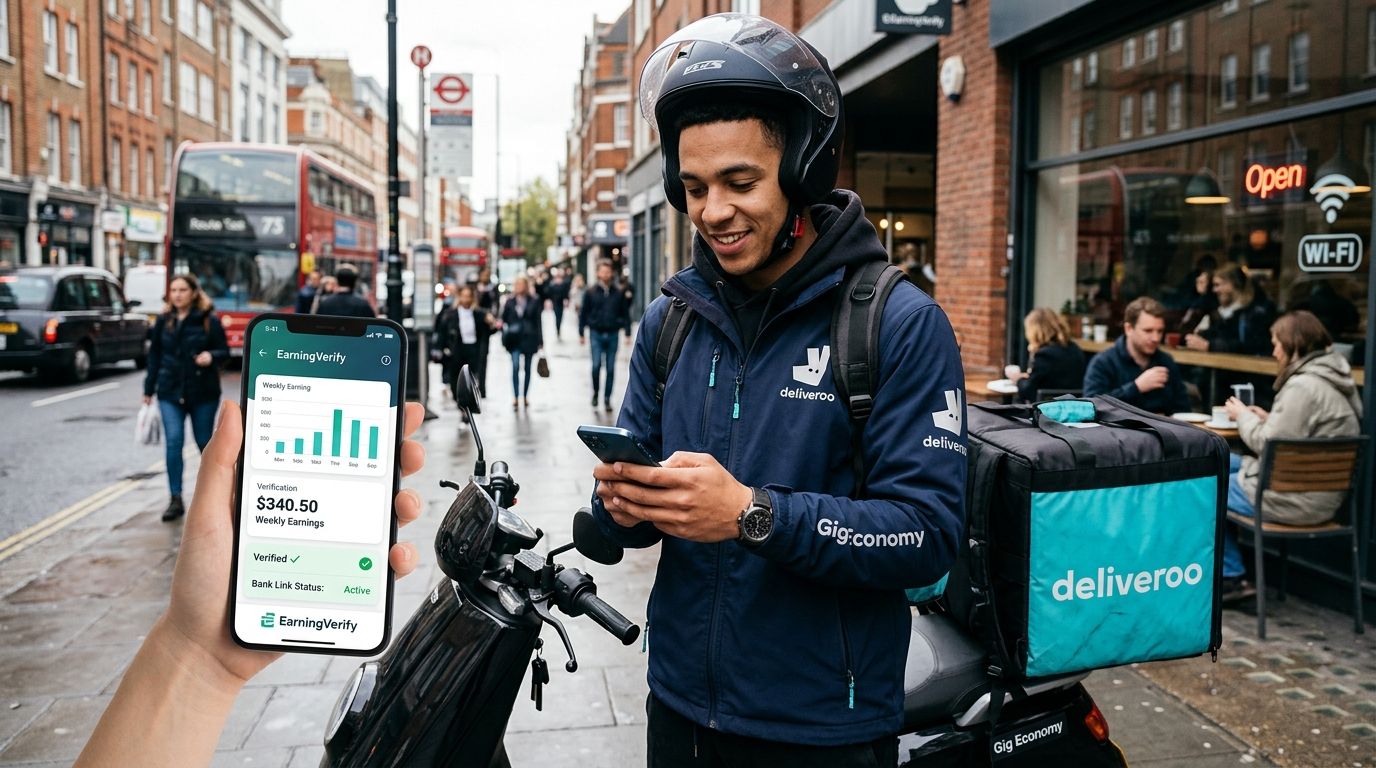
Gig workers don't have a single employer, a W-2, or a predictable biweekly deposit. A driver working three apps has three separate payout patterns landing in one checking account, and the amounts swing 30-40% month to month depending on demand, weather, and platform incentive cycles. Verification of employment services built for salaried workers can't confirm anything for this population — there's no HR department to call.
That gap matters for any platform extending credit, insurance, leasing, or embedded lending to its own driver or freelancer base. Underwriting teams end up asking applicants to upload PDFs of bank statements and 1099-NEC forms, then manually total deposits by hand. Income verification software built for gig economy platforms replaces that manual total with parsed, categorized deposit data in seconds, which is the difference between approving an application same-day in 2026 and losing the applicant to a competitor's faster process.
How to verify gig worker income
Collect the right documents up front
Start with what the applicant can actually produce — most gig workers can't get a traditional employment verification letter, so the document request has to match reality.
- Last 2-3 months of primary checking account bank statements
- 1099-NEC or 1099-K forms from each platform they drive or work for
- Platform-generated payout summaries exported from the driver or contractor dashboard
- A voided check or account confirmation for the deposit account
- Prior year tax return if the underwriting policy requires annualized income
Parse deposits instead of reading them line by line
A reviewer scanning a 20-page statement PDF for recurring platform deposits is slow and error-prone — deposit descriptors vary by platform and processor, and a tired reviewer misses one.
- Flag every deposit matching known gig platform descriptors automatically
- Separate gig income from personal transfers, refunds, and one-off peer-to-peer deposits
- Total deposits by platform and by month, not just a lump sum
- Catch statements that have been edited or reformatted before upload
- Surface any account with zero platform deposits despite a claimed gig income source
This is the step where a parser earns its keep. ClearStaq processes bank statements across 900+ statement formats in under 5 seconds at 99.5% accuracy, so a file that took a reviewer 20 minutes to hand-total is a categorized dataset before the applicant finishes the rest of the form.
Normalize multi-platform income across pay cycles
Raw deposit totals mislead if you don't normalize for pay frequency — some platforms pay out daily, others weekly, and a single high-deposit month can be an incentive period rather than the norm.
- Convert every platform's payout cadence to a monthly average
- Weight the most recent 90 days more heavily than older months
- Flag drivers with declining month-over-month trends separately from stable earners
- Cross-check the 1099 annual total against the sum of parsed monthly deposits
- Note gaps longer than 14 days with zero gig deposits — often a deactivation, not a slow month
Income volatility analysis built into the parsing layer catches this automatically instead of asking an underwriter to eyeball 90 days of transactions.
Screen for fraud signals specific to gig applicants
Gig income is easier to fake than a W-2 because there's no employer to verify against — a doctored bank statement or a borrowed account showing someone else's rideshare deposits both look plausible at first glance.
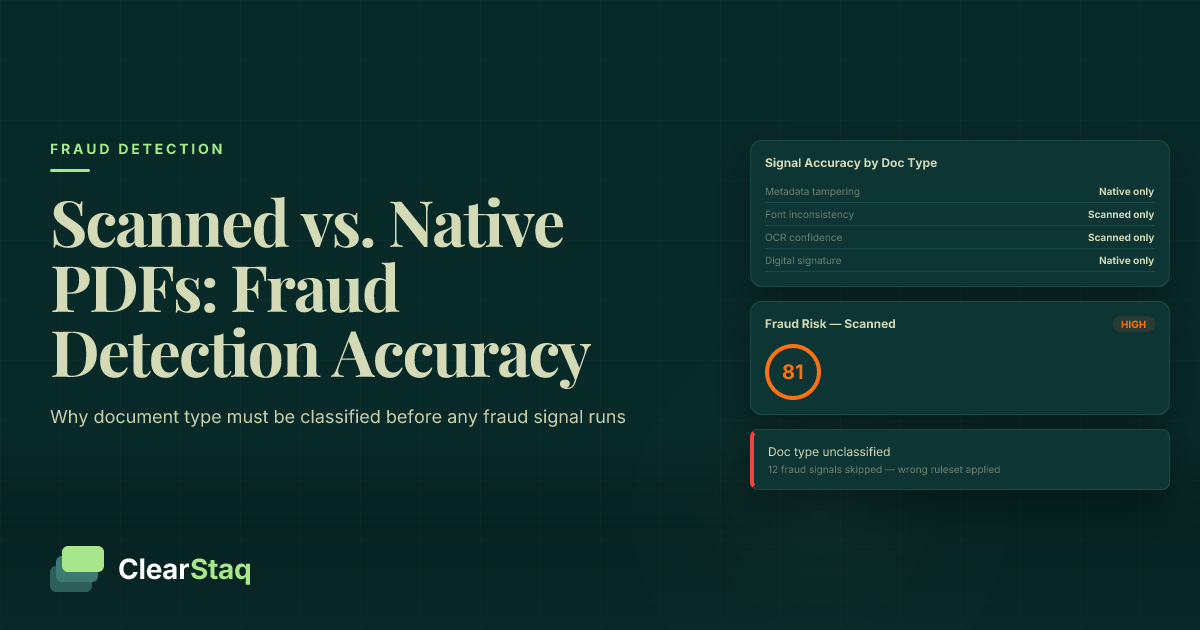
- Doctored or edited PDF statements with inconsistent fonts or metadata
- Deposit patterns that match a template rather than genuine bank formatting
- Duplicate account numbers or routing numbers reused across multiple applications
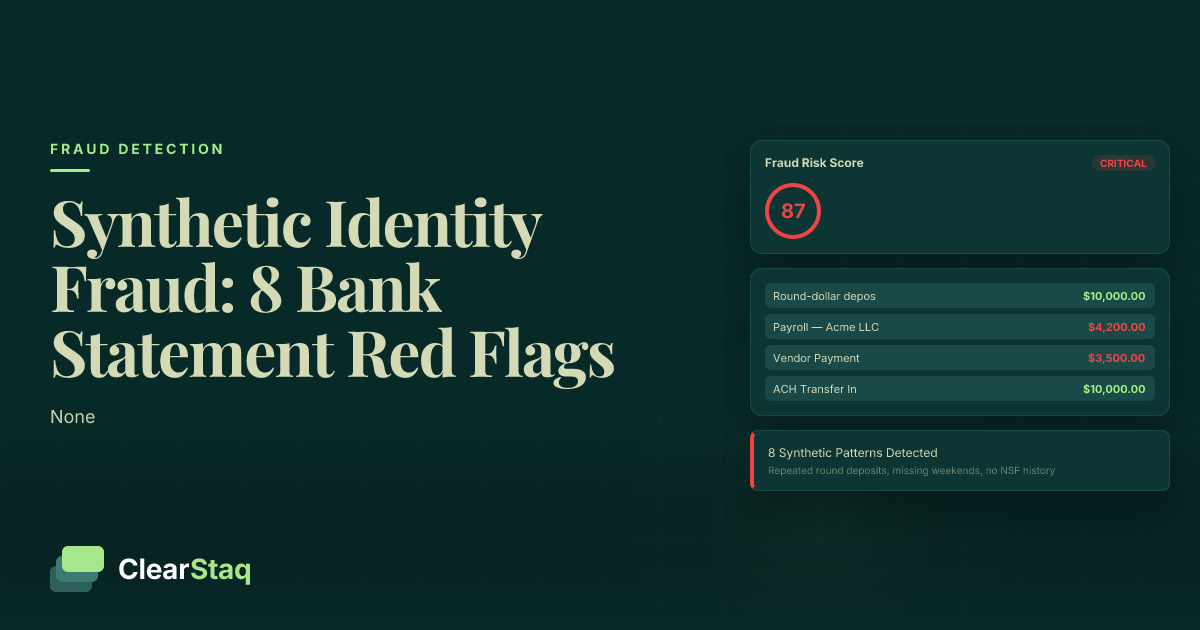
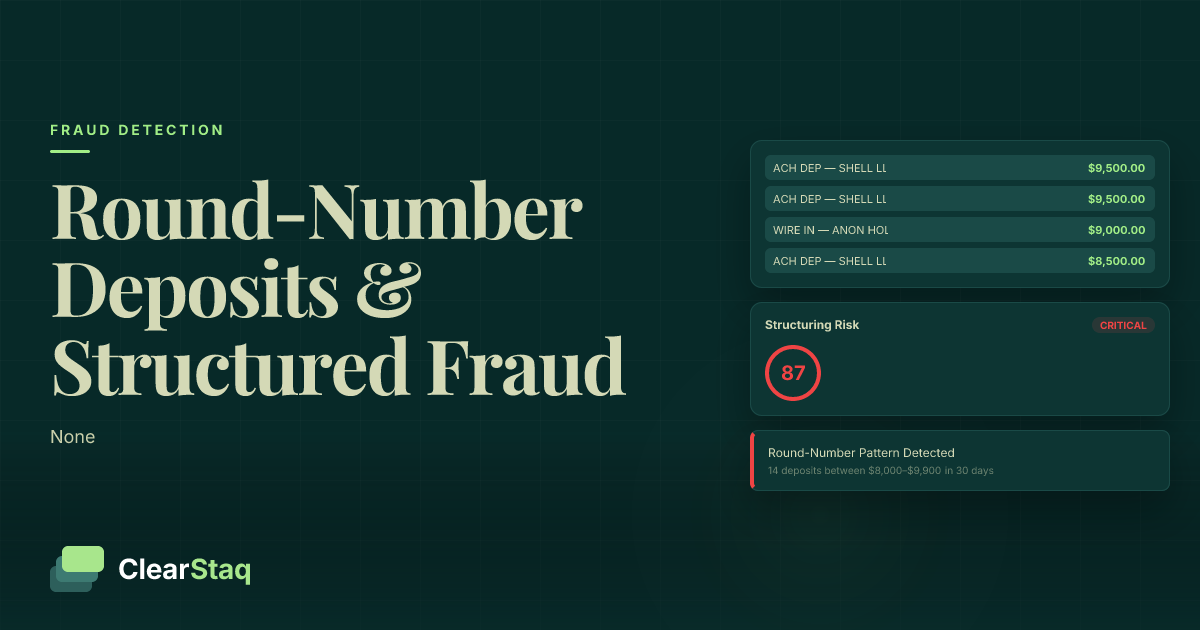
- Round-number deposits that don't match real platform payout math
- Bank statements uploaded as screenshots instead of native exports
ClearStaq runs 27+ fraud signals against every uploaded statement — the layer most manual review processes skip entirely, because nobody has time to check font consistency on page 14 of a PDF.
Verify the applicant is who they claim to be
Income verification without identity verification only confirms someone's bank account is real, not that the person applying owns it. Gig platforms specifically deal with account-sharing and rented-identity fraud where one person's driver profile gets used by another.
- Match the name on the bank statement to the name on the application
- Cross-reference the 1099 issuer against the claimed platform
- Run a liveness or biometric check against a government ID
- Confirm the applicant's device and location are consistent with the application
Biometric identity verification for gig economy platforms closes this gap without adding a second manual review step.
Verify 1099 contractor income against the tax return
Bank deposits show cash in the door; the 1099 shows what was reported to the IRS. The two should roughly match, and when they don't, that's worth a second look before approval.
- Total the 1099-NEC or 1099-K amount against 12 months of parsed deposits
- Flag mismatches over 15-20% as manual review candidates
- Confirm the issuer EIN on the 1099 matches the actual platform, not a shell entity
- Check for 1099s from platforms the applicant never disclosed
More detail on this cross-check lives in how to verify 1099 contractor income for underwriting.
Automate the approve/decline decision
Once deposits are parsed, normalized, fraud-screened, and identity-matched, the decision itself should be a rules engine, not a person re-reading the same file a fourth time.
- Set a minimum trailing-90-day average income threshold
- Set a maximum acceptable deposit-to-1099 variance
- Auto-decline files with unresolved fraud flags rather than routing every flag to a human
- Route only borderline cases to manual underwriting
See how ClearStaq parses gig income
27+ fraud signals and 99.5% accuracy on driver and freelancer bank statements.
Income verification options for gig platforms
| Option | Best for | Key limitation |
|---|---|---|
| Manual statement review | Very low application volume | Hours per file, inconsistent deposit categorization |
| Generic OCR document tools | Basic text extraction | No fraud scoring, no gig-specific deposit matching |
| Bank data aggregators | Real-time account linking | Requires live credential connection; doesn't parse uploaded PDFs or 1099s |
| ClearStaq | Platforms verifying 1099 driver and freelancer income at scale | Built for statement and tax document parsing, not live account linking |
Verdict: ClearStaq is built for gig platforms and lenders that need parsed, fraud-screened income data from uploaded statements and 1099s rather than a live account connection. Aggregators win when the applicant will connect a bank login directly; parsing wins when they upload a PDF, which is still how most gig drivers submit documents in 2026.
Common mistakes gig platforms make with income verification
- Treating one platform's deposits as total income. A driver working two rideshare apps simultaneously gets undercounted if the review only searches for one descriptor.
- Using a flat income threshold with no volatility adjustment. Gig income swings 30-40% seasonally; one low month shouldn't auto-decline an otherwise-stable earner.
- Skipping identity verification because the bank statement looks fine. A real statement doesn't mean the applicant owns the account behind it.
- Accepting screenshots of bank apps instead of statement exports. Screenshots are the easiest document type to fake and the hardest to parse reliably.
- Not cross-checking 1099 totals against deposits. A mismatch is often the first sign of either fraud or undisclosed platform work.
FAQ
What is income verification software for gig economy platforms?
It parses bank statements, 1099s, and platform payout data to confirm gig worker earnings without a pay stub or employer verification. ClearStaq does this across 900+ statement formats in under 5 seconds.
How do you verify income for someone with no pay stubs?
Use bank statement deposits matched against 1099 forms and platform payout summaries instead of a pay stub. This is the standard approach for 1099 drivers and freelancers in 2026, since no employer exists to confirm salary.
Is bank statement parsing more accurate than manual review for gig income?
Parsing removes the risk of a reviewer missing a deposit descriptor or miscounting a 90-day total by hand. ClearStaq runs at 99.5% accuracy, which is difficult to match with line-by-line review at volume.
How much does gig income verification software cost?
Pricing varies by provider and monthly document volume. Check current pricing directly with the vendor rather than relying on published estimates that go stale.
Can income verification software catch fake gig income documents?
Yes, when fraud detection is layered on top of parsing. ClearStaq runs 27+ fraud signals against every uploaded statement to flag doctored PDFs and mismatched 1099 totals.
Do gig platforms need identity verification in addition to income verification?
Yes, because a legitimate bank statement doesn't confirm the applicant owns the account. Biometric or liveness checks close that gap alongside income parsing.
What documents should a gig platform request for income verification?
Request 2-3 months of bank statements, 1099-NEC or 1099-K forms, and platform payout summaries. That combination covers both cash in the door and IRS-reported income.
How is gig income different from W-2 income for underwriting?
Gig income comes from multiple platforms with irregular pay cycles and no employer confirmation, while W-2 income is single-source and verifiable through payroll. Rules built for W-2 applicants routinely misfire on gig applicants.
One last thing
The deposit descriptor is the tell most manual reviewers miss. A driver running three apps often has one platform paying out daily and two paying weekly, so a reviewer who totals "this month's deposits" without separating by platform will overstate or understate income by a wide margin. Parse by platform first, then total — a small step that changes the 2026 approval decision more often than any single fraud flag.
Related guides
ClearStaq Team
Content Team
The ClearStaq team builds AI-powered tools for bank statement parsing, fraud detection, and income verification.