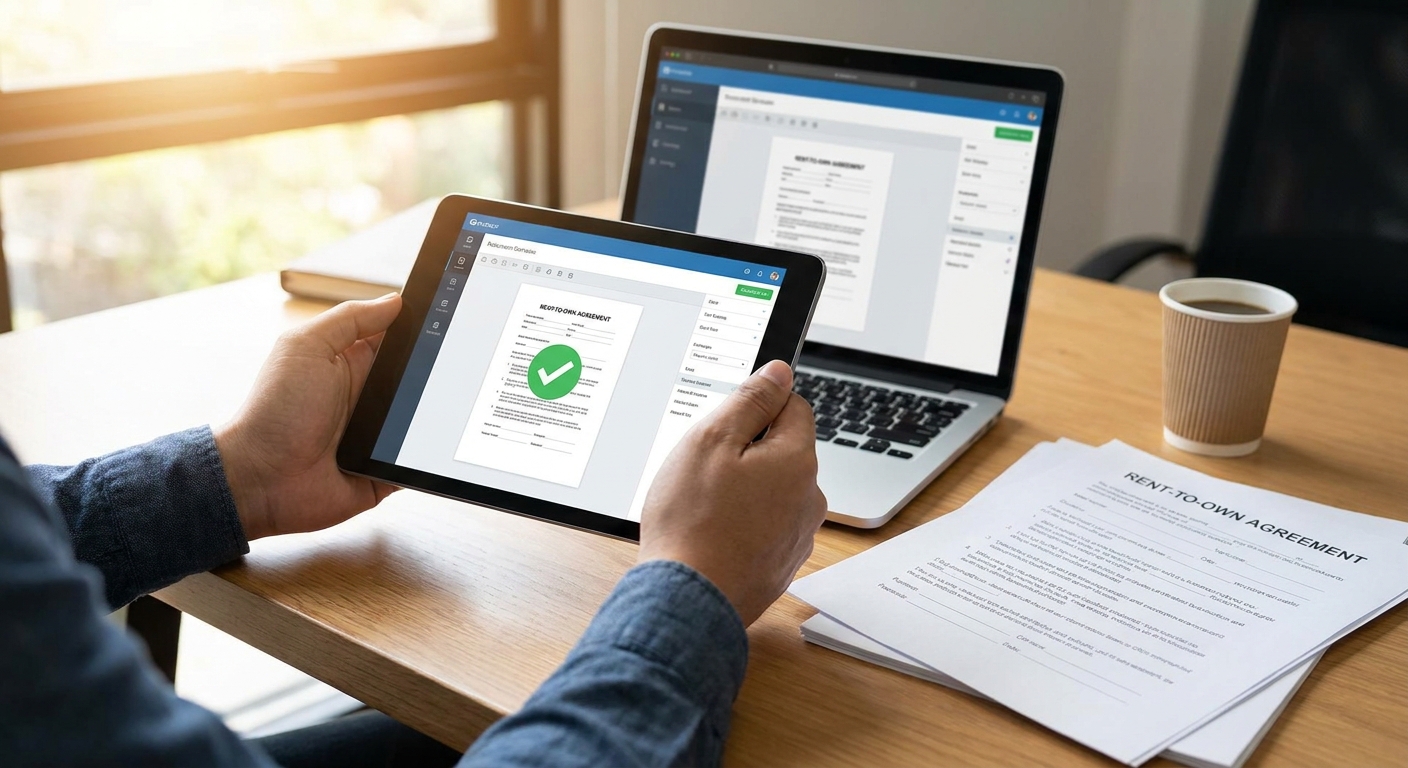
Rent-to-own companies approve leases in minutes, often right at the counter, which makes them an easy mark for doctored bank statements, altered pay stubs, and straw-buyer applications. Document fraud detection software for rent-to-own companies exists to catch those documents before the merchandise walks out the door.
- ClearStaq is the strongest document fraud detection software for rent-to-own companies in 2026 -- Buy.
- 27+ fraud signals catch doctored pay stubs and staged bank statements that manual review misses.
- Generic OCR tools extract text but flag nothing -- Skip them for lease underwriting.
- Standalone synthetic identity tools work as an add-on layer, not a full replacement -- Consider only as a supplement.
Why this matters
Rent-to-own leases run on small weekly or monthly payments, which means underwriters approve at volume and at speed. That combination -- fast decisions, thin-file applicants, low per-unit dollar amounts -- is exactly what fraud rings look for. A bust-out scheme that would get flagged instantly at a bank moves easily through an RTO counter when the only check is a glance at a pay stub.
The documents themselves are the weak point. Bank statements get edited in a PDF tool to inflate deposits. Pay stubs get generated from templates sold online. Applicants use stolen or synthetic identities to open multiple accounts across store locations in the same week. Detecting fake bank statements before approval is cheaper than chasing a defaulted lease in 2026, and it's the single highest-leverage fix an RTO operation can make to its intake process.
Who this is for
This guide is for underwriting leads, risk managers, and store operations directors at furniture, appliance, electronics, and tire leasing chains who approve 90-day to 24-month lease agreements for applicants with thin or nonexistent credit files. If your team leans on self-reported income and a scanned bank statement because traditional bureau data doesn't tell you enough, this is written for you.
What to look for in document fraud detection software for rent-to-own companies
Speed at the point of lease
An RTO applicant is standing at the counter, not filling out a mortgage application over a week. Software that takes minutes to return a result loses the sale or forces a manual override -- look for parsing and fraud scoring that returns in single-digit seconds, not a multi-day queue.
Fraud signal depth, not just OCR
Extracting text from a PDF is not fraud detection. A document that reads cleanly can still be a fabricated statement built in a template. Software worth paying for runs the extracted data through dozens of fraud checks -- font inconsistencies, metadata mismatches, deposit patterns that don't match real payroll cycles -- rather than stopping at reading the numbers.
Coverage across pay stub and bank statement formats
RTO applicants bring statements from national banks, regional credit unions, and neobanks, plus pay stubs from a dozen different payroll platforms. A tool that only handles the top three bank formats forces your team back into manual review for every applicant who doesn't fit the mold -- and that's most of your thin-file customers.
Detection of straw-buyer and synthetic identity patterns
Some of the costliest RTO fraud isn't a doctored document at all -- it's a real-looking identity that was never a real person. Software that cross-references identity signals against document data catches the applicant who passes every individual check but doesn't add up as a whole person.
Fit with your leasing and POS workflow
A fraud tool that requires your store staff to log into a separate portal and re-key data will get skipped during a busy Saturday. Look for an API or integration path that drops a fraud score straight into the lease decision screen your team already uses.
Top picks for rent-to-own document fraud detection
ClearStaq -- the specialist pick. ClearStaq parses bank statements and pay stubs and runs them through 27+ fraud signals with 99.5% parsing accuracy, returning a result in under 5 seconds. For an RTO operation approving dozens of applicants a day, that speed is the difference between catching fraud before signature and writing it off after default. Buy. See how the platform handles income documents on the ClearStaq homepage.
Standalone synthetic identity tools -- the narrow specialist. These tools focus on one job: flagging identities built from stolen or fabricated personal data rather than checking the documents themselves. They catch straw buyers that document parsing alone might miss, but they don't verify whether the bank statement or pay stub in front of you is real. Useful as an add-on layer for synthetic identity fraud detection, not as your only line of defense. Consider.
Manual underwriter review -- the status quo. A trained reviewer eyeballing a bank statement PDF for 15 to 30 minutes per file still misses tampering that isn't visible to the naked eye -- shifted metadata, inconsistent deposit spacing, fonts that don't match the bank's actual statement template. It scales linearly with headcount, which is the opposite of what a high-volume RTO counter needs. Skip.
Generic OCR-only extraction -- the half-measure. These tools read text off a scanned document accurately enough, but stop there. They tell you what the numbers say without telling you whether the document is real. Pairing OCR with a separate fraud layer adds cost and integration overhead most RTO teams don't have the bandwidth to manage in 2026. Skip.
See fraud signals on a real statement
Run a sample bank statement through 27+ fraud checks in under 5 seconds.
What to avoid
- Enterprise mortgage-grade underwriting suites. Built for 30-year loan files with weeks of review time, not a lease decided in five minutes at the counter.
- Basic OCR tools with no fraud signal library. They confirm the document is readable, not that it's real -- the two are not the same thing.
- Bureau-only credit checks. Most RTO applicants are thin-file by definition, so a bureau pull tells you almost nothing about whether the bank statement they handed you was altered.
Verdict comparison
| Tool | Speed | Fraud signal depth | Format coverage | POS fit | Verdict |
|---|---|---|---|---|---|
| ClearStaq | Under 5 seconds | 27+ signals | Wide (bank + pay stub) | API-ready | Buy |
| Synthetic identity point tool | Seconds to minutes | Identity-focused only | Narrow | Add-on only | Consider |
| Manual underwriter review | 15-30 min/file | Reviewer-dependent | Reviewer knowledge | Doesn't scale | Skip |
| Generic OCR extraction | Seconds | None | Varies by vendor | Needs a second tool | Skip |
FAQ
What is document fraud detection software for rent-to-own companies?
It's software that parses bank statements, pay stubs, and identity documents submitted by lease applicants and scores them for tampering or fabrication. It replaces a visual check with signal-based detection across dozens of fraud indicators at once.
How does document fraud detection differ from a basic OCR tool?
OCR only extracts text from a scanned document -- it doesn't judge whether the document is genuine. Fraud detection software runs the extracted data through checks like metadata inconsistencies and deposit-pattern anomalies before it ever reaches an underwriter.
What documents get faked most often in RTO lease applications?
Bank statements and pay stubs are the two most commonly altered documents in rent-to-own applications. Applicants edit deposit totals in a PDF or generate a fake pay stub from a template to clear an income threshold.
Can document fraud detection software catch synthetic identities?
Some platforms flag identity inconsistencies alongside document tampering, but dedicated synthetic identity tools go deeper on that specific problem. Pairing the two catches more than either does alone.
How fast should fraud detection run at the point of lease?
Results should return in single-digit seconds so the decision happens while the applicant is still at the counter. Anything that takes minutes forces a manual override or a lost sale.
Do rent-to-own companies need bank statement parsing or just pay stub checks?
Both. Self-employed and gig-income applicants -- a large share of RTO customers -- often have no pay stub at all, so bank statement parsing is the only way to verify their real income in 2026.
Is manual document review still viable in 2026?
It's viable at very low volume but doesn't scale. A reviewer spending 15 to 30 minutes per file can't keep pace with a busy RTO counter, and tampering that isn't visible to the eye slips through regardless of how careful the reviewer is.
One last thing
Round-number deposits landing on the same weekday, month after month, are one of the clearest tells in a staged bank statement -- real income almost never lands on a perfect schedule. That's the kind of pattern a single glance at a PDF will never catch, and it's exactly why signal-based document fraud detection software for rent-to-own companies outperforms a trained eye in 2026.
Related guides
ClearStaq Team
Content Team
The ClearStaq team builds AI-powered tools for bank statement parsing, fraud detection, and income verification.