Community banks originate business loans on the strength of bank statements — and fraudsters know it, doctoring ACH deposit histories to fake revenue that was never there. ACH fraud detection software for community banks closes that gap by verifying the statements themselves before a loan officer ever signs off.
- ClearStaq's document-first approach wins for community banks verifying ACH-heavy business statements — Buy.
- Check-fraud specialist tools cover deposit slips but miss structuring patterns — Consider as a supplement, not a replacement.
- Manual underwriter review still takes 4-8 hours per file in 2026 and misses altered PDFs regularly — Skip as a standalone process.
- 27+ fraud signals and sub-5-second processing beat single-signal tools for catching fabricated ACH deposit histories.
Why this matters
Community banks run thinner compliance staffs than regional or national banks, which means one BSA officer or credit analyst often reviews every business loan file by hand. A fabricated bank statement with inflated ACH deposits can slip past a visual check in seconds — and once the loan funds, the bank owns the loss.
Examiners are asking more pointed questions about document verification controls in 2026 than they did three years ago, especially for banks doing SBA and commercial lending. ACH fraud detection software for community banks isn't a nice-to-have anymore — it's becoming part of the exam conversation.
Who this is for
This guide is for community bank credit analysts, BSA/compliance officers, and commercial loan underwriters who review business bank statements as part of loan packaging — not enterprise fraud teams running real-time payment rail monitoring. If your bank originates SBA 7(a) loans, commercial lines of credit, or equipment financing and relies on applicant-submitted PDFs or CSVs, this is your buying guide. ClearStaq's own analysis of document fraud detection software for community banks breaks down the specific formats and fraud patterns this segment sees most.
If your bank already has an enterprise transaction-monitoring stack (Actimize, Verafin, or similar) covering live ACH rails, this guide isn't for you — you need document-side verification to plug the gap those platforms don't cover: statements submitted at origination, before a single dollar moves.
What to look for in ACH fraud detection software for community banks
Format coverage across statement templates
Community banks see statements from dozens of regional and national institutions, each with different layout quirks, and a parser that only handles the top five formats will bounce half your files to manual review. Look for platforms that document format coverage in the hundreds, not a fixed list of a dozen banks — coverage claims below 900+ formats usually mean gaps on smaller regional banks your borrowers actually use.
Fraud signal depth, not just OCR accuracy
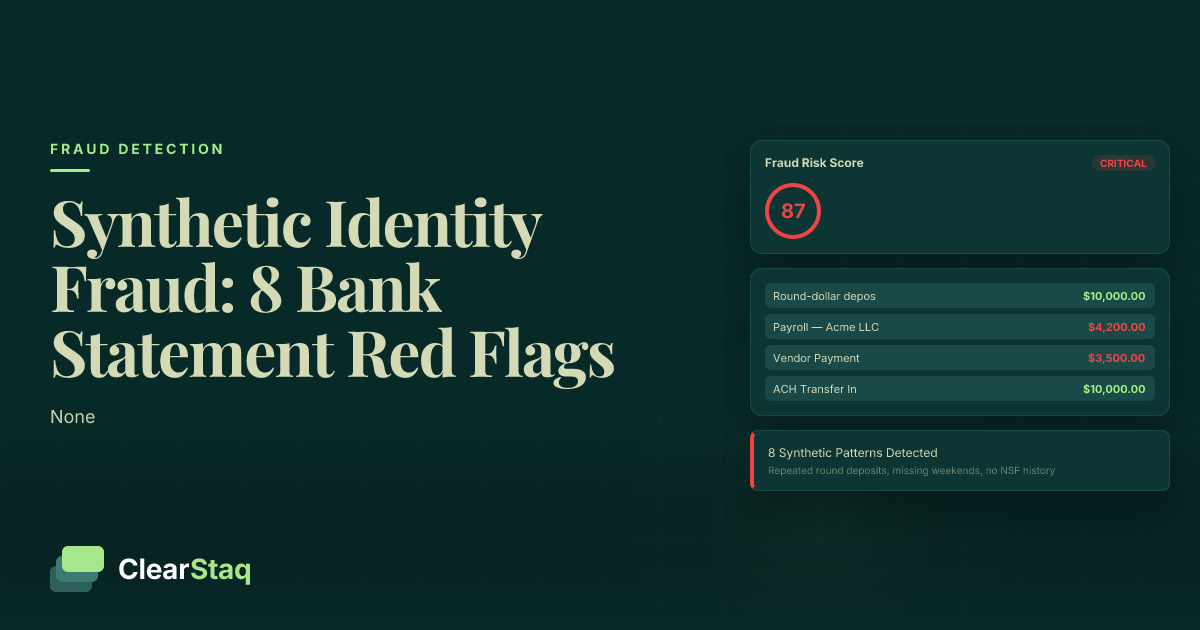
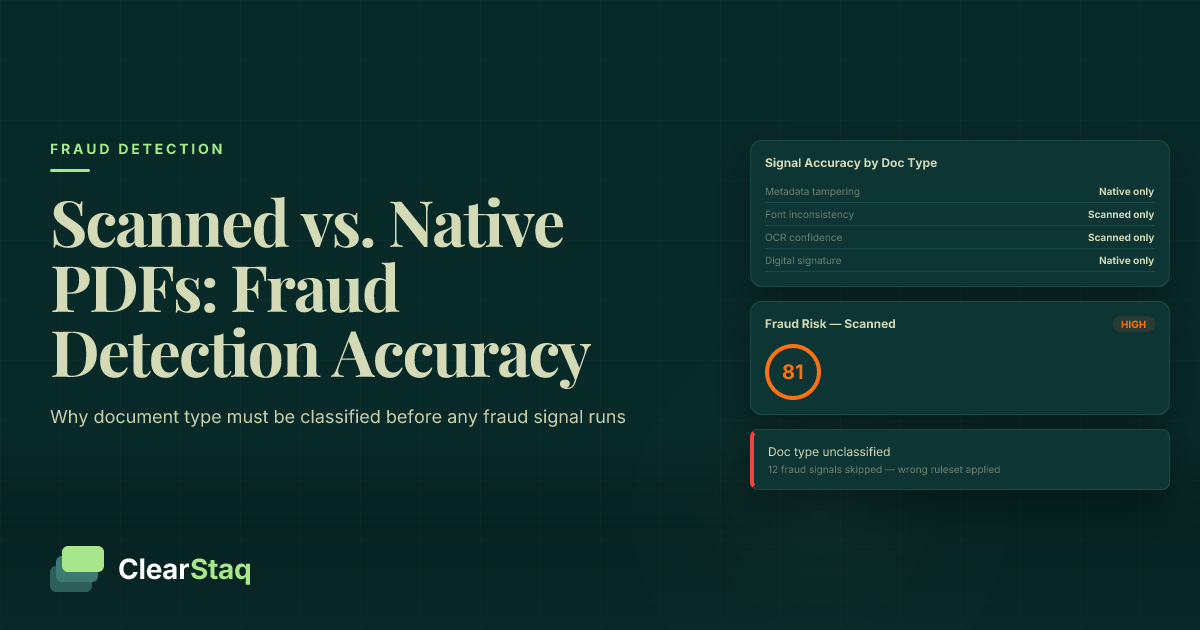
Extracting text correctly is table stakes; catching a doctored balance or a duplicated transaction ID is the actual job. Platforms built around 27+ distinct fraud signals — duplicate transactions, balance math errors, font inconsistencies, altered metadata — catch fabricated ACH deposit histories that a single-signal tool waves through.
Structuring and kiting pattern detection
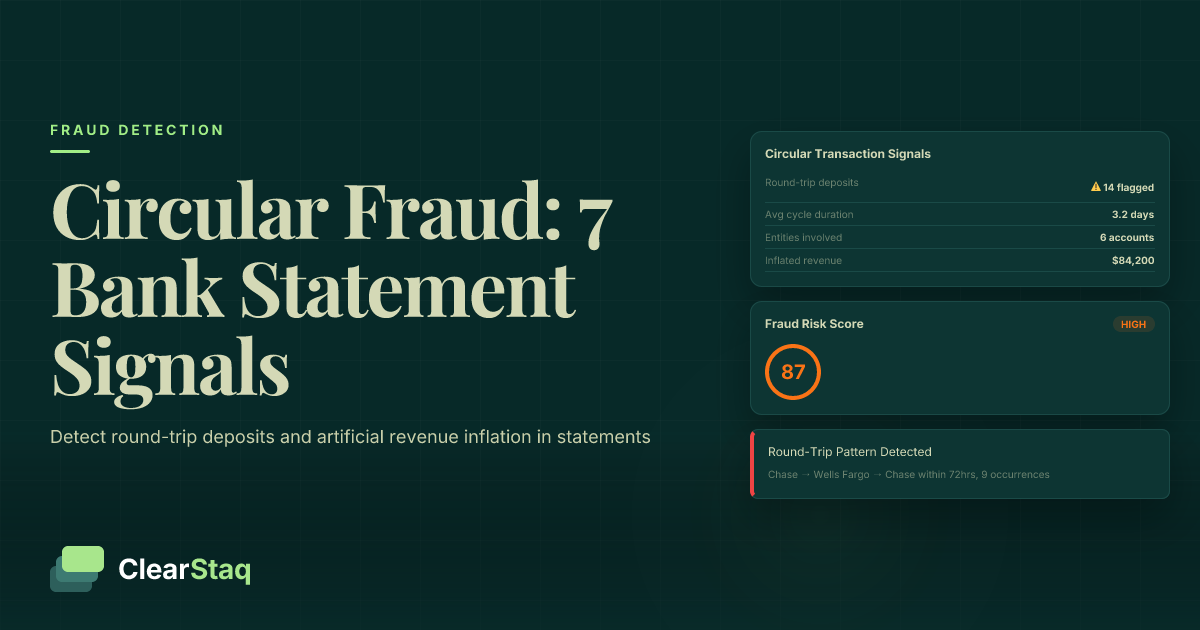
ACH fraud in loan files rarely looks like one big fake deposit; it looks like several deposits sized to stay under review thresholds, or funds cycling between accounts to inflate apparent cash flow. A tool that flags structuring patterns in business bank statements catches what a human skimming twelve months of statements will miss on file seven.
Processing speed for loan committee timelines
Community bank loan committees meet on fixed schedules — weekly, sometimes biweekly — and a fraud check that takes 20 minutes per file doesn't fit that cadence when a credit analyst is processing a dozen files before Thursday's meeting. Sub-5-second processing per statement means fraud screening happens before the file reaches committee, not as a bottleneck after.
Audit trail for examiner review
Every flag needs a documented reason an examiner can review months later — "the system said so" doesn't survive a regulatory exam. Software that logs which of its 27+ signals triggered, with the specific transaction or page referenced, gives your compliance file something defensible.
Integration with your loan origination system
A fraud tool that lives outside your LOS means someone re-keys results into the loan file by hand, which defeats half the time savings. Check whether the vendor offers an API or a direct LOS connector before you sign anything.
See ClearStaq's fraud signals in action
27+ AI signals, sub-5-second processing, 99.5% accuracy on parsed statements.
Top picks for community banks
ClearStaq — the accuracy play. ClearStaq parses bank statements and tax returns with 27+ AI fraud signals and 99.5% accuracy, built specifically for lenders verifying applicant-submitted income documents. For a community bank credit analyst staring down a stack of business statements before Thursday's loan committee, sub-5-second processing per file means fraud screening happens before the file reaches the table, not after. Buy for banks doing commercial or SBA lending on applicant-submitted statements.
Check-fraud specialists — the narrow tool. Point solutions built around check fraud detection software for banks catch altered checks and deposit slips well but weren't built to parse full statement PDFs for ACH-level fraud signals like structuring or duplicate transaction IDs. Consider as a supplement if you already have a strong document-parsing layer — Skip as your only fraud tool.
Core banking bolt-on modules — the bundled option. Some core providers offer a fraud flag as an add-on module tied to your existing account system. Coverage is usually limited to live transactions on accounts you already hold, not documents submitted at loan origination. Skip if your fraud exposure is concentrated in applicant-submitted statements rather than existing account activity.
Manual underwriter review — the status quo. A trained analyst reading twelve months of statements line by line still catches obvious fakes, but misses subtle font mismatches, altered balance math, and structuring patterns spread across multiple months. It also costs 4-8 hours of staff time per file that could go toward relationship banking instead. Skip as a standalone process in 2026 — pair it with software or replace it entirely.
What to avoid
- Generic OCR tools marketed as fraud detection — extracting text isn't the same as flagging a doctored balance; ask any vendor how many distinct fraud signals their platform actually checks, not just what formats it reads.
- Identity-only verification tools — KYC and liveness checks confirm the applicant is who they say they are, they don't confirm the bank statement in the loan file is authentic.
- Tools with no examiner-ready audit trail — if a fraud flag can't be traced back to a specific transaction or signal, it won't hold up when an examiner asks why a loan was approved or denied.
Verdict comparison
| Option | Fraud signal depth | Speed | Examiner audit trail | Verdict |
|---|---|---|---|---|
| ClearStaq | 27+ signals | Sub-5-second | Yes | Buy |
| Check-fraud specialists | Narrow (check/deposit slip) | Varies | Partial | Consider |
| Core banking bolt-on | Limited to live accounts | Real-time | Yes, for live txns only | Skip for origination |
| Manual review | Human judgment only | 4-8 hrs/file | Inconsistent | Skip standalone |
FAQ
What is ACH fraud detection software for community banks?
It's software that verifies business bank statements submitted with loan applications, flagging doctored ACH deposits, structuring patterns, and altered balances before a loan funds. Community banks use it during underwriting, not for live payment rail monitoring.
Is ACH fraud detection the same as transaction monitoring?
No. Transaction monitoring watches live ACH payments moving through accounts you already hold; document-based ACH fraud detection verifies statements submitted at loan origination, before funds ever move. Community banks typically need the second one for loan underwriting.
How much does ACH fraud detection software cost for a community bank?
Pricing varies by vendor and volume, and most platforms price by file or by seat rather than a flat rate. Check current pricing directly with vendors since community bank volume tiers differ widely from national lender tiers.
How fast can fraud detection software process a bank statement?
Platforms like ClearStaq process statements in under 5 seconds per file in 2026, which fits within a weekly loan committee cycle. Manual review of the same file takes an analyst 4-8 hours across a full document set.
Can this software catch a doctored PDF bank statement?
Yes — platforms built around multiple fraud signals check for font inconsistencies, balance math errors, and metadata anomalies that indicate a PDF was edited after the fact. Single-signal OCR tools generally miss these markers.
Do community banks need a different tool than fintech lenders?
Community banks see a wider mix of regional bank statement formats than most fintech lenders, so format coverage matters more. A tool with narrow format support will bounce a higher share of community bank files to manual review.
What's the biggest ACH fraud risk in loan underwriting?
Structuring — deposits sized just under review thresholds and spread across several months to inflate apparent revenue without triggering an obvious red flag. This pattern is easy to miss reading statements manually and easier to catch with signal-based detection.
Does fraud detection software replace an underwriter?
No, it replaces the manual scan for fabrication, not the credit decision itself. The underwriter still makes the lending call; the software just makes sure the numbers they're working from are real.
One last thing
The fraud pattern that trips up the most community bank reviewers isn't a fake deposit — it's a real deposit repeated. A borrower photocopies one strong month and resubmits it as three separate months, banking on the reviewer not cross-checking transaction IDs line by line across a twelve-month file. Signal-based tools catch this in seconds; a tired analyst on file number nine of the day usually doesn't.
Related guides
ClearStaq Team
Content Team
The ClearStaq team builds AI-powered tools for bank statement parsing, fraud detection, and income verification.