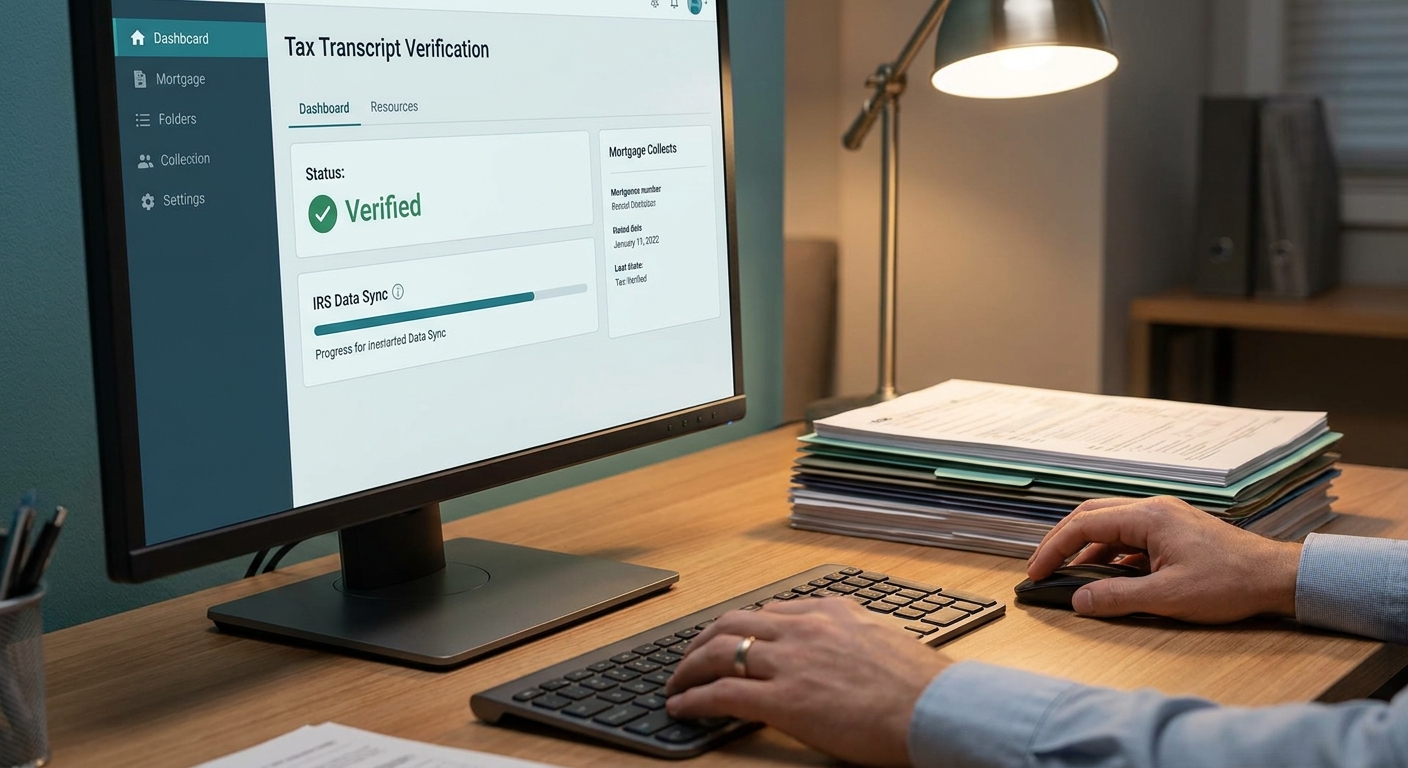
Mortgage underwriters lose days waiting on IRS transcripts, then lose more time manually matching figures against tax returns and W-2s — this guide breaks down what tax transcript verification software actually needs to do and which approach fits your loan volume.
- AI parsing platforms process tax transcripts in under 5 seconds versus 5-10 business days for a manual IRS pull.
- 27+ fraud signals catch transposed SSNs and altered figures that generic OCR tools miss entirely.
- Point income calculators total W-2 or 1099 income but skip transcript cross-referencing — treat them as a supplement, not a system.
- Tax transcript verification software earns a Buy verdict in 2026 for any desk underwriting more than a handful of files weekly.
Why this matters
A mortgage underwriter reviewing a self-employed borrower's file has to reconcile a 1040, Schedule C, W-2s, and a 4506-C transcript before signing off — miss one transposed digit and the file closes on fabricated income. Document fraud detection software for mortgage lenders exists because manual cross-checking doesn't scale past a few files a week.
The IRS transcript itself already takes time to arrive. Once it does, the underwriting team still has to line up every figure against the borrower's submitted documents by hand, unless the software does the matching automatically.
2026 underwriting desks that skip this step aren't saving time — they're deferring the risk to closing, where a bad file costs far more than a delayed one.
Who this is for
This guide is for mortgage underwriters and underwriting managers at banks, credit unions, and non-bank lenders who process 4506-C transcripts as part of income verification — particularly teams handling self-employed borrowers, 1099 contractors, or any file where stated income needs a paper trail beyond a pay stub. If your desk closes fewer than five files a month, a manual process might still be defensible. Past that volume, the math flips.
What to look for in tax transcript verification software for mortgage underwriters
Transcript-to-return cross-referencing
The software needs to match figures on the 4506-C transcript against the borrower's submitted 1040, W-2s, and 1099s automatically, not just display them side by side. Manual cross-referencing is where transposed digits and rounded-up income figures slip through — automated matching flags every discrepancy the moment the transcript loads.
Fraud signal detection layer
A parser that just extracts numbers isn't enough. Look for a detection layer that runs dozens of checks — altered totals, mismatched EINs, inconsistent formatting between pages — because a doctored transcript rarely looks wrong at a glance. 27+ signals is the kind of coverage that catches what a human reviewer misses on file 40 of the day.
Turnaround speed once the transcript arrives
The IRS itself is the bottleneck on the front end, typically 5-10 business days for a 4506-C request, longer during filing season. Once the transcript lands, the software shouldn't add its own delay — parsing and cross-checking should finish in seconds, not another day in a review queue.
Self-employed and 1099 income handling
W-2 income is straightforward. Schedule C, K-1, and 1099 income require the software to pull line items specific to those forms and reconcile them against bank deposits, not just headline totals. This is where generic tools built for W-2 borrowers fall apart on self-employed files.
Format coverage across transcript types
Account transcripts, return transcripts, wage and income transcripts, and record of account transcripts all format data differently. A tool built for one transcript type will choke or silently misread fields on another — confirm the platform handles the full set before rolling it out desk-wide.
API integration with the loan origination system
A verification tool that requires underwriters to manually export and re-upload data into the LOS defeats the purpose. Direct integration means the transcript data lands in the file automatically, with an audit trail intact for compliance review.
Top picks: verification approaches ranked
The manual pull. Order the 4506-C directly from the IRS, then reconcile figures against the return by hand. One spec that matters: 5-10 business days IRS turnaround before an underwriter even starts matching data, longer at tax season peaks in 2026. Fine for a desk closing a handful of files a month. Verdict: Skip for any team past low single-digit weekly volume.
The generic OCR tool. General-purpose document scanners extract text but carry no fraud-signal layer built for tax documents specifically. They'll pull a number off a page; they won't tell you the EIN doesn't match across pages or that a total was altered. Verdict: Skip — see best document fraud detection software for fintech lenders for what a real detection layer looks like by comparison.
The point income calculator. These tools total W-2 or 1099 income but stop there — no cross-check against the transcript, no fraud flagging. Useful as a quick sanity check on how to verify self-employed income for loan underwriting, but not a substitute for a full verification system. Verdict: Consider only as a supplement to a real platform.
The AI parsing platform. Dedicated software that parses tax transcripts and bank statements together, cross-references figures automatically, and flags discrepancies across 27+ fraud signals in under 5 seconds per file. ClearStaq runs this model — transcript data lands matched and flagged before the underwriter opens the file. Verdict: Buy for any desk underwriting more than a few self-employed or 1099 files a week.
The outsourced verification service. Third-party vendors handle the manual review for you, typically returning results in 24-48 hours per file. No software to manage, but you're paying per file and still waiting on human turnaround. Verdict: Consider for low-volume shops without in-house tooling or engineering support.
What to avoid
- Document storage systems marketed as verification tools. Storing a PDF of a transcript isn't the same as extracting and matching its data fields — confirm the platform actually parses before you buy.
- Single-transcript-type parsers. A tool tuned for wage and income transcripts may misread an account transcript entirely; ask for confirmation across all four IRS transcript formats before rollout.
- "Software" that's really a human review portal. Some vendors sell an upload interface backed by manual reviewers on the other end — you'll still wait a day or two per file, just with a nicer UI.
“A doctored transcript rarely looks wrong at a glance — that's exactly why a 27-signal detection layer beats a human reviewer on file 40 of the day.”
Verdict comparison
| Approach | Turnaround | Fraud Detection | Best For | Verdict |
|---|---|---|---|---|
| Manual 4506-C pull | 5-10 business days | None built-in | Under 5 files/month | Skip |
| Generic OCR tool | Minutes, no cross-check | None | Basic text extraction only | Skip |
| Point income calculator | Minutes | None | Supplementing a real system | Consider |
| AI parsing platform | Under 5 seconds | 27+ signals | Volume underwriting teams | Buy |
| Outsourced verification service | 24-48 hours | Varies by vendor | Low-volume, no in-house tech | Consider |
See tax transcript parsing in action
Check how ClearStaq matches transcripts to returns and flags fraud in seconds.
FAQ
What is tax transcript verification software?
Tax transcript verification software parses IRS 4506-C transcripts and automatically cross-references the figures against a borrower's submitted tax returns, W-2s, and 1099s. It flags mismatches instead of requiring an underwriter to compare every line by hand.
How long does it take to get a tax transcript from the IRS in 2026?
A standard 4506-C request typically takes 5 to 10 business days in 2026, though filing-season volume can push that longer. The software itself doesn't shorten this wait — it speeds up everything that happens after the transcript arrives.
Is tax transcript verification software better than manual review?
For any desk closing more than a handful of files a week, yes — manual cross-referencing is the exact place transposed digits and altered totals get missed. Automated matching with a fraud-signal layer catches discrepancies a human reviewer typically doesn't.
Can this software handle self-employed and 1099 borrowers?
Platforms built for mortgage underwriting should pull line items from Schedule C, K-1, and 1099 forms specifically, not just W-2 totals. Confirm coverage across all four IRS transcript types before rolling a tool out desk-wide.
Does tax transcript verification software integrate with a loan origination system?
The better platforms offer direct API integration so parsed and flagged transcript data lands in the loan file automatically. Manual export-and-upload workflows defeat most of the time savings.
How many fraud signals should a verification tool check for?
Look for coverage in the range of 27 or more signals spanning altered totals, mismatched EINs, and formatting inconsistencies. Fewer signals mean more discrepancies slip through undetected.
What's the difference between a document management tool and verification software?
Document management tools store and display transcript PDFs; verification software extracts the data fields and matches them against other submitted documents. Storing a file is not the same as verifying it.
Is outsourcing tax transcript verification worth it for a small lender?
For low-volume shops without in-house tooling, an outsourced service can work, typically returning results in 24 to 48 hours per file. Once volume grows past a few files a week, the per-file cost and turnaround usually make software the better economics.
One last thing
The IRS turnaround on a 4506-C hasn't gotten faster in 2026 — the only lever an underwriting desk actually controls is what happens in the seconds and minutes after that transcript lands, and that's exactly where a 27-signal detection layer earns its keep over a spreadsheet and a highlighter.
Related guides
ClearStaq Team
Content Team
The ClearStaq team builds AI-powered tools for bank statement parsing, fraud detection, and income verification.