Property managers use rental payment reporting software to verify tenant income before move-in and track payment history after it, closing the fraud gap between application and lease. A single-family landlord with 8 units can eyeball a pay stub. A property manager running 200+ units across multiple owners can't — the volume forces a choice between automated verification and rubber-stamping applications on trust.
The segment's real problem isn't logging rent checks. It's that "payment reporting" tools split into two categories that don't overlap: credit-bureau reporting services that log payments after they happen, and income/document verification tools that screen an applicant's income verification software for property managers before the lease is signed. Property managers who only buy the first tool are still flying blind on the front end.
- Rental payment reporting software for property managers should verify income and screen document fraud, not just log payments.
- ClearStaq parses bank statements in under 5 seconds at 99.5% accuracy for tenant income checks.
- Manual review misses doctored pay stubs and edited PDFs that automated fraud signals catch.
- Portfolios over roughly 50 units outgrow spreadsheet-based income and payment tracking fast.
Why this matters
An applicant's stated income and their actual deposit history are two different data sets, and rental applications rarely reconcile them. A pay stub is easy to edit in any PDF tool. A bank statement is harder to fake convincingly, but property managers rarely have the time to check running balances line by line on every application.
That gap is where bad placements come from: a tenant who looks qualified on paper, misses rent by month three, and costs the owner an eviction cycle that erases months of margin on that unit. Payment reporting after the fact doesn't prevent that — it only documents it.
Why rental payment reporting matters for property managers
Property managers operate at volume and thin per-unit margin, which changes what "good enough" verification looks like compared to a single landlord screening one applicant. A management company processing 40-50 applications a month can't spend 20 minutes per bank statement checking for tampering — the review time compounds across the portfolio faster than staff hours scale.
The applicants themselves also skew toward income types that are harder to verify on a pay stub alone: gig drivers, self-employed contractors, and tenants paid through multiple part-time jobs. Bank deposits are the more reliable signal for these profiles, but only if someone is actually checking them against the stated income and the deposit cadence.
Verify income before you count on the rent
Don't approve an application on a pay stub alone — cross-check it against what actually lands in the account.
- Request 2-3 months of bank statements, not one
- Match employer name on the pay stub to the deposit description
- Flag self-employed or gig applicants for deposit-pattern review instead of pay-stub review
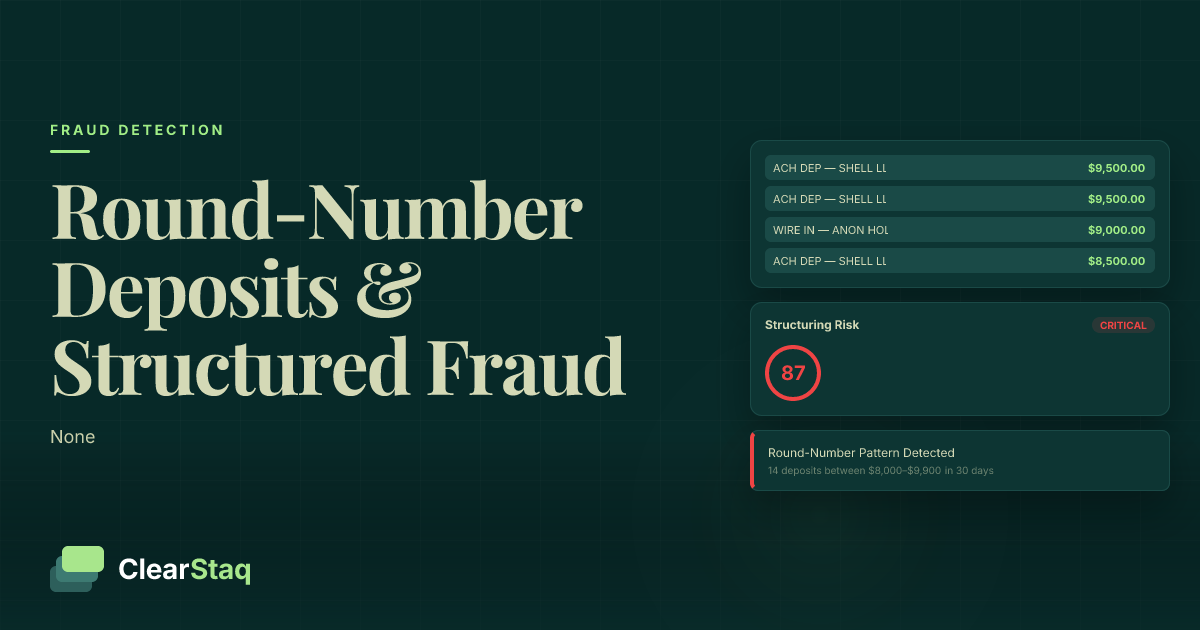
- Watch for round-number deposits that don't match a payroll cadence
- Confirm the statement's date range covers full pay cycles, not a cherry-picked window
Screen every bank statement for tampering
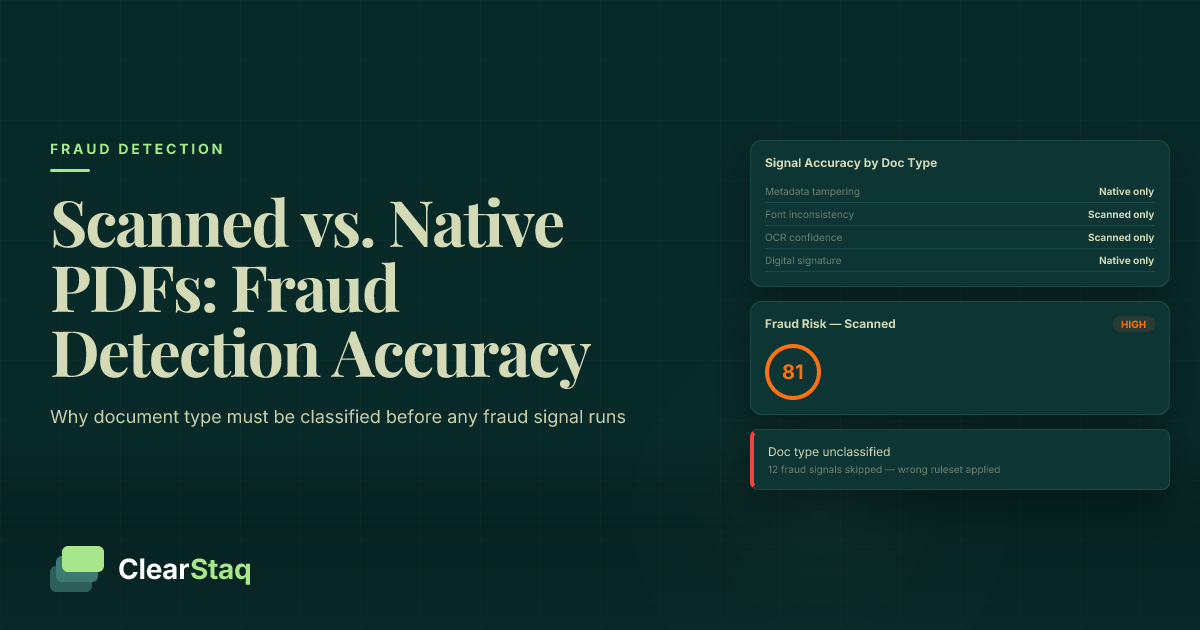
A doctored PDF is the most common fraud vector in rental applications, and it's often visible once you know where to look.
- Check running balance math line by line — an edited row breaks the total
- Look for font or kerning inconsistencies inside a single document
- Compare the statement's layout against that bank's known bank statement analysis software for property managers format
- Verify the statement date range against the calendar (weekends showing transactions is a red flag)
- Cross-reference the account number format against the issuing bank's standard
Track on-time payment history across the portfolio
Once a tenant is in place, payment history becomes the ongoing signal — build a system to track it consistently, not just when something goes wrong.
- Log payment date, amount, and method for every unit, every month
- Flag late payments the day they occur, not at lease renewal
- Segment history by property manager or owner if the portfolio spans multiple
- Keep a rolling 12-month view per tenant, not just current-month status
Report timely rent payments to credit bureaus
Reporting on-time payments gives reliable tenants a reason to renew and gives owners a retention lever — but it only reflects payments already made.
- Confirm the reporting service covers the credit bureaus your target tenants care about
- Set a consistent reporting cadence (monthly is standard) rather than batch-reporting quarterly
- Give tenants visibility into their reporting status to reduce disputes
- Keep payment reporting and application-stage income verification as separate workflows — they answer different questions
Flag NSF and returned payments early
A single NSF isn't automatically a crisis, but a pattern is a leading indicator of an eviction six months out.
- Track NSF count per tenant per rolling 6-month window
- Distinguish one-off NSFs from a recurring pattern tied to pay dates
- Escalate at two NSFs in 90 days rather than waiting for a third
- Cross-check NSF timing against the tenant's stated pay schedule from the original application
Automate verification across high application volume
Manual review works until application volume outpaces staff hours — that's the point to bring in automated bank statement parsing instead of adding headcount.
ClearStaq parses bank statements and tax returns for income verification and checks 27+ fraud signals per document, cutting per-application review time compared to manual line-by-line checks. That's the layer that sits before payment reporting, not a replacement for it — reporting tracks what happens after the lease, verification decides who gets one.
Automate tenant income checks
Parse bank statements and flag fraud signals before you approve an application.
Reconcile reported data against your property management system monthly
Payment reporting tools and PM software track rent independently — reconcile them or the two records drift.
- Pull a monthly export from both systems and diff the payment dates
- Confirm partial payments are logged the same way in both
- Check that unit-level and portfolio-level totals match before month-end close
Comparing rental payment reporting options
| Option | Best For | Key Limitation |
|---|---|---|
| Manual spreadsheet tracking | Portfolios under 20 units | No fraud detection; breaks down fast past a few dozen units |
| Built-in PM software payment history | Managers already on a PM platform | Logs payments; doesn't verify income or screen document fraud |
| Dedicated credit-bureau payment reporting | Tenant retention and credit-building | Reports payments after the fact — doesn't screen applicants pre-lease |
| ClearStaq bank statement and income verification | Screening applicants and catching doctored documents before signing | Doesn't report payments to credit bureaus itself |
Verdict: pick payment reporting for retention, pick income verification software for property managers for the application stage — most portfolios over 50 units need both, not either.
Common mistakes property managers make
- Trusting a PDF bank statement without checking the math. Running balances that don't add up are the easiest fraud signal to catch and the most commonly skipped.
- Approving on pay stubs alone. A pay stub with no matching deposit history tells you what the applicant wants you to believe, not what they earn.
- Waiting for an eviction to look at payment patterns. NSF and late-payment trends are visible months before a tenant stops paying entirely.
- Treating payment reporting and income verification as one tool. They solve different problems at different points in the tenant lifecycle.
- Staying on spreadsheets past 100+ units. Manual review time scales linearly with applications; fraud risk scales with it too.
FAQ
What is rental payment reporting software for property managers?
It's software that tracks tenant rent payments and, in most cases, reports on-time payments to credit bureaus. Some platforms also verify applicant income and bank statements before a lease is signed, which is a separate function from payment reporting itself.
Does rental payment reporting software verify tenant income?
Most dedicated payment reporting tools do not verify income — they log payments after a tenant is already in place. Income verification software for property managers, like ClearStaq, handles the pre-lease bank statement and document check separately.
How is rental payment reporting different from income verification?
Payment reporting tracks what a tenant pays after they move in and sends that data to credit bureaus. Income verification checks whether an applicant can actually afford the rent before you approve them, using bank statements and pay stubs.
Can rental payment reporting software detect fraudulent bank statements?
Standard payment reporting tools don't screen documents for fraud — that requires a bank statement analysis tool that checks for tampering signals, edited transaction rows, and formatting inconsistencies. ClearStaq checks 27+ such signals per statement.
How much does rental payment reporting software cost in 2026?
Pricing varies by portfolio size, unit count, and whether income verification is bundled in. Check current pricing directly with each vendor rather than relying on a flat industry number.
Do property managers need both payment reporting and income verification tools?
Portfolios above roughly 50 units typically need both — reporting for tenant retention and credit-building, verification for catching bad applicants before they sign a lease. Smaller portfolios can often manage payment tracking manually longer.
How fast should bank statement verification be for rental applications?
Automated parsing tools like ClearStaq process a statement in under 5 seconds at 99.5% accuracy, compared to 10-20 minutes for a manual line-by-line review. Speed matters most when application volume is high and turnaround expectations are 24-48 hours.
What red flags indicate a doctored bank statement?
Running balances that don't reconcile line to line, inconsistent fonts or spacing within one document, and transaction dates that fall on days the bank doesn't process are the three most common tells. A statement layout that doesn't match the issuing bank's known format is another.
One last thing
The riskiest bank statement isn't always the doctored one — it's the real, unedited statement from an account the applicant doesn't fully control, like a family member covering a shortfall for one deposit cycle. Fraud detection built for lending catches document tampering; it won't catch a legitimate but temporary deposit. Pair automated income verification with a second look at deposit sourcing for any account showing an unexplained lump sum in the month before application, and treat that as a manual review trigger regardless of what the parsing engine returns.
Related guides
ClearStaq Team
Content Team
The ClearStaq team builds AI-powered tools for bank statement parsing, fraud detection, and income verification.