Rental income is the entire loan file in DSCR underwriting — there's no W-2, no pay stub, no employer to call. Get the rent number wrong and the debt service coverage ratio is wrong, which means the loan is wrong.
- Verify rental income for DSCR loan underwriting by comparing the lease amount against the appraiser's Form 1007/1025 market rent and using the lower figure.
- Cross-check every rent deposit against bank statements before calculating the DSCR ratio — mismatches are the #1 red flag underwriters miss manually.
- Most DSCR programs in 2026 require a minimum ratio of 1.0x to 1.25x; some non-QM programs go as low as 0.75x with a rate hit.
- ClearStaq parses bank statements in under 5 seconds and runs 27+ fraud signals to catch doctored leases before they reach underwriting.
- Short-term rental income (Airbnb, VRBO) gets averaged over 12-24 months of payout statements, never annualized off a peak month.
Why this matters
DSCR loans qualify on the property's cash flow, not the borrower's income. That makes the rent figure the single input that decides approval, loan amount, and pricing. Underwriters who accept a lease at face value without checking it against bank deposits and the appraiser's rent schedule are approving loans on unverified data.
The stakes went up in 2026 as more brokers push DSCR volume into thinner-margin non-QM programs. A rent figure that's 15% too high can flip a 1.05x DSCR into a 0.91x DSCR — the difference between a funded loan and a declined one, or worse, a loan that defaults because the property never generated the income the file claimed.
What you'll need
- The signed lease agreement, or a short-term rental payout history if the property is run as an Airbnb or VRBO
- Fannie Mae Form 1007 (single-unit) or Form 1025 (2-4 unit) rent schedule from the property appraisal
- 2-3 months of the borrower's bank statements showing actual rent deposits
- The DSCR loan program's minimum ratio requirement and PITIA calculation
- A parsing tool that flags deposit mismatches and fraud signals automatically — ClearStaq's bank statement analysis software for DSCR loan lenders is built for exactly this workflow
- Time: manual review runs 1-3 business days per file; automated parsing cuts that to minutes
The steps
1. Pull the appraiser's rent schedule
Form 1007 covers single-unit properties, Form 1025 covers 2-4 unit properties. Both give you the appraiser's opinion of market rent based on comparable rentals in the area — this is your baseline, independent of what the borrower claims.
Don't skip this even when a lease exists. Market rent protects the lender from a lease that's inflated to make the DSCR math work.
2. Collect the lease or rental income history
For long-term rentals, get the signed lease showing monthly rent, term dates, and tenant name. For short-term rentals, pull 12-24 months of platform payout statements from Airbnb, VRBO, or the property manager's records.
Most DSCR programs use the lower of the lease amount or the Form 1007/1025 market rent, not whichever number is higher. Confirm which rule the specific lender's guidelines apply before you calculate anything.
3. Cross-check bank deposits against the lease
This is the step manual underwriting skips most often, and it's the one that catches the most problems. Pull the borrower's bank statements and match deposit dates and amounts against the lease's monthly rent figure.
A lease claiming $2,400/month rent needs $2,400 hitting the account on a consistent monthly cadence — not $1,800 one month and $3,000 the next with no explanation. ClearStaq's income verification software for landlords automates this match across every statement in the file instead of requiring a human to eyeball dates line by line.
4. Calculate the DSCR ratio
Divide the monthly gross rental income by PITIA (principal, interest, taxes, insurance, and association dues if applicable). A property generating $2,400/month rent against a $2,000/month PITIA produces a 1.20x ratio.
Most DSCR programs in 2026 set the minimum between 1.0x and 1.25x. Some non-QM lenders allow ratios as low as 0.75x, but they price the loan higher to offset the added risk.
5. Screen for doctored leases and altered statements
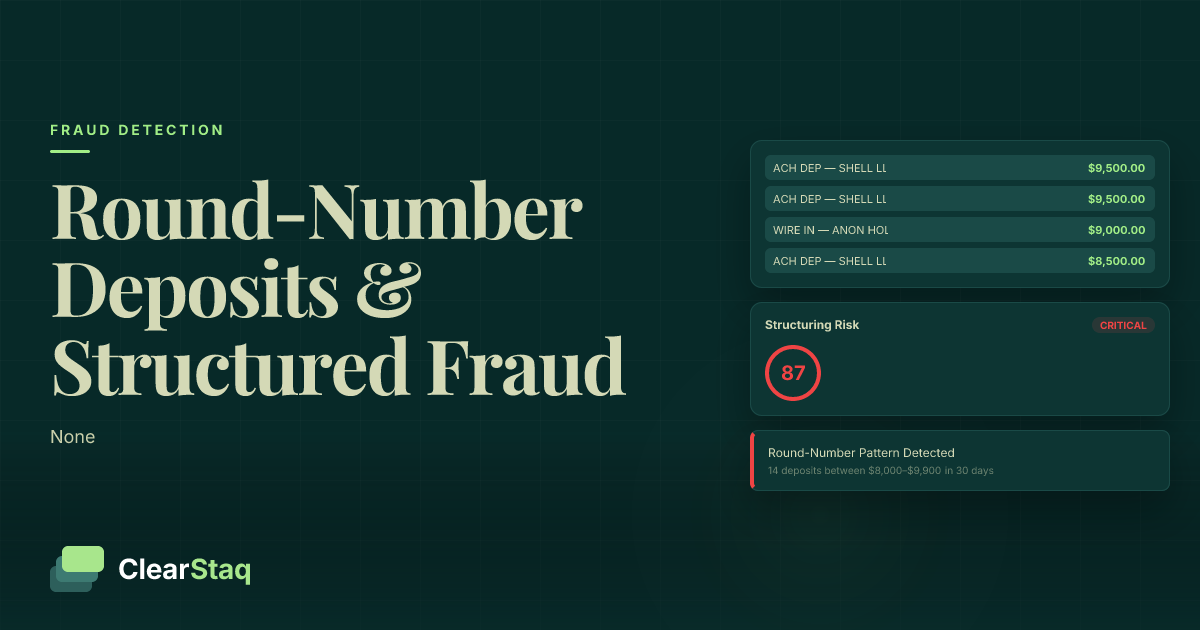
Check for font inconsistencies, misaligned line items, and deposit patterns that don't match a normal tenant payment cycle — round-number deposits every single month with zero variance is a common tell on a fabricated bank statement. ClearStaq runs 27+ fraud signals against every statement and flags altered PDFs before they reach an underwriter's desk.
Any file with rent income that never wavers, never shows a late payment, and never shows a partial month deserves a second look.
6. Handle short-term rental income separately
Airbnb and VRBO income doesn't come with a fixed monthly figure, so average the trailing 12-24 months of payout statements instead of using a single peak month. A property that cleared $8,000 in July and $1,200 in February needs the full annual average, not the July number annualized.
7. Document and package the file for underwriting
Attach the Form 1007/1025 rent schedule, the lease or payout history, the bank statement cross-check, and the DSCR calculation worksheet as one package. A file that shows the math, not just the conclusion, moves through underwriting faster and survives audit review.
Verify rental income in seconds, not days
Parse statements, match deposits to lease terms, and flag fraud signals automatically.
Troubleshooting
No lease exists because the property is a recent owner-occupied-to-rental conversion. Use the Form 1007/1025 market rent alone — there's no deposit history to check yet, and most DSCR programs allow this for a first rental year.
Deposits don't match the lease amount. Request a written explanation from the borrower and check for rent concessions, partial-month prorations, or a rent increase that hasn't hit the lease paperwork yet.
The property is vacant with no rental history. Use 100% of the appraiser's market rent estimate from Form 1007/1025 — this is standard practice across most DSCR programs in 2026.
Short-term rental income swings wildly month to month. Average the trailing 12 months and resist the urge to annualize a single strong month; seasonal properties in beach or ski markets will always show this pattern.
Bank statement shows cash deposits with no clear source. Flag it. Cash deposits that don't trace to a tenant name or a payment platform are a common fraud signal and need additional documentation before the file moves forward.
The lease term has expired and no renewal is on file. Confirm month-to-month status in writing or request the renewed lease — an expired lease with no renewal creates a gap underwriters will question.
Tools and resources
- Income verification software for property managers — for verifying rent rolls across multi-unit portfolios
- Bank statement analysis software for DSCR loan lenders — the parsing layer that automates steps 3 and 5 above
- Fannie Mae Form 1007 and Form 1025 templates from the appraisal management company
- The DSCR loan program's underwriting matrix, which sets the minimum ratio and defines which rent figure (lease vs. market) takes priority
What to do next
Once rental income is verified, the next fraud check most underwriters skip is the bank statement itself. Read how to detect fake bank statements in loan applications to see the specific formatting and deposit-pattern tells that separate a real statement from a fabricated one.
FAQ
What's the minimum DSCR ratio for rental property loans in 2026?
Most DSCR programs in 2026 require a minimum ratio between 1.0x and 1.25x. Some non-QM lenders allow ratios as low as 0.75x, but price the loan higher to offset the added risk.
Is a lease required to verify rental income for DSCR loans?
Not always. If no lease exists, such as with a vacant property or recent conversion, lenders use 100% of the appraiser's Form 1007 or 1025 market rent instead.
How do lenders verify short-term rental income for DSCR loans?
Lenders average 12 to 24 months of Airbnb or VRBO payout statements rather than using a single month. This smooths out seasonal peaks so the DSCR isn't inflated by one strong month.
What's the difference between Form 1007 and Form 1025?
Form 1007 covers single-unit rental properties and Form 1025 covers 2-4 unit properties. Both give the appraiser's opinion of market rent based on comparable rentals.
Can vacant rental properties qualify for DSCR loans?
Yes. Most DSCR programs accept the appraiser's market rent from Form 1007 or 1025 in place of an actual lease when the property is vacant or newly converted.
How long does rental income verification take for DSCR underwriting?
Manual review typically takes 1 to 3 business days per file. Automated parsing tools like ClearStaq process bank statements in under 5 seconds, cutting the bulk of that review time.
What documents prove rental income for DSCR underwriting?
A signed lease or short-term rental payout history, the appraiser's Form 1007 or 1025 rent schedule, and 2 to 3 months of bank statements showing the deposits match the claimed rent.
Do lenders use the lease amount or the appraised market rent for DSCR?
Most DSCR programs use whichever figure is lower between the signed lease and the appraiser's market rent from Form 1007 or 1025, not whichever is higher.
One last thing
The deposit-matching step catches more bad files than the DSCR math itself. A lease that says $2,400/month with bank deposits that never vary by more than a few dollars, land on the same date every single month, and never show a partial or late payment, is often a fabricated statement rather than a well-run rental. ClearStaq's fraud detection checks 27+ signals against exactly that kind of pattern before the file reaches an underwriter, at 99.5% accuracy across the bank statement formats it parses.
Related guides
ClearStaq Team
Content Team
The ClearStaq team builds AI-powered tools for bank statement parsing, fraud detection, and income verification.