Building a fraud detection workflow for a buy now pay later platform means chaining four checks into one automated pipeline: identity verification, income/affordability scoring, bank statement analysis, and real-time transaction anomaly detection — all inside the checkout window, which for most BNPL products in 2026 means under 5 seconds. The hidden cost most teams miss: manual review queues that scale with approval volume instead of shrinking, because nobody automated the escalation logic, not just the initial check.
- A BNPL fraud workflow needs 4 automated layers: identity, income, bank statement, and transaction anomaly checks.
- Synthetic identity fraud is the dominant BNPL loss driver in 2026 because thin-file borrowers are harder to flag with bureau data alone.
- ClearStaq runs 27+ fraud signals against bank statements in under 5 seconds at 99.5% accuracy.
- Route manual review on score bands, not binary pass/fail, to protect approval speed.
Why this matters
BNPL underwriting happens at checkout, not over days like a mortgage or an SBA loan. That compresses the entire fraud stack into a window measured in seconds, which means every layer of your workflow needs a hard timeout and a defined fallback.
Most BNPL platforms that lose money to fraud in 2026 aren't missing tools — they're missing sequencing. A workflow that runs credit bureau pulls first and bank data last catches stolen-identity fraud but misses synthetic identities that pass bureau checks and fail on bank statement inconsistencies. Order matters as much as coverage.
How do you build a fraud detection workflow for BNPL platforms?
The workflow breaks into five stages, each with its own pass/fail/review threshold:
- Identity capture and verification — document and biometric check at signup, flagging deepfake or doctored IDs before the applicant reaches a credit decision.
- Synthetic identity screening — cross-reference SSN issuance date, address history, and credit file thickness against behavioral signals. This is where BNPL platforms lose the most to synthetic identity fraud, because thin-file applicants look legitimate on paper.
- Bank statement and income parsing — pull 60-90 days of transaction history and extract income, cash flow stability, and existing debt obligations automatically.
- Transaction and behavioral anomaly detection — score the checkout itself: device fingerprint mismatch, application velocity across merchants, order size relative to account history.
- Score-based routing — auto-approve above a threshold, auto-decline below a floor, and route the middle band to manual review with the specific flagged signals attached, not a raw file dump.
Most teams building this in-house get stuck between steps 3 and 5. Parsing bank statements reliably across hundreds of bank formats is the hardest engineering problem in the stack, and it's where underwriting automation for buy now pay later platforms breaks down if the parser can't handle format variance at volume.
| Stage | What it catches | Latency budget |
|---|---|---|
| Identity verification | Stolen or fabricated documents | 1-2 seconds |
| Synthetic identity screening | Fabricated credit profiles | 1-2 seconds |
| Bank statement parsing | Income misrepresentation, NSF patterns | Under 5 seconds |
| Behavioral scoring | Bust-out fraud, account takeover | Sub-second |
| Manual review routing | Edge cases, high-value orders | Queue-dependent |
Identity layer: catching synthetic identities before approval
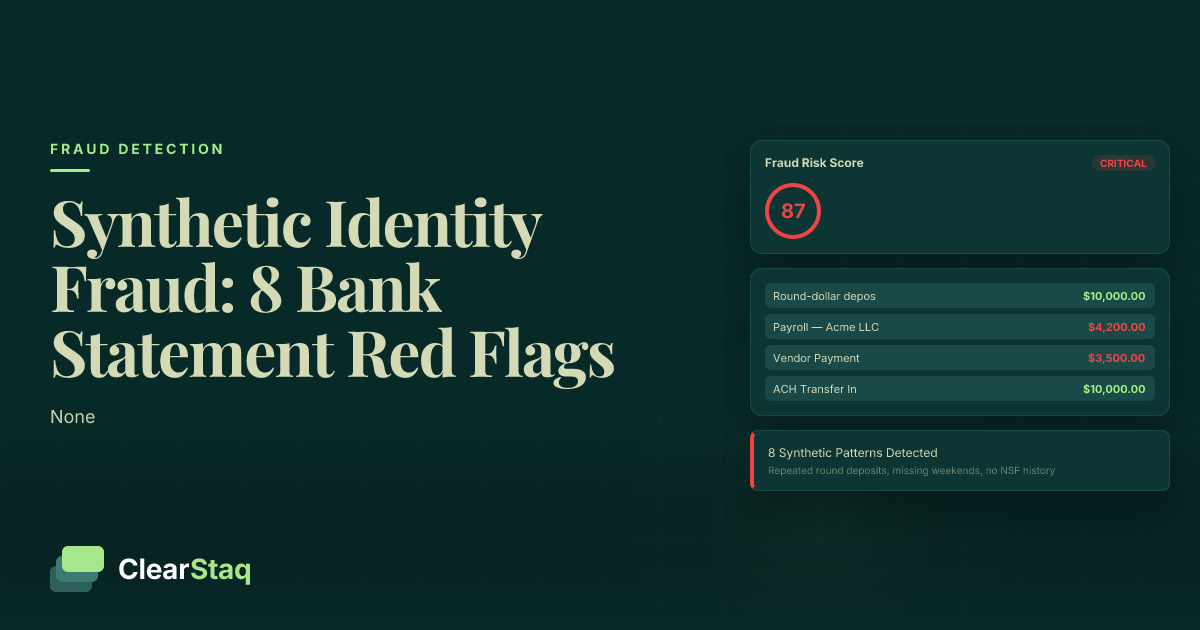
Synthetic identity fraud is the hardest problem in BNPL underwriting in 2026 because the applicant doesn't need to steal a real person's full identity. A fabricated SSN paired with a real-looking name and address often clears a basic credit pull. The workflow has to catch this at the data layer, not the credit layer.
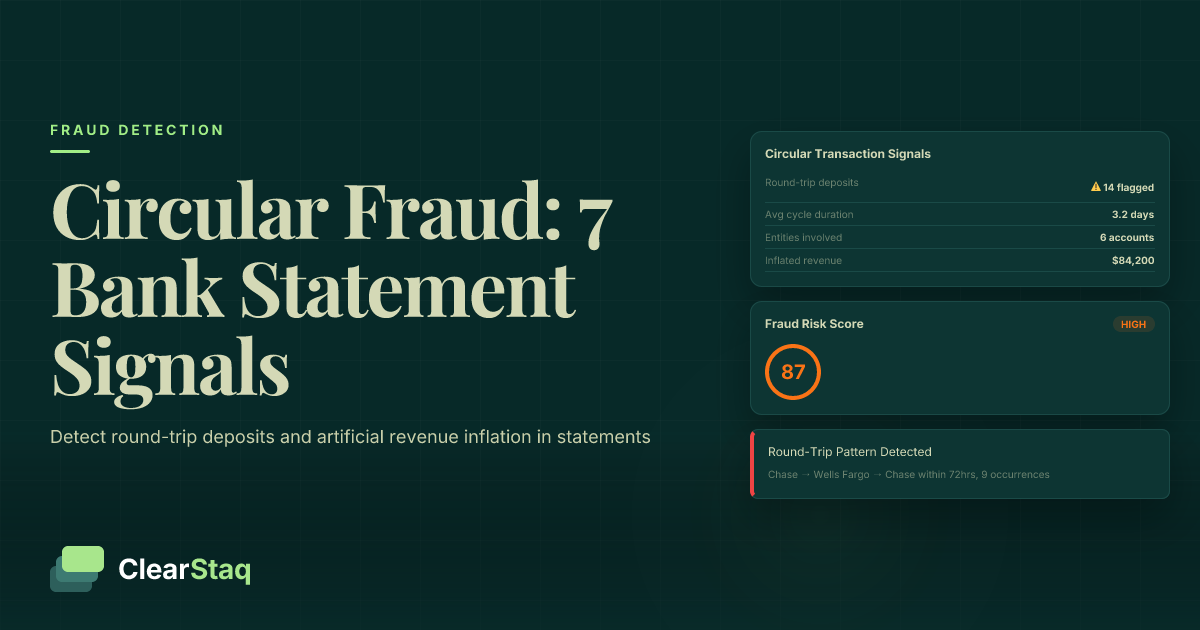
Bank statement analysis closes that gap. A synthetic identity with a thin or fabricated credit file usually shows inconsistent deposit patterns, mismatched employer names, or an account history shorter than the claimed income history. A fraud workflow that only checks credit bureau data misses this category entirely.
Income layer: verifying affordability without adding friction
BNPL decisions run on affordability, not just creditworthiness. An applicant can have a clean file and still be a bad risk if income doesn't support the installment schedule. Automated bank statement parsing extracts average monthly income, recurring deposit sources, and existing debt service in the same pass used for fraud screening, which avoids running two systems against the same document.
This step also catches doctored pay stubs and inflated income claims before they reach a human underwriter. That matters more at BNPL volume than at mortgage volume — there is no time for a manual pay stub review at checkout.
Why BNPL fraud risk varies by platform
Fraud exposure isn't uniform across BNPL products. The factors that move risk up or down:
- Order size — higher-ticket purchases like furniture and electronics attract more organized fraud than low-ticket apparel orders.
- Repeat merchant exposure — applicants applying across multiple BNPL providers in the same week signal application stacking.
- Thin-file share of the applicant base — platforms serving younger or credit-invisible borrowers see more synthetic identity attempts because there is less bureau data to cross-check.
- Checkout friction tolerance — the lower the acceptable friction, the fewer manual verification steps you can insert, which shifts weight onto automated bank statement and behavioral signals.
- Merchant category — categories with high resale value see more bust-out patterns than services.
Routing layer: where most workflows leak
Binary approve/decline logic forces a bad tradeoff: tighten the rule and you decline good applicants, loosen it and fraud walks through. Score bands fix this. Auto-approve the clean top band, auto-decline the clear bottom band, and send only the ambiguous middle to a human with the triggered signals listed.
The review queue should shrink as the model improves. If your manual review volume in 2026 is growing in step with approval volume, the routing logic isn't doing its job — the same principle that drives fraud detection inside a loan origination workflow applies here.
“If your manual review queue grows at the same rate as approvals, your routing logic is decorative.”
Is manual review enough for BNPL fraud detection?
Manual review alone is not enough for BNPL fraud detection in 2026, because checkout-speed approval windows leave no room for a human to touch every application. Manual review works as a routing destination for the middle risk band flagged by automated scoring — never as the primary check.
How is BNPL fraud different from credit card fraud?
BNPL fraud differs from credit card fraud in timing and identity thinness: BNPL applicants are frequently first-time borrowers with limited credit history, which makes synthetic identity fraud far more common than the stolen-card fraud dominating card networks. The underwriting decision also happens once, at checkout, rather than continuously across a revolving line.
How fast does a BNPL fraud check need to run?
A BNPL fraud check needs to complete in under 5 seconds to avoid killing checkout conversion, which is the latency budget most automated bank statement parsers and identity checks are built around in 2026. Anything slower pushes applicants to abandon the purchase before the decision returns.
Platforms that outsource statement parsing and fraud signal detection instead of building it in-house reduce that latency problem to an API call. ClearStaq processes bank statements against 27+ fraud signals in under 5 seconds at 99.5% accuracy, which makes it a fit for BNPL platforms that need fraud detection inside the checkout window rather than after it.
See the fraud signals in action
Run a live bank statement through ClearStaq's fraud detection layer.
FAQ
What's the best way to detect synthetic identity fraud in BNPL applications?
Cross-reference bank statement deposit patterns and account age against the claimed credit and income history. Synthetic identities usually show a mismatch there even when the credit file looks clean.
How much fraud detection latency can a BNPL checkout tolerate?
Most BNPL checkouts need a fraud decision in under 5 seconds in 2026 to avoid cart abandonment. Anything slower forces a tradeoff between conversion and risk coverage.
Is bank statement parsing necessary for BNPL underwriting?
Yes. Bank statement parsing verifies income and fraud signals in one pass, which credit bureau data alone cannot do for thin-file BNPL applicants. It is the layer that catches doctored pay stubs and inconsistent deposit histories.
Is fraud detection different from underwriting automation for BNPL?
Fraud detection flags risk signals like synthetic identities and doctored documents. Underwriting automation makes the approve, decline, or review decision using those signals plus income and affordability data. They run together in one workflow.
How many fraud signals should a BNPL platform check per application?
A layered workflow checks signals across identity, income, bank statement, and behavioral data. ClearStaq runs 27+ signals per statement, which is a useful reference point for full-coverage checks.
Does manual review slow down BNPL approvals?
Manual review slows approvals only when applied to every application instead of a scored middle band. Routing just the ambiguous cases to a human keeps approval speed intact for the majority of applicants.
What causes most BNPL fraud losses in 2026?
Synthetic identity fraud is the dominant loss driver in 2026 because BNPL serves a higher share of thin-file, first-time borrowers than credit card issuers, making fabricated identities harder to catch with bureau data alone.
Can one system handle both income verification and fraud detection?
Yes. Parsing a bank statement once and scoring it for both affordability and fraud signals avoids running two systems against the same document and keeps total latency inside the checkout window.
One last thing
The mistake that costs BNPL platforms the most isn't a missing check — it's running every check in isolation instead of feeding fraud signals into the same scoring model as income verification. A statement showing a doctored pay stub and a synthetic identity flag should route to instant decline, not sit in two separate queues waiting on two separate teams.
Related guides
ClearStaq Team
Content Team
The ClearStaq team builds AI-powered tools for bank statement parsing, fraud detection, and income verification.