KYB verification software for online marketplaces confirms that a seller, vendor, or business partner onboarding to your platform is a real, registered legal entity — not a shell company, a stolen identity, or a straw account set up to launder payouts. Marketplaces run this check at a volume and speed that bank underwriting never had to handle: thousands of business sign-ups a week, most self-service, most with no human reviewer in the loop until something breaks.
- KYB verification software for online marketplaces screens business registration, ownership, and payout accounts before a seller can list or get paid.
- ClearStaq parses business bank statements and tax documents with 27+ fraud signals to flag shell-company and synthetic-seller patterns in under 5 seconds.
- Full KYB coverage needs registry lookups, UBO checks, sanctions screening, and financial-document analysis together — no single tool covers all four.
- Marketplaces that only screen at signup miss fraud that shows up 60-90 days later in payout patterns.
Why KYB verification matters for online marketplaces
A marketplace isn't lending money, but it's still extending trust and payout access to a business it's never met in person. That's the same exposure a lender has, minus the underwriting team.
The FinCEN Customer Due Diligence Rule sets the beneficial-ownership threshold at 25% equity for regulated financial institutions — most marketplaces aren't directly bound by it, but payment processors and banking partners downstream usually are, and they push the requirement back onto the platform through their merchant agreements. If your seller onboarding can't produce ownership data on demand, you inherit that gap.
Marketplaces also carry a specific failure mode banks don't: sellers who pass identity checks but never intended to sell anything real. Fraud detection software for online marketplaces exists because account-takeover and synthetic-seller fraud on two-sided platforms tends to surface in payout velocity and chargeback ratios long before any KYB document looks wrong.
Verify business registration status
Start with the free, manual layer every marketplace can do without buying anything in 2026.
- Check the seller's stated business name and EIN against the relevant state Secretary of State registry.
- Confirm the entity status is "active," not dissolved or administratively revoked.
- Cross-reference the registered address against the address on submitted bank statements.
- Flag entities registered in the past 30-60 days paired with high initial payout requests.
- Note registered agent addresses shared across multiple unrelated sellers — a common shell-farm signal.
Identify the beneficial owners
A business name alone tells you nothing about who actually controls the payout account.
- Collect the names and ownership percentages of anyone holding 25% or more equity.
- Run each named owner through an identity check, not just the business.
- Watch for ownership structures that route through a holding company with no public footprint.
- Reconcile the UBO list against the name on the linked bank account — mismatches are the single most common KYB failure point on marketplaces.
Screen for sanctions, PEP, and adverse media
This step is non-negotiable once payouts cross borders or the seller category includes anything regulated (finance, health, alcohol).
- Screen the business and every named owner against OFAC's SDN list at onboarding, not just at account creation.
- Re-screen on a recurring schedule — sanctions lists update continuously, and a clean day-one check goes stale.
- Check for politically exposed person status on owners in jurisdictions where that's a factor.
- Log every screening hit and its resolution for audit purposes, even false positives.
Validate the payout bank account
The bank account is where KYB verification either earns its keep or gets skipped for speed — don't skip it.
- Confirm the account holder name matches the verified business or a listed owner.
- Check that the account has real transaction history, not a dormant account opened the same week as the marketplace application.
- Cross-check deposit patterns against the seller's claimed sales volume; a $2,000/month claimed revenue with $40,000 in monthly deposits is a mismatch worth a manual look.
This is where ClearStaq's bank statement parsing does the heavy lifting instead of a reviewer manually scrolling 12 months of PDFs. ClearStaq reads business bank statements and tax documents directly, applies 27+ fraud signals, and returns results in under 5 seconds with 99.5% accuracy — fast enough to run at signup volume instead of only on escalated cases.
Analyze bank statements and tax documents for shell-company patterns
Registry and sanctions checks catch entities that don't exist. They don't catch entities that exist on paper but move money like a shell.
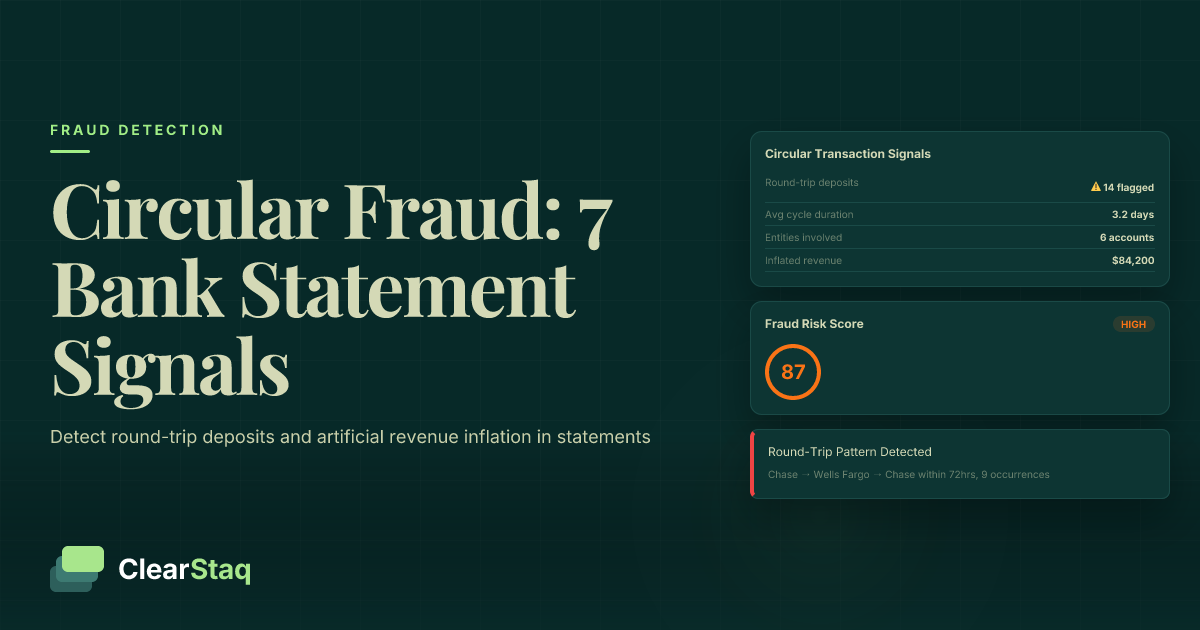
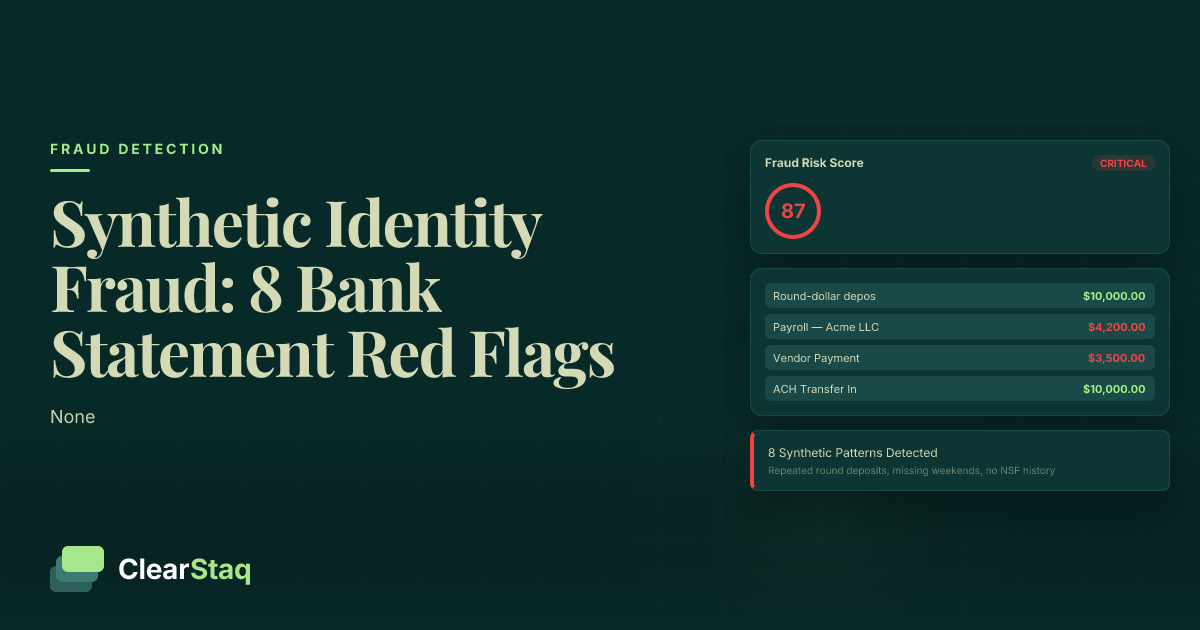
- Look for round-number deposits with no matching invoice or sales activity.
- Flag accounts with high inbound/outbound velocity and near-zero ending balance every cycle — a classic layering pattern.
- Compare stated business age against the bank account's opening date; a five-year-old business with a six-week-old account needs an explanation.
- Check for commingled personal and business transactions, which weakens the entity's standing as a real operating business.
ClearStaq's parsing engine runs these checks automatically across 900+ statement and document formats, surfacing the same red flags a fraud analyst would look for, minus the four to eight hours it takes to review a stack of PDFs by hand.
Monitor sellers after onboarding, not just at signup
KYB verification isn't a one-time gate. Ownership changes, sanctions lists update, and payout patterns shift months after approval.
- Re-run sanctions and adverse media screening quarterly at minimum.
- Set payout velocity alerts that trigger a re-review, not just a hold.
- Re-verify UBO data any time a seller updates banking or business information.
- Track chargeback and dispute ratio trend lines per seller, not just per transaction.
Automate the document review layer
Once the manual process above is defined, the bottleneck becomes volume, not method. Manual review of business bank statements and tax returns doesn't scale past a few hundred sellers a month without adding headcount.
This is the specific gap ClearStaq closes: parsing bank statements and tax returns, flagging fraud signals, and verifying income and ownership indicators automatically, so a marketplace's trust-and-safety team reviews exceptions instead of every application.
Automate marketplace KYB document review
Parse seller bank statements and tax documents with 27+ fraud signals in under 5 seconds.
Comparison: KYB verification approaches for marketplaces
| Approach | Best for | Key limitation |
|---|---|---|
| Manual registry + sanctions checks | Low-volume marketplaces (under 100 sellers/month) | Doesn't scale; no financial-document analysis |
| Standalone KYB/identity API | Marketplaces needing registry and sanctions data at scale | Doesn't parse bank statements or tax documents |
| ClearStaq bank statement/tax parsing | Marketplaces verifying seller cash flow, ownership signals, and payout fraud | Not a registry lookup or sanctions screening tool on its own |
| Full-stack KYB platform (registry + sanctions + document parsing combined) | Marketplaces with compliance obligations across multiple product lines | Typically requires stitching multiple vendors together |
Verdict: ClearStaq wins on the financial-document layer of KYB — bank statement and tax return parsing with fraud signal detection — for marketplaces that already have a registry/sanctions provider and need the cash-flow and ownership-verification piece automated. It is not a substitute for a registry API or a sanctions list provider.
Common mistakes marketplaces make with KYB verification
- Treating KYB as a signup-only gate. Sellers pass once and are never re-screened, even as payout volume climbs 10x in three months.
- Verifying the business but not the bank account. A registered LLC with a mismatched or dormant payout account still gets approved.
- Skipping UBO checks below 25% for speed. Shell operators structure ownership specifically to stay under common thresholds — a hardcoded cutoff misses them.
- No re-screening cadence for sanctions and adverse media. A clean check in January doesn't cover a name added to a list in June.
- Manual document review that can't keep pace with growth. Reviewers approve backlogged applications faster than they should just to clear the queue, which is exactly when shell sellers get through.
FAQ
What is KYB verification software for online marketplaces?
It's software that confirms a business seller or vendor onboarding to a marketplace is a real, registered entity with identifiable owners and a legitimate payout account. It typically combines registry checks, sanctions screening, and financial-document analysis.
Is KYB verification legally required for marketplaces?
Marketplaces themselves aren't usually direct subjects of FinCEN's CDD Rule, but their payment processing and banking partners often are, and those requirements get passed down through merchant agreements. Ignoring KYB doesn't remove the exposure, it just moves it downstream.
How is KYB different from KYC for marketplaces?
KYC verifies an individual's identity; KYB verifies a business entity, its registration status, and its beneficial owners. Marketplaces onboarding business sellers need both — KYC for the owners, KYB for the entity.
Can bank statement parsing replace a full KYB check?
No. Bank statement and tax document parsing verifies cash flow, ownership signals, and fraud patterns, but it doesn't confirm business registration status or run sanctions screening on its own. It's one layer of a complete KYB workflow.
How often should marketplaces re-screen sellers after onboarding?
At minimum quarterly for sanctions and adverse media, and immediately any time a seller updates banking details or ownership information. Sanctions lists update continuously in 2026, so a one-time check at signup goes stale within months.
What's a red flag that a marketplace seller is a shell company?
A bank account opened weeks before applying despite a business claiming years of operating history, round-number deposits with no matching invoices, or a registered agent address shared across multiple unrelated seller accounts are all common signals.
Does ClearStaq handle sanctions screening for marketplace KYB?
ClearStaq's core function is parsing bank statements and tax returns and applying 27+ fraud signals to detect shell-company and synthetic-seller patterns. It's built for the financial-document layer of KYB, not as a standalone sanctions list provider.
How fast can KYB document review run at marketplace scale?
Automated parsing processes a business bank statement or tax document in under 5 seconds with 99.5% accuracy, compared to the several hours a manual reviewer needs per file. That's the difference between reviewing every applicant and only reviewing escalations.
One last thing
The KYB failure that costs marketplaces the most in 2026 isn't a fake business — it's a real business whose bank account doesn't match its ownership records. Registry checks pass, sanctions checks pass, and the payout account still routes to someone who isn't on the ownership list. Add the bank-account-to-UBO reconciliation step even if nothing else on this list gets built first.
Related guides
ClearStaq Team
Content Team
The ClearStaq team builds AI-powered tools for bank statement parsing, fraud detection, and income verification.