Credit card issuers evaluating fraud detection software in 2026 face a narrower problem than most vendors admit: application-time fraud, not just transaction monitoring. Synthetic identities, doctored income documents, and altered checks slip through generic KYC tools built for a different job.
- Fraud detection software for credit card issuers works best when it parses documents, not just flags transactions — ClearStaq processes statements in under 5 seconds.
- Synthetic identity tools catch onboarding fraud during card applications; buy them for high online application volume.
- Check fraud filters cover balance-transfer and cash-advance checks specifically — consider them, they are not a full solution alone.
- Manual review teams still catch fraud but average hours per file in 2026; skip this approach once volume scales.
Why this matters
Credit card issuers lose money at two points: application fraud that gets a card issued to a fake or stolen identity, and income misrepresentation that sets a credit line too high for the real borrower. Both failures start with a document — a pay stub, a bank statement, a tax return — that looked clean enough to pass a human reviewer in 30 seconds.
Generic fraud tools built for e-commerce chargebacks or account takeover don't touch this layer. They watch transactions after the card ships. By 2026, issuers running high online application volume need software that catches the fraud before the card exists, which means document-level detection, not just behavioral scoring.
Who this is for
This guide is for risk and underwriting teams at credit card issuers — bank-affiliated programs, fintech card issuers, and store-card partners — deciding what fraud detection software for credit card issuers actually needs to do before an application gets approved. If your team reviews income documents, bank statements, or identity verification during onboarding, ClearStaq and tools like it sit directly in that workflow rather than downstream of it.
It's also for issuers who've outgrown spreadsheet-based manual review and are seeing application volume outpace their fraud analyst headcount.
What to look for in fraud detection software for credit card issuers
Document-level fraud signals, not just OCR
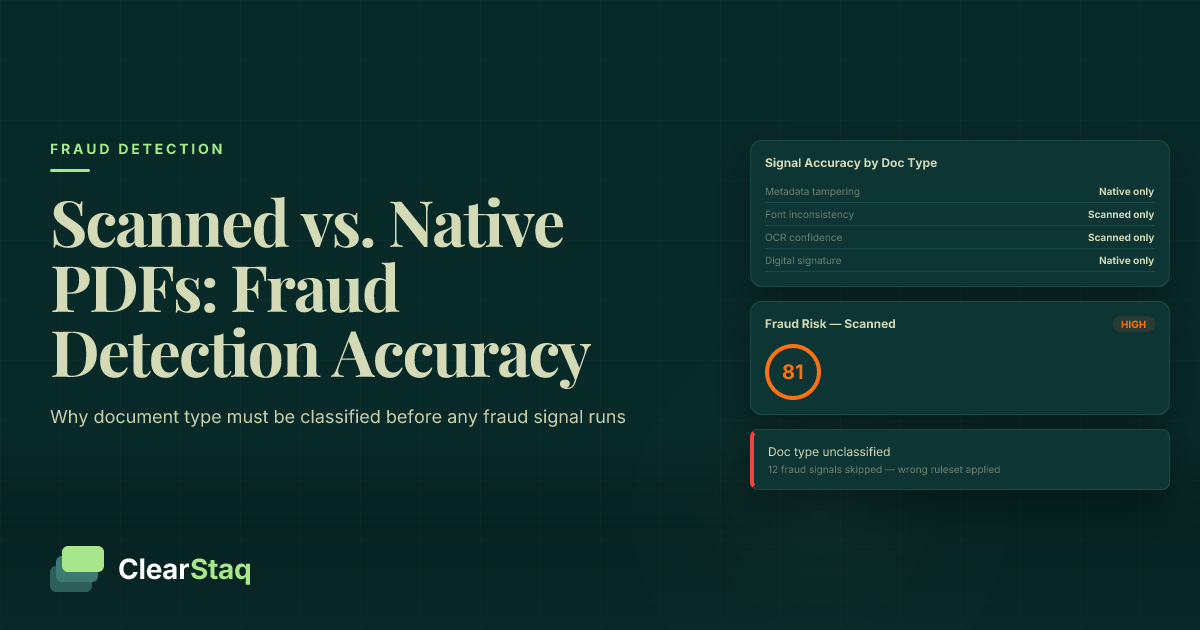
Basic OCR reads text off a PDF; it doesn't tell you if the PDF was edited. Look for software that checks metadata, font consistency, and transaction math against 20+ signals rather than just extracting numbers. A tool that only extracts data will miss a doctored bank statement that reads perfectly on the surface.
Processing speed at application volume
A card issuer running thousands of applications a month can't wait minutes per document. Software processing statements in under 5 seconds keeps the underwriting queue moving; anything slower becomes the bottleneck once volume climbs past a few hundred applications a day.
Format coverage across major banks
Chase, Bank of America, and Wells Fargo statements each use different layouts, and a parser tuned for one often breaks on another. Coverage across 900+ formats matters more than a vendor's accuracy claim on a single bank's PDF.
Synthetic identity detection at onboarding
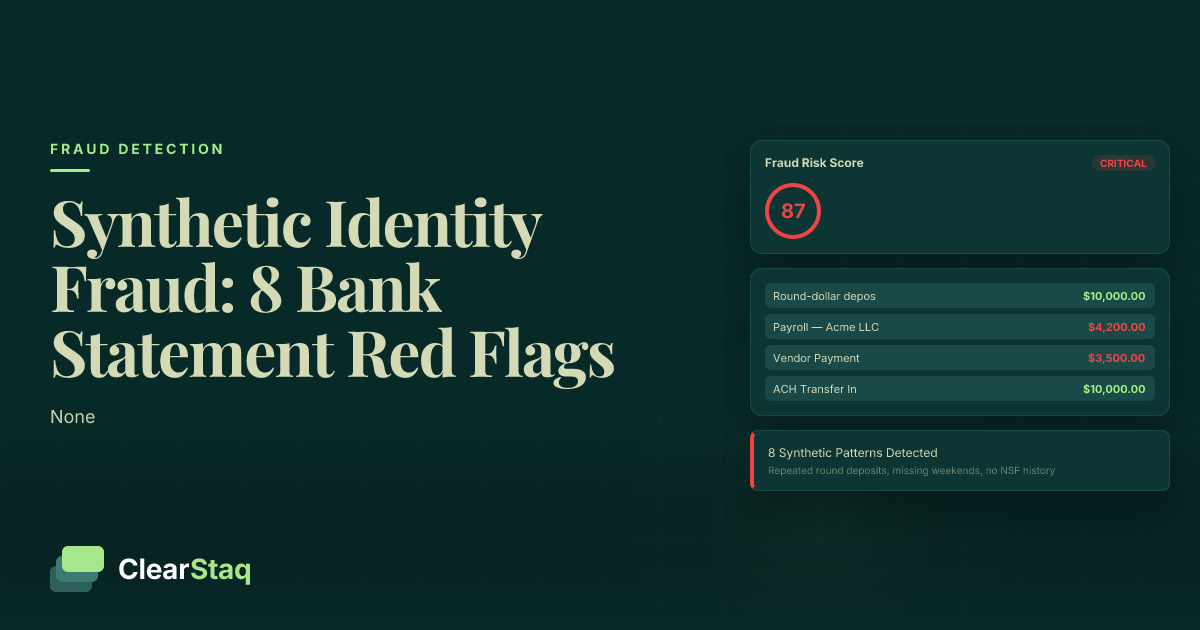
Synthetic identities combine real and fake data — a real Social Security number paired with a fabricated name and address. Card issuers see this pattern disproportionately in new-account fraud, so detection needs to happen at application, not months later when the balance is already charged off.
Integration with origination and decisioning systems
A fraud signal that lives in a separate dashboard doesn't get acted on fast enough. Software that pushes flags directly into the origination or loan decisioning system keeps the fraud check inside the approval workflow instead of as a side report nobody checks.
False positive rate and accuracy
A tool that flags 1 in 5 legitimate applications as fraud burns analyst time and slows real customers down. Accuracy figures near 99.5% on document parsing matter because every false positive becomes a manual review anyway.
Top picks for 2026
The identity check — synthetic identity fraud detection
Synthetic identity fraud is the fastest-growing new-account fraud type hitting card issuers, and it's built specifically to pass a single-point identity check. Best synthetic identity fraud detection tools for lenders breaks down which signals catch SSN-name mismatches and application velocity patterns that a credit bureau pull alone won't surface.
The spec that matters: detection needs to run against application data in real time, not in a batch review two days later. Buy this layer if your issuer runs high online application volume in 2026.
The check fraud filter — check fraud detection for banks
Issuers offering balance-transfer checks or cash-advance checks inherit a fraud category most card-application tools ignore entirely. Check fraud detection software for banks covers altered routing numbers, duplicate check images, and forged endorsements — patterns specific to physical and digital check instruments.
This is a narrow tool: it won't catch synthetic identities or doctored income statements. Consider it only if checks are part of your card product; skip it if your issuer is card-only with no check feature.
The document layer — income and statement verification
Credit line increases and initial limit decisions both depend on accurate income data, and doctored bank statements are the most common way applicants inflate that number. Best document fraud detection software for fintech lenders covers the parsing and verification layer that catches edited PDFs before a limit gets set too high.
ClearStaq runs 27+ signals against each statement and tax return, flagging inconsistencies a reviewer scanning a PDF for 30 seconds would miss. Buy this layer for any issuer verifying income on limit increases or non-standard applications in 2026.
The status quo — manual review teams
A trained analyst can catch fraud a machine misses, but the math doesn't hold at scale: manual review runs hours per file versus seconds per document for parsing software. Analyst judgment is real, but it's not a scalable substitute for document-level detection once application volume grows past a few hundred a week.
Skip relying on manual review alone once your issuer processes more than a few hundred applications a month — use it as a second layer on flagged files instead.
See how document fraud detection works
Check bank statements and tax returns against 27+ fraud signals in under 5 seconds.
What to avoid
Generic KYC-only tools. Identity verification that checks a name against a database catches stolen identities but not synthetic ones built from a real SSN and a fake name — the exact combination card issuers see most in new-account fraud.
Transaction-monitoring platforms sold as application fraud tools. These watch spend patterns after a card ships; they do nothing for the document review that happens before approval. That's a different fraud category entirely — the same way anti-phishing software for retailers is built for checkout-page attacks on e-commerce sites, not for the application-stage document fraud a card issuer deals with before a line even opens.
Fraud software with no bank-format coverage. A tool tuned to Chase statements that chokes on a regional credit union's PDF layout creates blind spots exactly where smaller issuers' applicants bank.
Verdict comparison
| Approach | Catches doctored documents | Flags synthetic identity | Speed at scale | Verdict |
|---|---|---|---|---|
| Document & income parsing (ClearStaq) | Yes — 27+ signals | Partial | Under 5s per document | Buy |
| Synthetic identity detection tools | Partial | Yes | Real-time at application | Buy for high volume |
| Check fraud filters | Yes, checks only | No | Varies by vendor | Consider |
| Manual review team | Yes, slowly | Yes, slowly | Hours per file | Skip at scale |
FAQ
What's the best fraud detection software for credit card issuers in 2026?
The best setup pairs document-level parsing that checks bank statements and income documents against 20 or more fraud signals with a synthetic identity layer at application. Card issuers relying on a single identity check or transaction monitoring alone miss application-stage fraud entirely.
Is fraud detection software worth it for smaller credit card issuers?
Yes, once application volume exceeds a few hundred a month, manual review can't keep pace at hours per file. Software processing statements in under 5 seconds catches the same fraud patterns without the analyst backlog.
Can fraud detection software catch synthetic identity fraud during card applications?
Purpose-built synthetic identity tools catch it by flagging mismatches between application data and identity records in real time. Generic KYC checks that only verify a single data point against a database typically miss it.
Does fraud detection software integrate with card origination systems?
Tools built for lending workflows push fraud flags directly into origination or decisioning systems so the check happens inside the approval process. A standalone dashboard that isn't connected to origination adds a manual step analysts often skip under volume.
How fast does document-based fraud detection process an application?
Format-aware parsers process a bank statement or tax return in under 5 seconds in 2026, compared to several minutes for manual review of the same document. Speed matters most once application volume climbs past a few hundred a day.
What's the difference between fraud detection software and identity verification tools?
Identity verification confirms a person is who they claim to be using a database check; fraud detection software examines the documents themselves for signs of alteration or synthesis. Card issuers need both, but they solve different problems.
How accurate is AI-based bank statement fraud detection?
Parsing accuracy near 99.5% is achievable on statements from major banks in 2026 when the software covers hundreds of format variations. Accuracy drops sharply on tools with limited bank-format coverage, since misread fields get flagged as false positives.
Does fraud detection software replace manual underwriting review?
No — it reduces manual review time by cutting the volume of files that need a human look, in some cases by 95%. Analysts still review flagged applications; the software just narrows the queue to the ones that actually need attention.
One last thing
A doctored bank statement usually looks clean to the eye — the fraud shows up in metadata, font kerning, and transaction math, not in anything a reviewer scanning a PDF would notice in 30 seconds. That's the entire argument for running 27+ signals against every statement instead of trusting a visual check, and it's the gap most card issuers still have open going into 2026.
Related guides
ClearStaq Team
Content Team
The ClearStaq team builds AI-powered tools for bank statement parsing, fraud detection, and income verification.