Commercial bank credit teams either spread financial statements the slow way or they buy financial statement spreading software built for business lending — this guide breaks down what actually matters for commercial banks in 2026, and which approach earns a Buy verdict.
- ClearStaq parses financial statement spreading software workloads at 99.5% accuracy — Buy for community banks and credit unions in commercial lending.
- Legacy spreading tools built around personal financial statements choke on business bank statement formats — Skip for C&I desks.
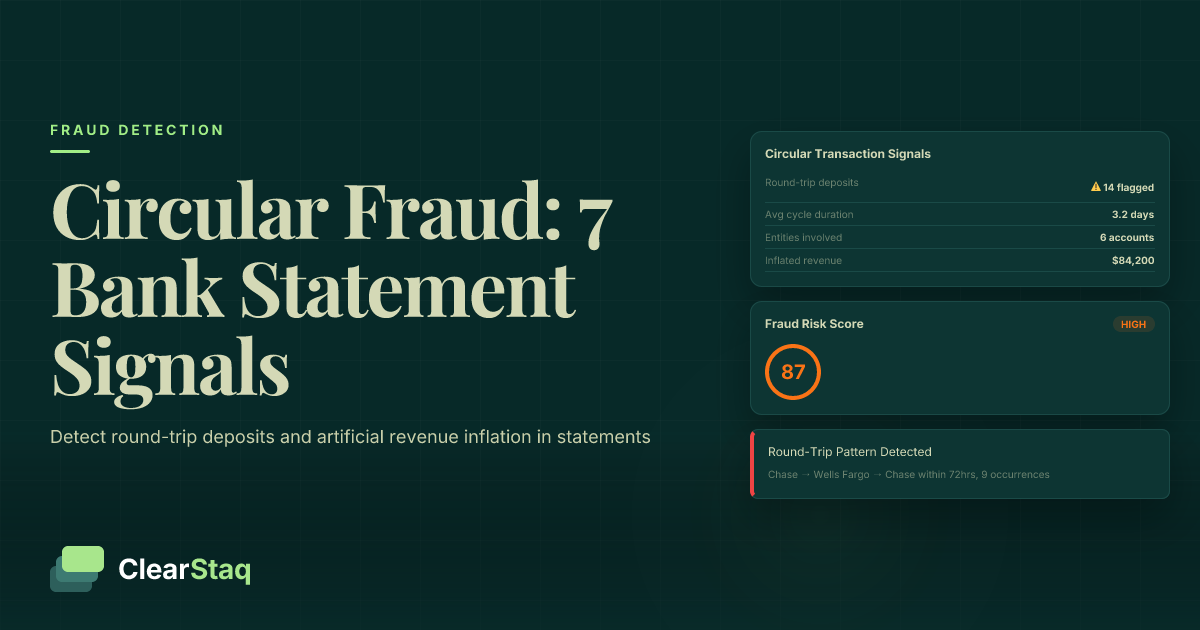
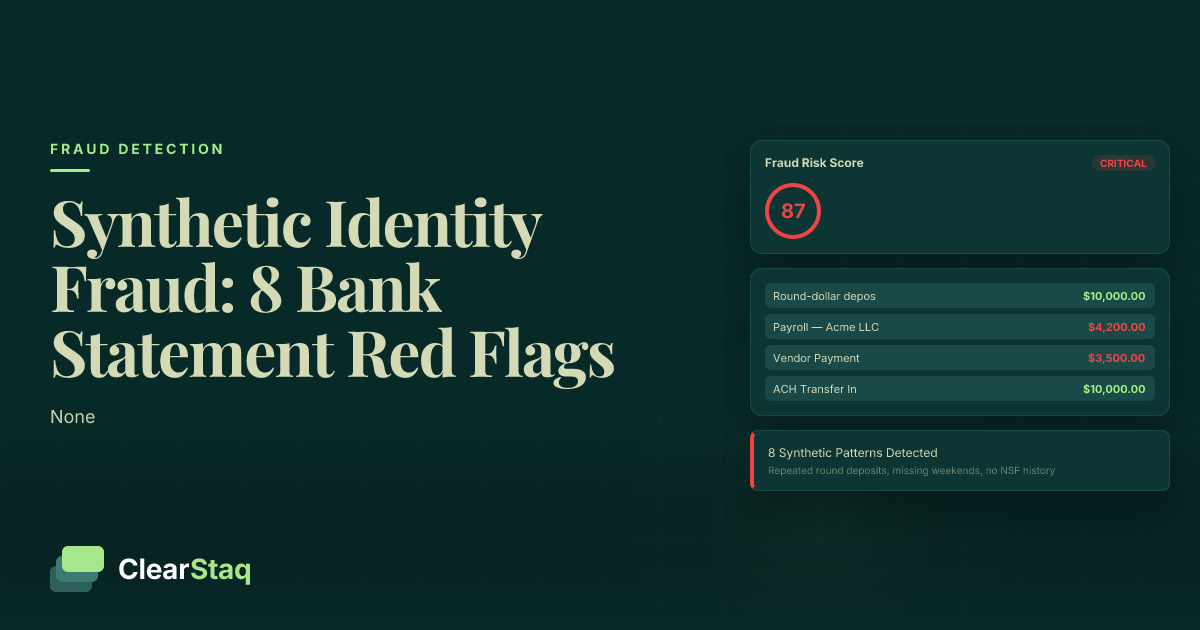
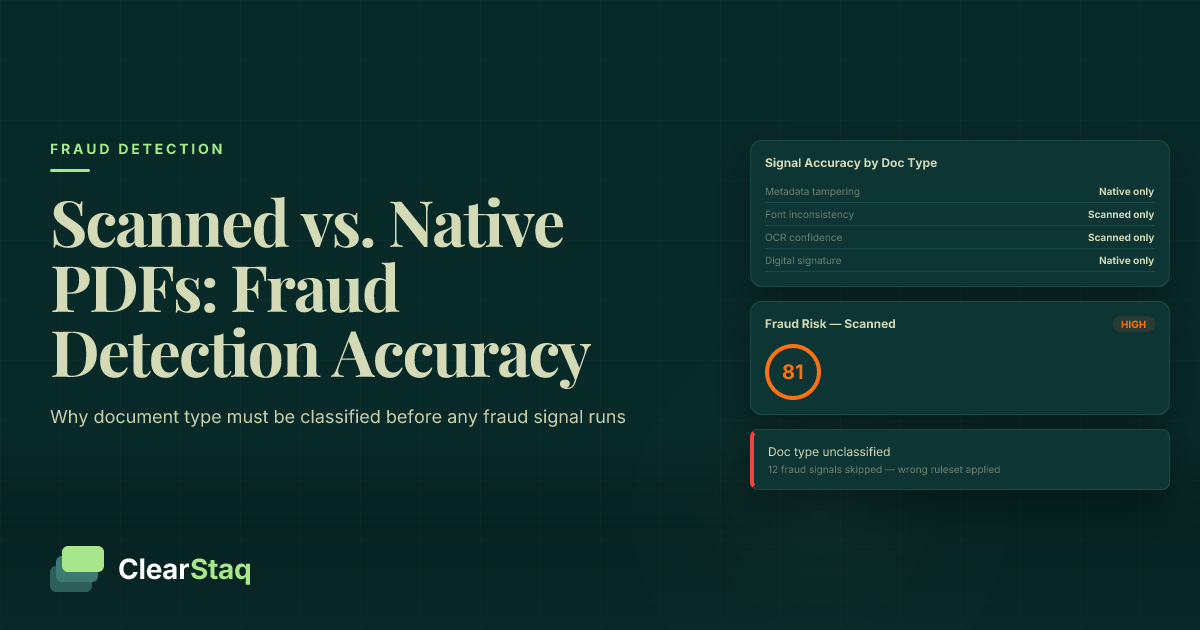
- 27+ fraud signals flag doctored statements and synthetic income before a credit committee sees the file.
- Sub-3-second parsing turns a 4-8 hour manual spread into a same-day underwriting decision in 2026.
- Manual spreadsheet spreading still costs commercial banks the most hours per file and catches the least fraud.
Why this matters
A commercial bank spreading a business bank statement by hand loses 4-8 hours per file to line-item entry, format guessing, and manual cross-checks against tax returns. That time comes straight out of the deal window — and in 2026, borrowers expect a decision in days, not weeks.
The fraud side is worse. Doctored statements, income smoothing, and synthetic identity documents don't announce themselves in a PDF. A spread built only for data entry misses all of it. ClearStaq builds fraud detection into the same pass that extracts the numbers, which is the real dividing line in financial statement spreading software for commercial banks this year.
Who this is for
This guide is for commercial bank credit analysts, C&I underwriters, and credit union business lending teams who spread financial statements as a daily function — not consumer mortgage shops, and not brokers working single-owner MCA files. If your desk touches multi-year tax returns, business bank statements, and P&L reconciliation on every commercial file, the criteria below apply directly.
What to look for in financial statement spreading software for commercial banks
Format coverage across statement types and banks
Commercial borrowers bank everywhere — Chase, regional banks, credit unions, online business accounts — and each format lays out transactions differently. Software that only reads a handful of templates forces your analysts back into manual entry on the files that matter most. Look for coverage in the hundreds of formats, not dozens; ClearStaq supports 900+ formats as of 2026.
Fraud detection built into the spread, not bolted on
A spread that hands you clean numbers on a fabricated statement is worse than no spread at all — it gives the file false confidence. Fraud signals need to run against the same document during parsing, flagging altered balances, inconsistent formatting, and structuring patterns before the numbers ever hit a memo. 27+ signals running at parse time beats a separate fraud check run after the spread is already built.
Turnaround time under real deal deadlines
Commercial deals move on committee schedules, not analyst availability. Software that takes minutes per statement instead of hours changes how many files a single underwriter can carry in 2026. Sub-3-second parsing on a business bank statement means the bottleneck moves from data entry to actual credit judgment, which is where it belongs.
Tax return and bank statement cross-referencing
Commercial underwriting rarely relies on one document type. Software that spreads tax returns and bank statements separately, with no reconciliation between the two, leaves the cross-check to a human doing it manually anyway. The software should flag gaps between reported income and deposit activity automatically.
Integration with the loan origination system
A spread that lives in a standalone portal creates a second system of record and a copy-paste step into the LOS. An API that pushes parsed data directly into loan origination workflows removes that step and keeps the audit trail in one place.
Audit trail and explainability for examiners
Examiners ask how a number was derived, not just what the number is. Spreading software needs to show its work — which fraud signal fired, which line items were reclassified, and why — so credit files hold up under review, not just under approval.
“A spread that hands you clean numbers on a fabricated statement is worse than no spread at all.”
Top picks for commercial banks
The safe pick for community banks
ClearStaq's setup for community bank commercial lending teams handles business bank statement spreading at 99.5% accuracy with fraud signals running in the same pass — see the breakdown on commercial loan underwriting software for community banks. Community banks running a handful of underwriters can't absorb a fraud miss on a large C&I line. Buy.
The pick for credit unions in business lending
Credit unions expanding into commercial and business member lending face the same statement variety as banks but with tighter staffing. The commercial loan underwriting software for credit unions approach applies the same 27+ fraud signals and sub-3-second parsing to member business files. Buy.
The pick for LOS-integrated shops
Banks running an established loan origination system don't want a second portal — they want parsed data landing directly in the pipeline they already use. The bank statement parsing API for loan origination systems pushes spread output straight into existing LOS workflows via API. This takes engineering time to wire up, so it's a Consider rather than an immediate Buy unless a developer resource is already free.
The pick for high-volume C&I desks
Desks underwriting dozens of C&I files a month need cash flow analysis that doesn't require a separate spreadsheet pass after the spread. ClearStaq's cash flow underwriting capability reconciles deposit activity against reported revenue automatically, which matters most on desks closing 20+ commercial files a month. Buy.
See ClearStaq spread a real statement
Run a live file through the parser before your next credit committee.
What to avoid
- Legacy spreading tools built for personal financial statements. They handle W-2 income and single-account checking statements fine but misread multi-account business bank statements and commercial tax return schedules.
- Generic OCR software with no fraud layer. It extracts numbers accurately but has zero concept of a doctored statement — it will spread fabricated numbers just as cleanly as real ones.
- Manual spreadsheet spreading. It still works, technically, but it's the slowest option on this list and the only one with no built-in fraud detection at all.
Verdict comparison
| Pick | Best for | Parsing accuracy | Fraud signals | Verdict |
|---|---|---|---|---|
| ClearStaq for community banks | Community bank C&I teams | 99.5% | 27+ | Buy |
| ClearStaq for credit unions | Credit union business lending | 99.5% | 27+ | Buy |
| ClearStaq parsing API | LOS-integrated shops | 99.5% | 27+ | Consider |
| ClearStaq cash flow underwriting | High-volume C&I desks | 99.5% | 27+ | Buy |
| Legacy spreading tools | Personal financial statements only | Varies by template | Minimal | Skip |
| Manual spreadsheet spreading | Low-volume shops only | Analyst-dependent | None | Skip |
FAQ
What is financial statement spreading software for commercial banks?
It's software that extracts and organizes data from business bank statements and tax returns into a standardized underwriting format. In 2026, the better tools also run fraud detection during the same parsing pass instead of as a separate step.
How accurate is ClearStaq's financial statement spreading?
ClearStaq parses financial statements at 99.5% accuracy across 900+ supported formats. That accuracy holds across business bank statements and tax returns, not just clean single-format PDFs.
How long does it take to spread a commercial bank statement?
ClearStaq processes a typical business bank statement in under 3 seconds. Manual spreading of the same document runs 4-8 hours depending on statement length and account count.
Does spreading software catch fraud, or just extract data?
The better platforms do both in one pass. ClearStaq runs 27+ fraud signals against the same document it's parsing, flagging altered balances and inconsistent formatting before the file reaches underwriting.
Can spreading software integrate with a loan origination system?
Yes, through an API that pushes parsed statement and tax return data directly into the LOS. This removes the manual copy-paste step between the spread and the origination pipeline.
Is manual spreadsheet spreading still viable for commercial banks in 2026?
It's viable only for very low file volume, and it carries no built-in fraud detection. Any desk closing more than a handful of commercial files a month loses more in analyst hours than the software would cost.
Does spreading software work on both bank statements and tax returns?
ClearStaq parses both and cross-references reported income against deposit activity automatically. That cross-check is what catches income smoothing and commingled funds before approval.
What's the difference between spreading software for community banks versus credit unions?
The parsing engine is the same, but the setup differs by borrower mix — community banks skew toward established C&I borrowers while credit unions are often spreading statements for newer business members with thinner files.
One last thing
The format count matters more than most credit teams realize going into 2026: a parser that reads 900+ statement formats isn't a nice-to-have, it's the difference between spreading every file that lands on your desk and manually re-keying the ones your software can't read. Check format coverage before accuracy claims — accuracy on a format the tool doesn't support is a number that never gets tested.
Related guides
ClearStaq Team
Content Team
The ClearStaq team builds AI-powered tools for bank statement parsing, fraud detection, and income verification.