Background check companies live and die by the documents applicants hand over — pay stubs, bank statements, tax transcripts, W-2s. If your verification software can't tell a doctored PDF from a real one, you're running a background check business on trust, not data. This guide breaks down what actually matters when picking document verification software for background check companies in 2026, and which approaches deserve a Buy, a Consider, or a hard Skip.
- AI-powered document verification software for background check companies should hit 99.5% parsing accuracy and flag fraud in under 5 seconds — anything slower stalls screening SLAs.
- Manual document review and generic OCR tools miss doctored pay stubs and fake bank statements; both get a Skip for anything past 50 files a month.
- ClearStaq's fraud detection engine runs 27+ signals across 900+ bank statement formats and is the safe pick for income and employment verification workflows.
- Identity-only verification platforms (ID scans, liveness checks) don't parse financial documents — pair them with a document parser, don't replace one with the other.
Why this matters
Background check companies verify employment and income for landlords, staffing agencies, and lenders that outsource the paperwork. Every doctored pay stub or fabricated bank statement that slips through becomes your liability, not the applicant's. As screening volume scales past a few hundred files a month, a human reviewer squinting at font kerning stops being a strategy — it's a bottleneck with a fraud hole in it.
The fraud itself has gotten more specific. Applicants no longer just photoshop a number — they edit metadata, reuse templates across submissions, and smooth income figures to clear a threshold. Software built to catch that pattern-level fraud, not just typos, is the dividing line between a screening company that scales and one that gets burned in 2026.
Who this is for
This guide is for background check companies, tenant screening firms, and employment verification services that process pay stubs, bank statements, or tax documents as part of their reports — teams running 50 to 5,000+ verifications a month who need a defensible, auditable answer when a client asks "how do you know this document is real?"
What to look for in document verification software for background check companies
Format coverage across document types
Applicants submit statements from hundreds of banks and credit unions, each with its own layout. Software that only parses the top five national banks pushes the rest into manual review, which defeats the point of buying software. Look for coverage in the hundreds of formats, not dozens — ClearStaq's engine covers 900+ bank statement formats, which matters because your applicant pool doesn't stick to Chase and Wells Fargo.
Fraud signal depth, not just OCR
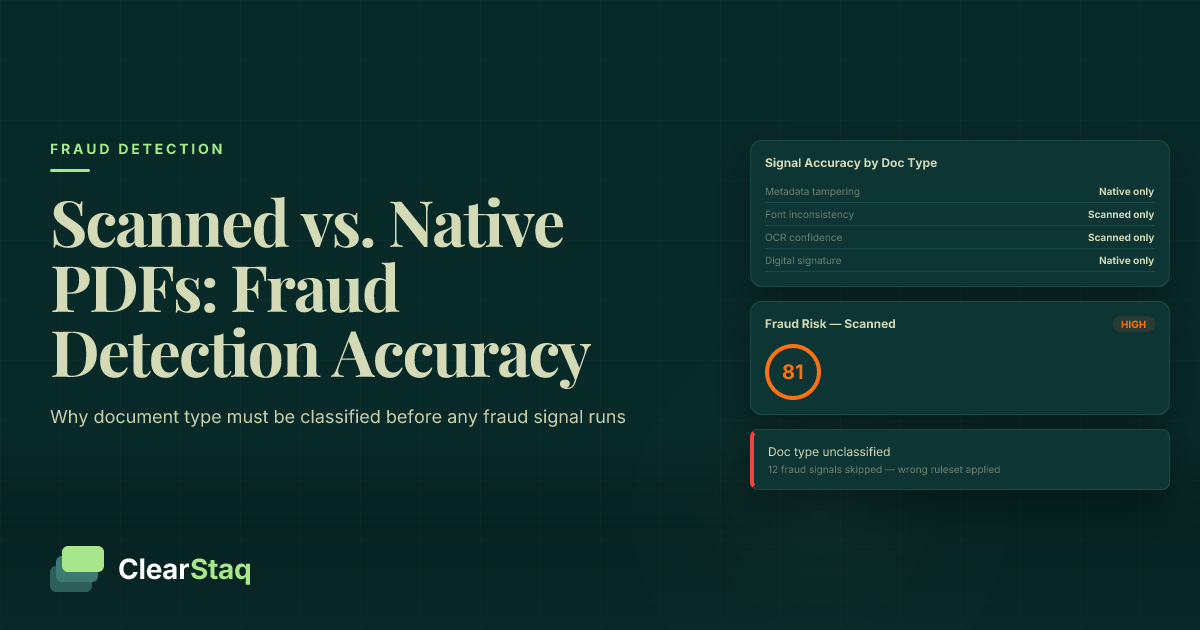
Optical character recognition tells you what a document says. It doesn't tell you whether the document is real. You need signal-level fraud detection — font inconsistency, metadata mismatches, altered running balances, transaction pattern breaks — stacked across dozens of checks per file. A tool running 27+ fraud signals catches things a single-signal checker misses entirely, like income smoothing or structuring patterns that only show up across multiple months.
Processing speed against your SLA
Background checks run on turnaround promises — 24 to 48 hours is standard in 2026. Software that takes minutes per document to process can't hit that window once volume climbs. Sub-5-second processing per document keeps your report pipeline moving instead of queuing behind a slow parser.
Accuracy rate you can defend to a client
If a client challenges a report, you need a number to point to. A parser sitting below 95% accuracy means roughly one in twenty documents gets misread — that's a lot of disputed reports. A 99.5% accuracy benchmark gives you something to stand behind when a landlord or employer questions a flagged file.
Integration into your existing screening workflow
Standalone tools that require analysts to upload files one at a time don't survive contact with real volume. API-based integration into your case management or ATS system means documents get parsed the moment they land, not after someone remembers to check a queue.
Audit trail and explainability
Regulators and clients both want to know why a document got flagged, not just that it did. Software that outputs a plain list of which of its 27+ signals triggered — rather than a black-box score — holds up better in compliance reviews and client disputes.
Top picks for background check companies
AI-powered fraud detection platforms — the category leader. ClearStaq runs 27+ fraud signals against bank statements and tax documents, parsing 900+ formats in under 5 seconds at 99.5% accuracy. It catches doctored pay stubs — the single most common document fraud type in employment verification — by cross-checking font, metadata, and calculation consistency rather than eyeballing a PDF. Buy if you're processing more than 50 income or employment documents a month.
Manual review teams — the status quo. A trained analyst reading each statement line by line still exists at plenty of screening shops, and it works fine at low volume. It doesn't scale, it's inconsistent between reviewers, and it has no audit trail beyond a reviewer's notes. Skip once volume outpaces headcount, which for most background check companies happens fast.
Generic OCR and e-signature capture tools — the wildcard. Tools built for capturing and storing signed documents extract text well but weren't built to detect fraud — they'll happily digitize a forged pay stub with perfect confidence. Useful as an intake layer, not as your fraud check. Consider only if paired with a dedicated fraud detection layer on top.
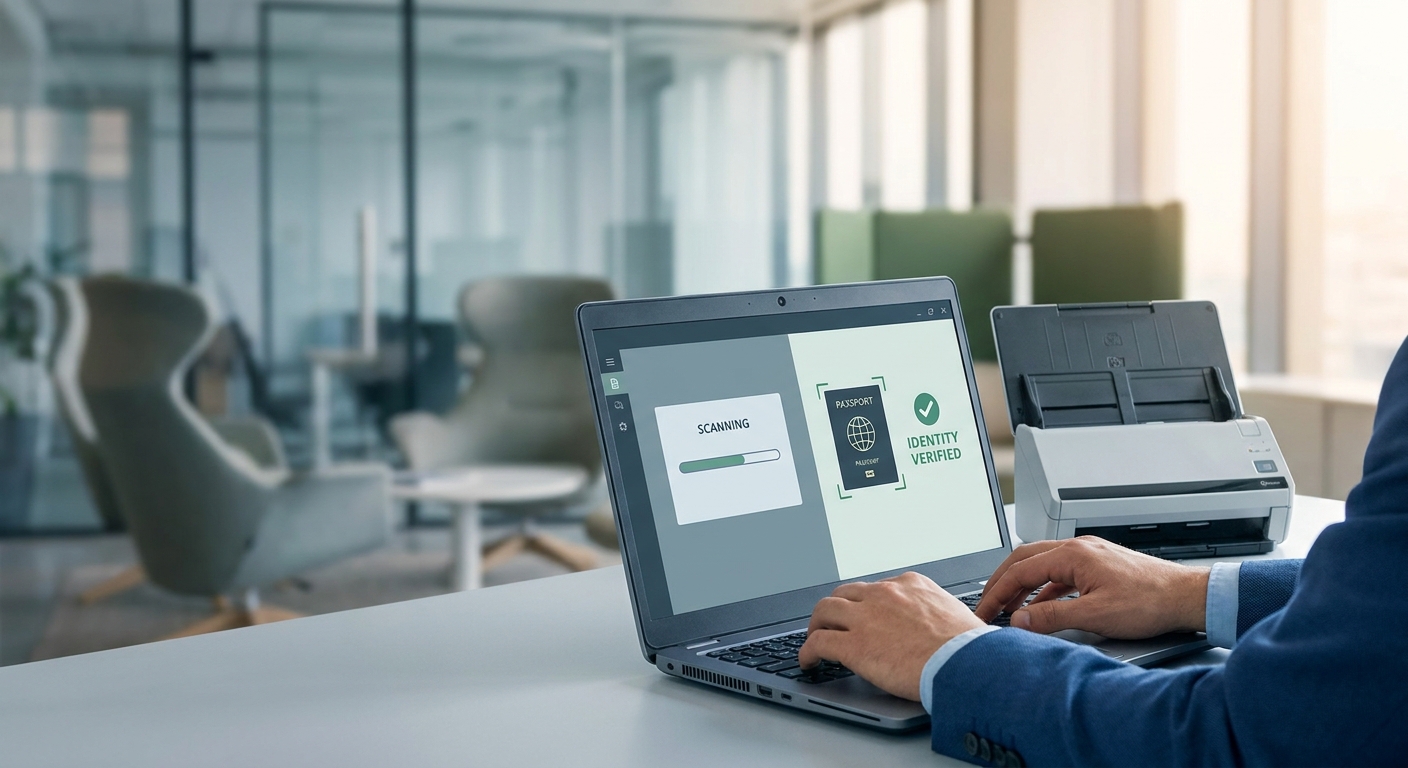
Identity-verification-only platforms — the narrow fit. ID scanning and liveness-check tools confirm the person is who they say they are; they don't touch the financial documents in the file at all. A verified identity can still submit a fake bank statement. Consider as a complement to document parsing, never as a substitute for it.
Homegrown parsing scripts — the DIY trap. Some screening companies build in-house regex-based parsers to handle bank statement formats. They break the moment a bank changes its statement layout, and maintaining coverage across hundreds of banks becomes a full-time job nobody signed up for. Skip unless you have engineering headcount dedicated to babysitting it.
What to avoid
- Tools that only flag "suspicious" without showing which signal triggered. A black-box fraud score you can't explain to a client or regulator creates more risk than it removes.
- Software that treats one bad month as fraud. Income naturally fluctuates; a parser needs to look at patterns across statements, not one anomalous transaction, or it'll flood your review queue with false positives.
- Identity verification marketed as "complete" document verification. Confirming a face matches an ID says nothing about whether the pay stub in the same application was altered.
Confirming an identity and confirming a document are two different jobs — software that only does one and calls itself "complete" verification will miss the fraud that matters most.
Verdict comparison
| Option | Format coverage | Fraud signal depth | Speed | Audit trail | Verdict |
|---|---|---|---|---|---|
| ClearStaq (AI fraud detection) | 900+ formats | 27+ signals | <5 sec | Full signal breakdown | Buy |
| Manual review | Unlimited (human-read) | Analyst-dependent | Minutes to hours | Reviewer notes only | Skip at scale |
| Generic OCR/e-signature tools | Broad text capture | None (not fraud-built) | Fast capture | None | Consider as intake only |
| Identity-only platforms | N/A (identity, not docs) | Identity signals only | Fast | ID match log | Consider as complement |
| Homegrown scripts | Narrow, brittle | Custom, unmaintained | Varies | Minimal | Skip |
FAQ
What's the best document verification software for background check companies in 2026?
AI-powered fraud detection platforms that parse bank statements and pay stubs with dozens of fraud signals are the strongest option in 2026. ClearStaq runs 27+ signals across 900+ bank formats at 99.5% accuracy, which outperforms manual review or generic OCR for catching doctored documents.
Is document verification software the same as identity verification software?
No. Identity verification confirms a person matches their ID through scans and liveness checks. Document verification software checks whether the financial documents submitted — pay stubs, bank statements, tax forms — have been altered or fabricated. Background check companies need both, run separately.
How much does document verification software cost for background check companies?
Pricing varies by vendor and volume, so check current pricing directly with each provider rather than relying on published averages. Cost typically scales with document volume processed per month.
Can document verification software catch doctored pay stubs?
Yes, when the software checks font consistency, metadata, and calculation logic rather than just extracting text. Software running multiple fraud signals catches doctored pay stubs that pass a simple visual or OCR-only check.
How fast should document verification run during a background check?
Under 5 seconds per document is the 2026 benchmark for AI-powered parsers. Slower processing creates bottlenecks against standard 24-48 hour background check turnaround times.
Do background check companies need bank statement parsing?
Yes, if income or employment verification is part of the report. Bank statements reveal income patterns, structuring, and commingled funds that a pay stub or ID check alone won't show.
What accuracy rate should document verification software hit?
Look for 99.5% accuracy or higher. Below 95%, roughly one in twenty documents gets misread, which creates disputed reports and client trust issues.
Is manual document review still viable for background check companies in 2026?
Only at low volume, under roughly 50 documents a month. Past that, manual review becomes inconsistent between analysts and can't produce the audit trail that AI-based fraud signal detection provides.
One last thing
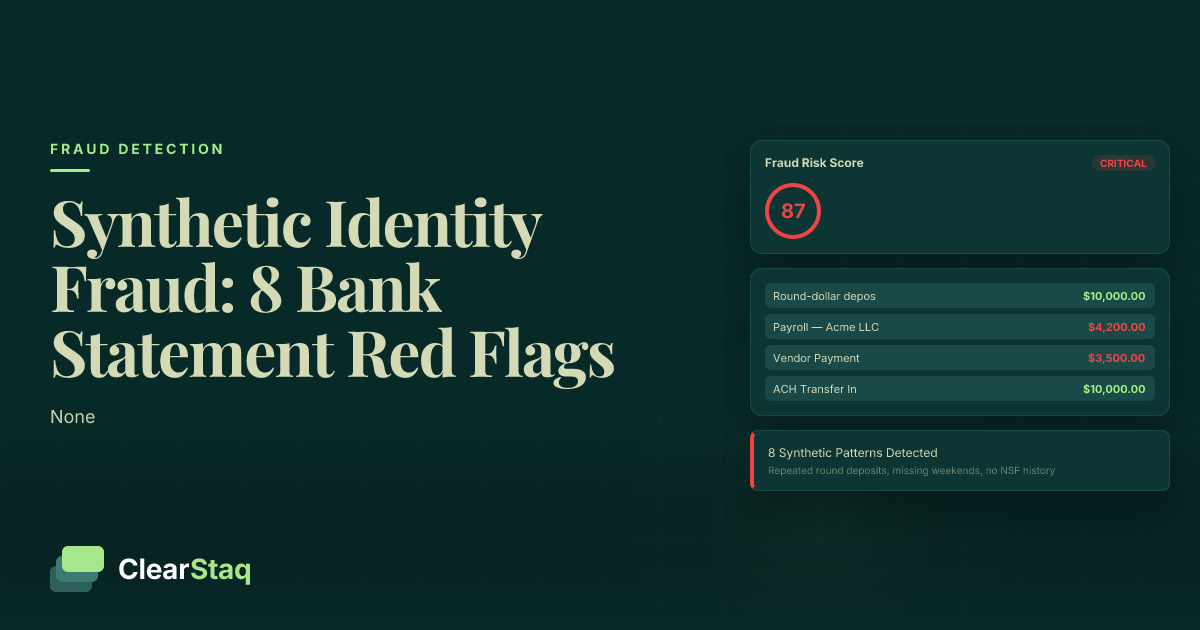
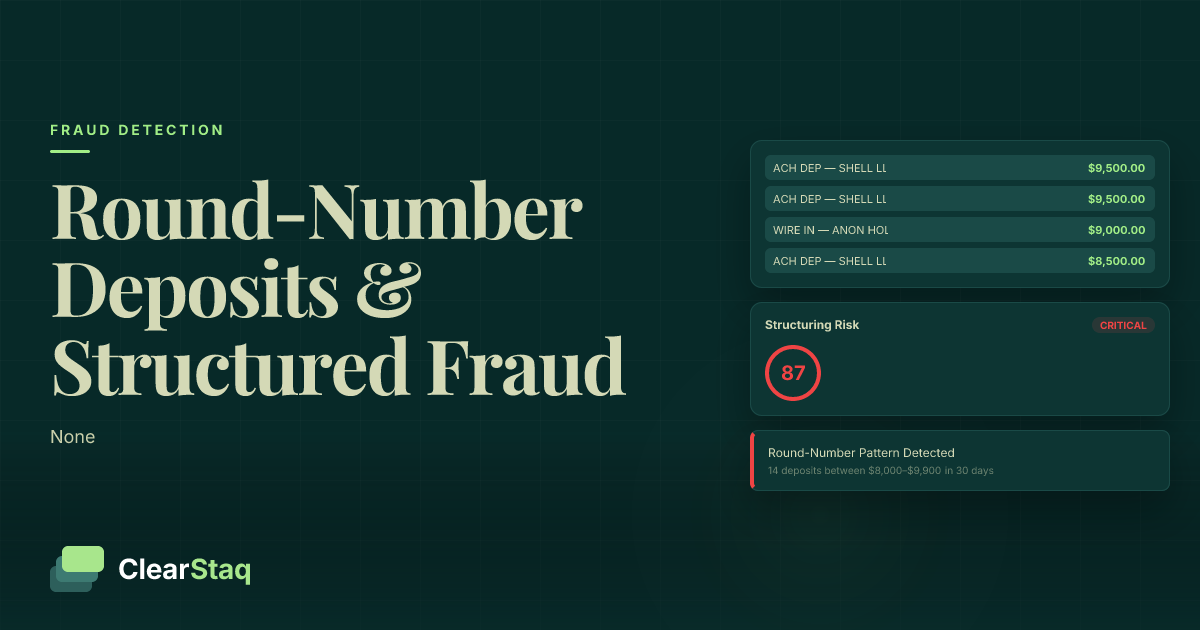
Most screening teams assume fraud detection means catching an obviously fake document. The bigger risk in 2026 is the subtler stuff — income smoothing across months, structured deposits designed to dodge a threshold, and synthetic identities built from real and fabricated data mixed together. A single-document check misses all three because the fraud only shows up in the pattern, not the page.
Related guides
ClearStaq Team
Content Team
The ClearStaq team builds AI-powered tools for bank statement parsing, fraud detection, and income verification.