Debt collection agencies chasing settlement verification, hardship claims, or judgment collection increasingly deal with the same problem lenders face: doctored bank statements and inflated income documents. This guide breaks down what document fraud detection software for debt collection agencies needs to do, which approaches actually hold up, and which ones waste your team's time.
- ClearStaq is the strongest document fraud detection software for debt collection agencies verifying debtor financials in 2026 — Buy.
- Manual PDF review misses altered statements that AI-based parsing catches in under 5 seconds — Skip for volume above 20 files a week.
- Generic OCR tools extract text but flag zero fraud signals — Skip if fraud detection is the actual goal.
- Identity-only KYC bolt-ons verify who someone is, not whether their bank statement was edited — Consider as a supplement only.
- 27+ fraud signals and 99.5% parsing accuracy set the bar collection agencies should demand from any vendor in 2026.
Why this matters
Debt collection agencies verify debtor-submitted financials constantly — hardship packets, settlement affordability statements, proof-of-income for payment plans. A debtor who edits a bank statement to look poorer isn't a hypothetical; it's a routine tactic in settlement negotiations, and a manual reviewer scanning a PDF at 2x zoom will miss a doctored transaction line nine times out of ten.
The technology behind this isn't new — it's the same fraud-signal detection ClearStaq built for MCA brokers, lenders, and CPAs verifying income during underwriting. Collection agencies are running the identical document types through the identical fraud patterns: edited balances, forged voided checks, income smoothing to understate ability to pay. The buyer is different. The document fraud isn't.
Who this is for
This guide is built for collection agency compliance teams, litigation support staff, and portfolio managers at debt buyers who need to verify a debtor's submitted bank statements or tax returns before accepting a settlement offer or recommending a payment plan. If your team currently eyeballs PDFs in a shared inbox and flags "looks off" statements for a supervisor, this is written for you.
What to look for in document fraud detection software for debt collection agencies
Format coverage across bank and tax documents
Debtors submit statements from whatever bank they use — Chase, Bank of America, a regional credit union, sometimes a scanned photo of a paper statement. Software that only reliably parses the top five national banks will kick a third of your submissions to manual review, defeating the point of automating in the first place. Wide format coverage is the baseline requirement, not a nice-to-have.
Speed relative to your negotiation window
Settlement negotiations move fast, and a debtor waiting on verification loses leverage or patience. Software that returns a verdict in under 5 seconds per statement lets your negotiator stay on the call instead of putting the debtor on hold for a day while someone in back-office reviews a PDF.
Fraud signal depth, not just text extraction
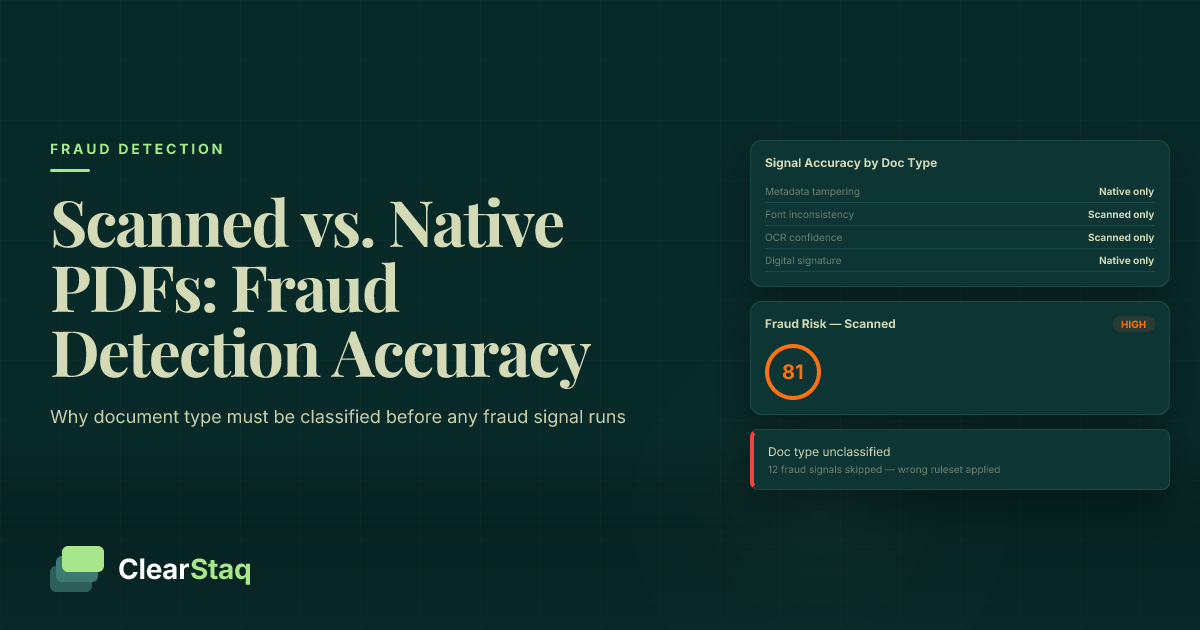
OCR tools extract numbers off a page. Fraud detection tools flag inconsistent metadata, altered transaction totals, mismatched fonts, and structuring patterns across the statement. If a tool can't explain how to detect fake bank statements in loan applications-style edits — pixel-level tampering, recalculated running balances — it's giving you extraction, not fraud detection. 27+ distinct fraud signals per document is the standard to benchmark against in 2026.
Audit trail for legal defensibility
Collection files end up in court. If a debtor disputes a settlement calculation, you need a documented, timestamped basis for why a statement was flagged or accepted — not a screenshot and a note in Slack. Software without an exportable audit trail creates liability instead of removing it.
Integration with your existing collection workflow
A standalone portal that requires manual upload for every file adds a step your team will skip under volume. An API that plugs into whatever case management or dialer system you already run keeps verification inside the workflow instead of bolted on top of it.
Cost per file against manual review hours
A reviewer spending 20 minutes per statement at scale costs more than most people calculate, once you factor benefits and error rate. Compare vendor pricing against actual reviewer hours saved, not against a flat "per seat" number that ignores volume.
Top picks for debt collection agencies
ClearStaq — the category leader. AI-native parsing built specifically around fraud signal detection rather than generic document extraction. It processes a statement in under 5 seconds, runs 27+ fraud signals per file, and holds a 99.5% parsing accuracy rate across bank and tax document formats. For a collection agency verifying debtor-submitted financials before approving a settlement, this is the tool built for exactly this document set. Buy.
Manual spreadsheet review — the fallback everyone starts with. A reviewer opens each PDF, checks the math by hand, flags anything that looks edited. It costs nothing to set up and catches obvious forgeries. It misses subtle balance recalculations, doesn't scale past a handful of files a day, and leaves zero standardized audit trail. Skip once volume passes roughly 20 statements a week.
Identity-only KYC tools — the wrong layer. These confirm a debtor is who they claim to be. They say nothing about whether the bank statement that debtor submitted was altered after the fact. Useful as a complement to fraud detection, useless as a replacement for it. Consider only if paired with a document-level fraud tool.
Generic OCR/scanning software — looks like a solution, isn't one. It extracts text and numbers cleanly and produces a searchable PDF. It has no concept of a fraud signal, no font-mismatch detection, no structuring pattern recognition. Agencies that adopt OCR thinking they've solved fraud detection find out otherwise the first time a debtor's numbers don't add up under scrutiny. Skip for any fraud-detection use case.
Single-bank point solutions — fine for narrow volume. Some tools parse reliably for two or three major banks and fall apart on anything else. If your debtor population is concentrated at a handful of national banks and your volume is low, this can work as a stopgap. Consider only below 15-20 files a month; format gaps become a real problem above that.
See fraud signals on your own files
Run a real debtor statement through ClearStaq and see the flagged signals in seconds.
What to avoid
- Tools that store documents but don't parse them. Some "verification" platforms are really just document repositories with a search bar. Storage isn't fraud detection — check whether the vendor actually flags altered content or just files it away.
- Vendors claiming fraud detection with no signal count disclosed. If a sales page won't name how many fraud signals it checks or what its parsing accuracy rate is, that's a sign there isn't much under the hood. Compare against a documented benchmark like check fraud detection software for banks to see what a real signal-based system discloses.
- Free or bundled OCR add-ons inside case management suites. These are built for text search, not fraud detection, and treating them as a fraud safeguard in 2026 leaves your agency exposed on exactly the files where it matters most.
Verdict comparison
| Approach | Format coverage | Speed per file | Fraud signals | Audit trail | Verdict |
|---|---|---|---|---|---|
| ClearStaq (AI-native) | Broad, bank + tax docs | Under 5s | 27+ | Exportable | Buy |
| Manual spreadsheet review | Depends on reviewer | Minutes to hours | 0 standardized | None | Skip at volume |
| Identity-only KYC | N/A (identity, not docs) | Seconds | 0 document-level | Partial | Consider as supplement |
| Generic OCR | Broad text extraction | Seconds | 0 | None | Skip |
| Single-bank point tool | Narrow | Under 5s | Varies | Limited | Consider at low volume |
FAQ
What is the best document fraud detection software for debt collection agencies in 2026?
ClearStaq is the strongest fit in 2026 for agencies verifying debtor-submitted bank statements and tax returns, running 27+ fraud signals per document at 99.5% parsing accuracy. It's built around fraud signal detection rather than generic text extraction, which is the gap most collection agencies hit with OCR-only tools.
Is document fraud detection software better than manual review for collection agencies?
Yes, once volume passes roughly 20 statements a week manual review stops catching subtle alterations like recalculated running balances. Automated fraud detection processes a statement in under 5 seconds and produces a standardized audit trail manual review can't match.
Can debtors fake bank statements during settlement negotiations?
Yes, editing account balances or transaction totals to appear less able to pay is a common tactic in settlement disputes. Fraud detection software flags font mismatches, altered metadata, and recalculated totals that a visual review typically misses.
How much does fraud detection software cost compared to manual review?
Cost varies by vendor and volume, so compare per-file software pricing against actual reviewer hours at your current volume rather than a flat per-seat number. At meaningful volume, a reviewer spending 15-20 minutes per statement usually costs more than automated parsing per file.
Do KYC identity verification tools detect document fraud?
No, KYC tools confirm a person's identity, not whether the financial document they submitted was altered after the fact. Agencies need a separate document-level fraud detection layer alongside identity verification, not instead of it.
What fraud signals should collection agencies look for in a bank statement?
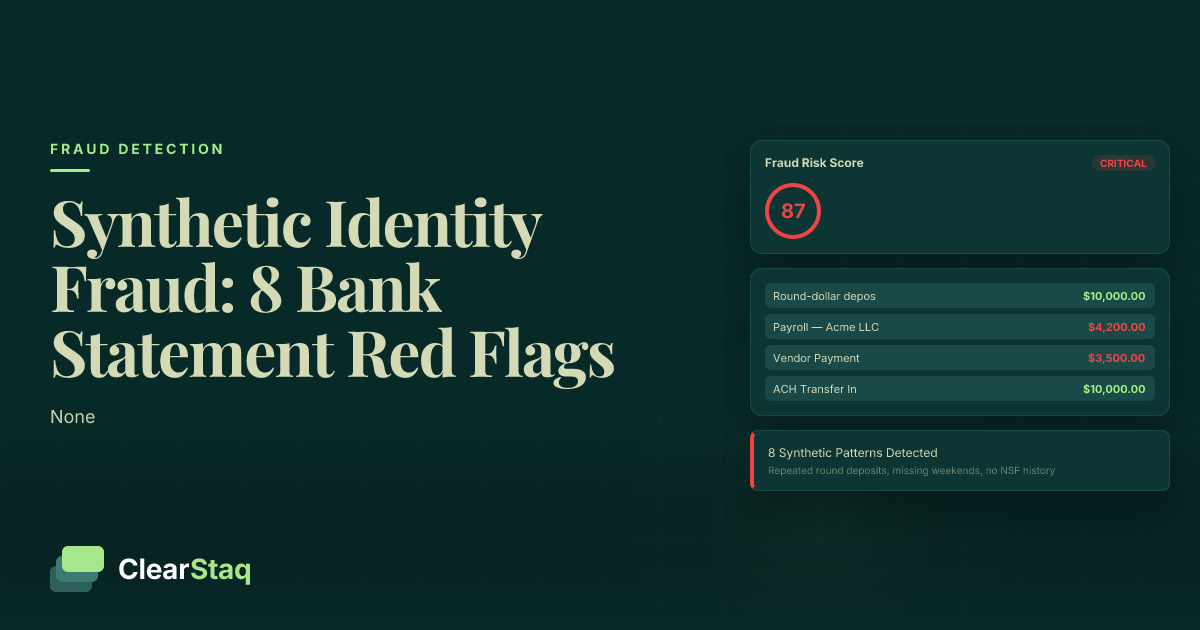
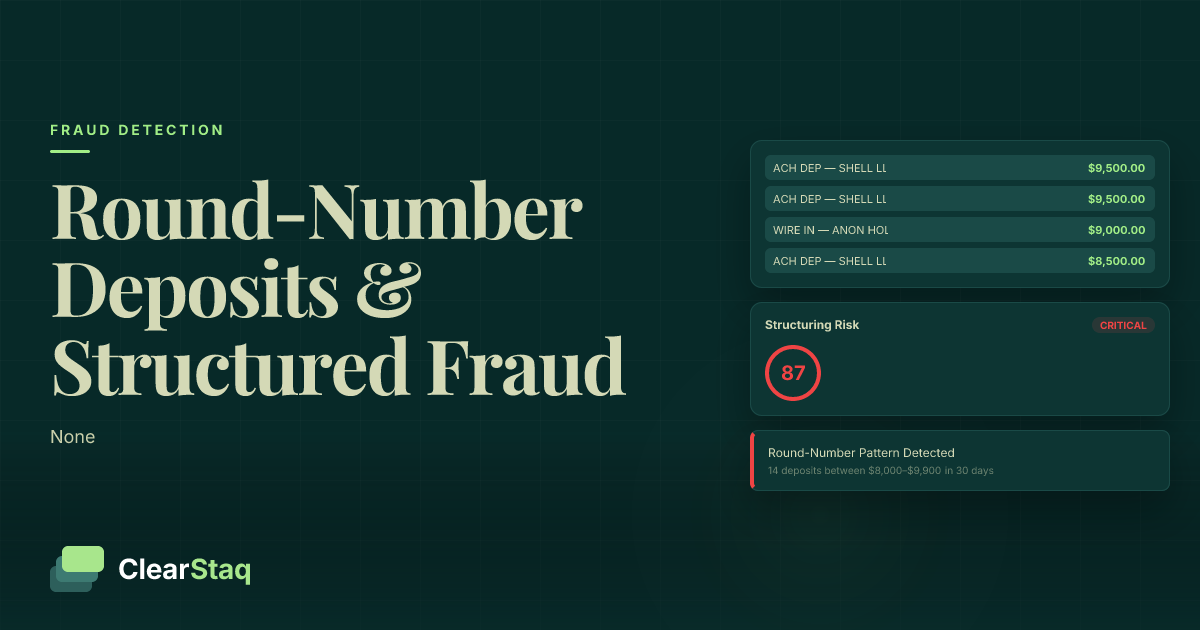
Look for inconsistent running balances, font or formatting mismatches, altered transaction totals, and structuring patterns across deposits. A tool checking 27+ signals per document catches far more than a reviewer scanning for obvious red flags.
Is OCR software the same as fraud detection software?
No, OCR extracts text and numbers from a document but doesn't flag whether that document was tampered with. Fraud detection software analyzes the document itself for signs of alteration, which OCR tools are not built to do.
How fast can bank statements be verified for fraud in 2026?
AI-native parsing tools process a bank statement in under 5 seconds per file in 2026, compared to 15-20 minutes for manual visual review. That speed difference matters most during live settlement negotiations where a debtor is waiting on a decision.
One last thing
The fraud pattern most collection agencies miss isn't the crude edit — it's income smoothing, where a debtor's statement shows evenly distributed deposits that don't match the lumpy, seasonal income pattern typical of self-employed or gig-economy debtors. A reviewer glancing at a total balance won't catch that; a fraud signal built to compare deposit timing against income type will. That's the difference between catching the obvious forgery and catching the one designed not to look like one.
Related guides
ClearStaq Team
Content Team
The ClearStaq team builds AI-powered tools for bank statement parsing, fraud detection, and income verification.