Proof of funds sounds simple until an SBA underwriter finds a $40,000 deposit that showed up four days before the application went in. Verifying proof of funds for SBA loan applications means confirming both the balance and the source of every dollar counted toward the borrower's equity injection.
- Verify proof of funds for SBA loan applications by tracing every large deposit to a documented source, not just confirming the balance.
- SBA SOP 50 10 8 requires funds to be seasoned for at least two statement cycles before closing in 2026.
- A screenshot or scanned balance with no bank letterhead fails every SBA lender's underwriting standard — reject it.
- Manual review runs 2-4 hours per file; ClearStaq's parsing platform returns fraud signals and deposit history in under 5 seconds.
Why this matters
SBA lenders lose the guarantee if the file gets flagged for fabricated equity injection after funding. That's not a compliance footnote — it's the difference between a loan the SBA backs and one your institution eats alone in 2026.
Borrowers know underwriters check balances. Fewer know underwriters are supposed to check the paper trail behind the balance. A parked deposit from a personal loan, a family gift with no letter, or a transfer from an undisclosed account all pass a lazy balance check and fail a real one.
This is where document review either protects the lender or becomes theater. ClearStaq built its bank statement parsing platform around exactly this gap — flagging deposit patterns that look like proof of funds but aren't, in seconds instead of hours.
What you'll need
- Two to three months of business and personal bank statements, direct from the bank (PDF export, not a photo)
- A signed SBA loan application with the borrower's stated equity injection amount
- Source documentation for any deposit over 25% of average monthly balance — gift letters, sale agreements, retirement account withdrawal statements
- Access to a statement authenticity check — metadata review, font/kerning consistency, or an automated parser
- 1-3 hours per file if reviewing manually, or a processing window under 5 seconds per statement if using an automated tool
The steps
1. Pull the correct statement window
SBA SOP 50 10 8 calls for evidence that equity injection funds have been in the borrower's account long enough to rule out last-minute borrowing. Most SBA 7(a) lenders in 2026 request two full statement cycles, some request three for larger injections.
Grab consecutive months, not cherry-picked ones. A borrower who sends March and June but skips April and May is hiding something in the gap.
Common mistake: accepting a single month's statement because the balance looks sufficient. One snapshot proves nothing about seasoning.
2. Confirm the funds are seasoned
Seasoned means the money sat in the account before the application, not that it arrived to match the number on the form. Compare the balance from day one of the earliest statement against the balance on the application date.
If the balance jumped by more than 20% in the final two weeks before submission, that jump needs its own explanation. A lender that skips this check is underwriting the deposit, not the borrower.
Common mistake: treating average balance as proof of seasoning. Averages hide spikes; you need the day-by-day ledger.
3. Trace every large deposit to a source
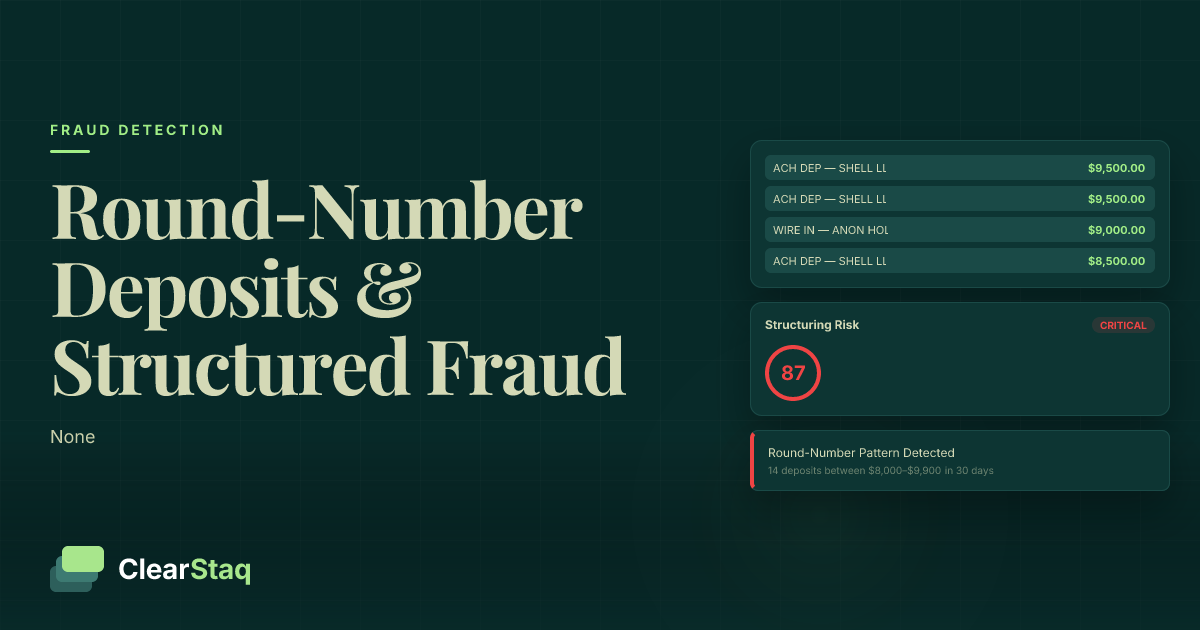
Any single deposit over roughly 25% of the account's typical monthly inflow needs documentation — a gift letter, a home sale closing statement, a retirement distribution notice, or a business receivable. No documentation, no credit for that deposit.
This step catches the most common proof-of-funds failure: a borrower's relative wires $30,000 the week before closing with zero paperwork behind it. Verdict: flag and hold until the source is documented in writing.
4. Check the statement for authenticity artifacts
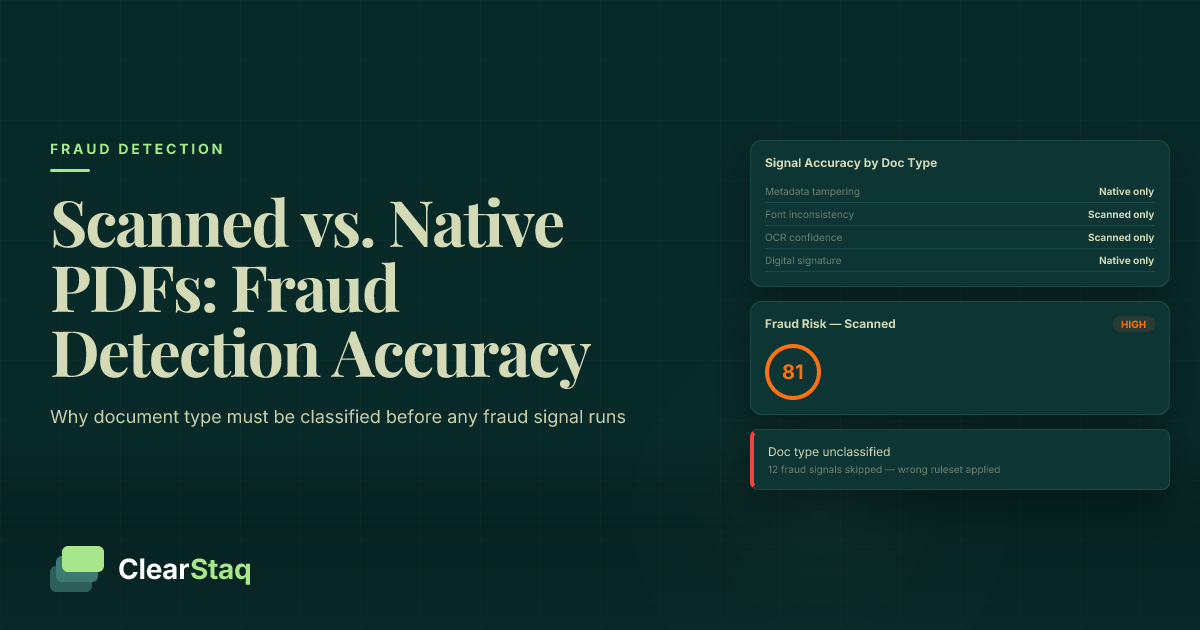
Fabricated statements share tells: inconsistent fonts across transaction rows, misaligned running balances, missing bank routing footers, or PDF metadata showing an edit date after the stated statement period. ClearStaq's guide on detecting fake bank statements breaks down the specific formatting signals that separate a real Chase or Wells Fargo export from an edited one.
Manual reviewers catch maybe half of doctored statements on a visual scan. Format-aware parsing catches formatting inconsistencies a human eye skips after the tenth file of the day.
Common mistake: trusting a PDF because it "looks official." Doctored statements in 2026 are good enough to pass a glance — they fail a byte-level check.
5. Verify account ownership matches the applicant
Proof of funds only counts if the account belongs to the person or business on the loan application. A statement from a spouse's account, a business partner's account, or an LLC the borrower doesn't control is not proof of funds for that borrower — it's a straw-account problem.
Cross-check the account holder name on the statement header against the SBA Form 1919 signer. If they don't match, escalate before crediting the balance toward equity injection.
6. Cross-reference with tax returns and deposit history
If the borrower claims the equity injection came from business profit, the deposit pattern should line up with revenue shown on the business tax return and the deposit history on prior months' statements. A sudden six-figure deposit with no matching revenue trail is a mismatch worth a direct question, not a rubber stamp.
Common mistake: reviewing bank statements and tax returns in separate silos. The fraud signal lives in the gap between the two documents, not in either one alone.
7. Document the finding in the credit memo
Write down what was verified, what documentation backed each large deposit, and what — if anything — is still outstanding. An SBA guarantee purchase request gets denied fastest when the file shows the lender never actually checked the source of funds, just the balance.
Troubleshooting
- Lump deposit right before applying, no explanation offered. Request 60-90 days of history instead of 30, and ask directly for a source letter before crediting the funds.
- PDF statement has inconsistent fonts or spacing between rows. Treat as a red flag; request a bank-direct download or call the bank's business line to confirm the account exists.
- Personal and business funds mixed in one account. Separate the analysis — count only the portion clearly tied to the borrower's personal or business use, not the combined balance.
- Statement is from an account not in the applicant's name. Reject as standalone proof of funds; require a gift letter and evidence the funds have actually transferred to the applicant's account.
- Screenshot or scanned image with no bank letterhead or account number visible. Decline it outright and request an official statement export — screenshots are the single easiest document to fabricate.
- Deposit history shows recurring transfers from an undisclosed account. Ask for statements on that source account too; an undisclosed account often means undisclosed debt.
Tools and resources
- ClearStaq's fraud detection guide for SBA lenders covers the specific signal patterns SBA files trigger most often
- Bank-direct PDF statement portals (avoid emailed screenshots entirely)
- SBA SOP 50 10 8 for current equity injection and seasoning requirements
- A statement parser that flags altered PDFs and deposit anomalies without a manual line-by-line read
Automate proof of funds review
Parse statements and flag deposit anomalies in under 5 seconds per file.
What to do next
Once proof of funds is verified for the SBA equity injection, apply the same seasoning and source-tracing logic anywhere else in the file that touches borrowed or gifted funds — down payment assistance programs use nearly identical documentation rules. ClearStaq's breakdown of verifying proof of funds for down payment assistance programs walks through the parallel checklist for that document type.
FAQ
What counts as proof of funds for an SBA loan?
Proof of funds for an SBA loan is a bank statement showing seasoned funds equal to or greater than the required equity injection, with documented sources for any large deposits. A balance alone without a source trail does not satisfy most SBA lenders' underwriting standards in 2026.
How many months of bank statements does the SBA require?
Most SBA 7(a) lenders request two to three consecutive months of statements to confirm funds are seasoned, following SBA SOP 50 10 8 guidance. Larger equity injections often trigger a request for a longer window.
Can a gift count as proof of funds for an SBA loan?
Yes, but only with a signed gift letter stating the amount, the relationship to the borrower, and confirmation the funds don't need to be repaid. Without the letter, the deposit is treated as undocumented and excluded from the equity injection calculation.
How do lenders verify bank statements aren't fake?
Lenders check for formatting inconsistencies, PDF metadata edit dates, and deposit patterns that don't match stated income, and increasingly rely on automated parsing to flag these signals faster than a manual scan. A doctored statement often passes a visual check but fails a byte-level review.
Is a screenshot of a bank balance acceptable proof of funds?
No. A screenshot lacks the account details, bank letterhead, and transaction history needed to verify seasoning and source, and it's the easiest document type to fabricate. Request an official PDF statement export instead.
How long does it take to verify proof of funds manually?
Manual review of statements, deposit tracing, and source documentation typically takes 1-3 hours per file depending on the number of large deposits. Automated parsing tools can return the same fraud and seasoning signals in under 5 seconds per statement.
Does the SBA require seasoning of equity injection funds?
Yes, SBA SOP 50 10 8 requires funds to be seasoned in the borrower's account for a set period before the application, generally two statement cycles, to rule out last-minute borrowed money.
What's the difference between proof of funds and equity injection verification?
Proof of funds confirms the balance exists; equity injection verification confirms the balance is seasoned, sourced, and belongs to the applicant. SBA underwriting requires both, not just the balance check.
One last thing
The deposit that sinks an SBA file almost never looks suspicious on its own — a $25,000 transfer reads as ordinary until it lands six days before the application and has no matching gift letter or sale agreement behind it. Underwriters who trace every large deposit to a source, every time, catch that pattern before the guarantee purchase request does it for them. ClearStaq's income verification workflow runs that trace automatically across every statement in the file, which is the difference between a 2026 SBA file that survives an audit and one that doesn't.
Related guides
ClearStaq Team
Content Team
The ClearStaq team builds AI-powered tools for bank statement parsing, fraud detection, and income verification.