Straw borrower schemes hide inside otherwise clean applications — a real person with real credit, funded by someone who can't qualify on their own. This guide breaks down the specific document and behavior patterns that expose straw borrowers before a loan funds, using the checks underwriters and fraud teams run in 2026.
- Straw borrower fraud hides behind a qualified name funded by an unrelated third party.
- Detect straw borrower patterns in loan applications by matching income source to account owner, not the name on the form.
- ClearStaq's 27+ fraud signals flag mismatched funding sources and duplicate bank statement templates in under 5 seconds.
- Manual cross-referencing misses coordinated applications filed weeks apart in 2026 — automation catches the link.
- Verdict: automate document-level cross-checks now or keep absorbing straw borrower losses at charge-off.
Why this matters
A straw borrower isn't a fabricated identity — it's a real person with a real credit file who signs for a loan on someone else's behalf, usually because the actual beneficiary can't qualify or wants to stay off the paper trail. Auto lenders see it in buy-here-pay-here deals, mortgage underwriters see it in down payment assistance files, and MCA brokers see it when a business owner recruits a friend with clean personal credit to front a loan the business itself can't get.
The fraud rarely shows up as a lie on the application. It shows up as a mismatch between what the applicant claims and what the bank statements actually say. That's why ClearStaq's fraud detection platform is built around parsing the statement itself, not just scoring the answers on the form. Catching a straw borrower before funding means reading transaction-level behavior, not trusting the narrative.
What you'll need
- The full application file for every co-applicant, guarantor, and authorized signer on the deal
- 3 to 12 months of bank statements for each named party, not just the primary borrower
- Device, IP, and session metadata from the origination platform, if your system captures it
- A parsing tool that reads statement structure and transaction history, not just reported balances
- 15 to 30 minutes of manual review time per flagged file once automated checks run
The steps
1. Cross-reference every name on the file against every other file in the pipeline
Straw borrower schemes rarely stop at one loan. Run every applicant, co-applicant, and guarantor name — plus address and phone number — against active and recent files in your own pipeline. A match across unrelated deals in the same 30 to 60 day window is the single strongest early flag you'll get, and it costs nothing more than a database query.
Common mistake: checking only the primary borrower's name and skipping guarantors, who are frequently the actual straw party.
2. Match income source to the bank account owner, not the applicant on paper
The application lists a job and an income figure. The bank statement tells you whether that income actually lands in the applicant's own account, from an employer or client that matches the stated occupation. When the deposits come from a business entity, a person, or a payroll provider with no connection to the applicant's stated employer, you're looking at income routed through a straw party rather than earned by one.
This single check catches more straw borrower patterns than any identity document review, because the money trail doesn't lie the way a signature can.
3. Trace where the down payment or initial deposit actually came from
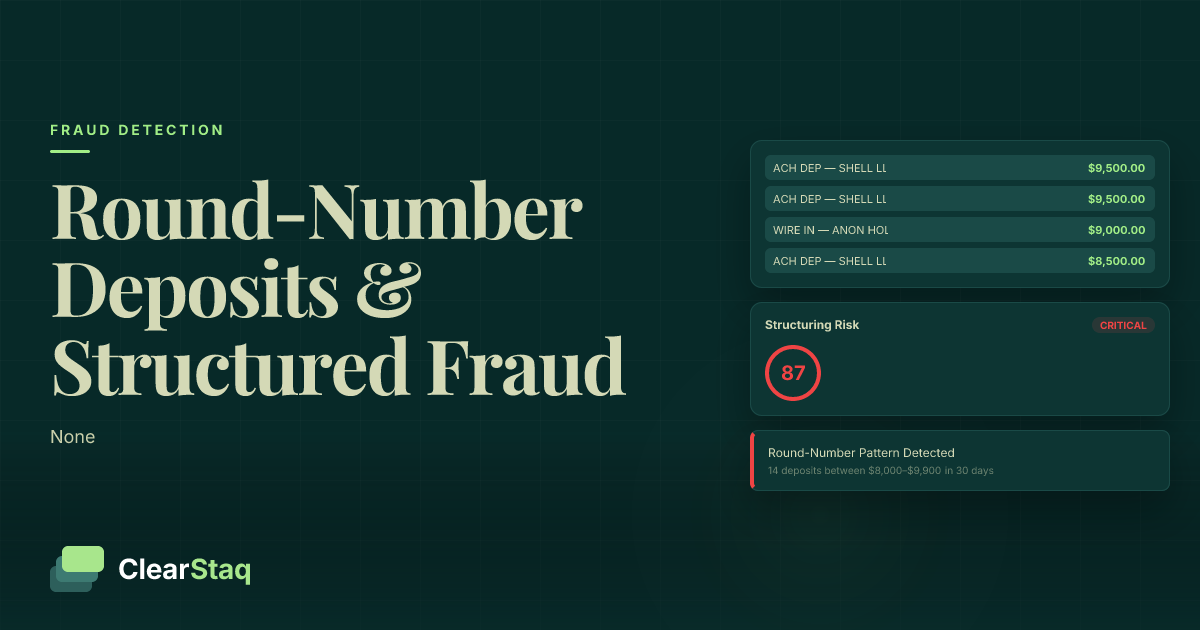
Pull the transaction immediately before the down payment or deposit clears. A same-day or next-day inbound transfer from a third party, especially one who also appears elsewhere in your pipeline, means the applicant isn't the one funding the deal. Legitimate gift funds usually show a documented paper trail and a consistent relationship; straw-funded deposits show a round-number transfer with no history between the parties.
Expected outcome: you either confirm the applicant funded their own stake, or you find the actual party behind the loan.
4. Compare device, IP, and session metadata across "unrelated" applications
If your origination platform logs device fingerprints, IP addresses, or session timestamps, compare them across every application filed in the same 90-day window. Straw borrower rings frequently reuse the same laptop or the same office network to file for multiple "unrelated" applicants, because one person is filling out every form.
Without metadata capture, this step isn't available — flag it as a gap and lean harder on steps 1, 2, and 5.
5. Watch for identical bank statement templates across different applicants
Straw borrower schemes tied to shell entities or coordinated rings often reuse the same statement template, the same balance patterns, or the same transaction formatting across supposedly unrelated files. This is exactly the pattern behavior covered in how to identify shell company bank statements during underwriting — the tell is structural, not narrative.
Manual reviewers miss this because they review files one at a time. A parsing engine comparing structure across the whole pipeline catches it in seconds.
6. Check for immediate post-funding transfers to a third party
If funds hit the applicant's account and move out within 24 to 72 hours to a person who isn't a co-applicant, that's the clearest post-close signal of a straw arrangement. This check requires servicing-side visibility, so build it into your first 90 days of post-funding monitoring, not just the underwriting stage.
Common mistake: treating every rapid outbound transfer as normal cash flow instead of flagging the recipient for cross-reference.
7. Verify occupancy and employment claims against actual transaction patterns
An applicant claiming to occupy a property or hold a job should show transaction patterns consistent with that claim — local merchant activity, commute-related spending, payroll timing that matches the stated employer's pay cycle. When the transaction geography and timing don't match the claim, you're likely looking at a straw borrower who has no actual connection to the property or the job listed.
Troubleshooting
A legitimate family co-signer trips every flag. Family co-signing is common and legal — the difference is whether the co-signer's own funds and credit support the deal, or whether they're a pass-through for someone who can't qualify. Check whether the co-signer's income and assets independently support the loan terms before clearing the flag.
The applicant has a thin bank statement history. A new account opened 60 to 90 days before the application is itself a flag, not a disqualifier. Pull whatever history exists and weight the funding-source check in step 3 more heavily than usual.
Multiple applicants share an office network and it's triggering false positives. Staffing agencies, co-working spaces, and small offices legitimately generate shared IP addresses. Cross-check step 4 hits against steps 1 and 2 before escalating — device overlap alone isn't enough.
A cross-border applicant's statement format doesn't parse cleanly. Foreign bank statements use different layouts, date formats, and currency notation. A parser built for 900+ statement formats reduces this friction, but manually verify currency conversion and transaction dating before applying the same fraud checks.
An MCA broker submits the same statement template for multiple legitimate clients. Template reuse by a broker's own software isn't automatically fraud — cross-reference the underlying account numbers and balances to confirm the businesses are actually distinct before flagging the broker.
Tools and resources
- A parsing engine that reads transaction-level detail across statement formats, not just summary balances
- A pipeline-wide name, address, and device cross-reference check run before every funding decision
- How to verify business bank accounts before loan disbursement for the account-ownership verification step in detail
- Post-funding transaction monitoring for at least 90 days after disbursement
- A documented escalation path for flagged files so underwriters aren't making judgment calls alone
What to do next
Straw borrower detection is one slice of document-level fraud review. If your team is still reviewing statements manually, the bigger fix is automating the parsing layer that catches synthetic identities, doctored documents, and template reuse in the same pass as straw borrower checks — a broader comparison of tools built for that job is worth reading before you pick one.
FAQ
What is a straw borrower in a loan application?
A straw borrower is a real person with qualifying credit who signs for a loan on behalf of someone who can't qualify on their own. The name on the application is genuine, but the money and the intent behind the loan belong to a third party.
How do lenders detect straw borrower patterns in loan applications in 2026?
Lenders detect straw borrower patterns by matching income source to account owner, tracing down payment funding, and cross-referencing names and devices across their pipeline. Tools like ClearStaq automate these checks across 27+ fraud signals in under 5 seconds per file.
Is a straw borrower the same as loan stacking?
No. Loan stacking is one borrower taking multiple loans from different lenders in a short window; straw borrowing is a different person qualifying for a loan on behalf of someone else. The two can overlap in fraud rings but they're distinct patterns.
What documents reveal straw borrower patterns?
Bank statements reveal straw borrower patterns better than application forms because they show where income and down payment funds actually originate. Device metadata and cross-applicant name matching add a second layer of confirmation.
Can bank statement analysis catch straw borrowers before funding?
Yes. Bank statement analysis catches straw borrowers by flagging income deposits that don't match the applicant's stated employer and down payments funded by unrelated third parties, both visible before disbursement.
What's the difference between a straw borrower and a legitimate co-signer?
A legitimate co-signer's own income and assets independently support the loan terms. A straw borrower is a pass-through name with no independent financial stake in the deal, confirmed by tracing where the down payment and repayment funds actually come from.
How fast can AI fraud detection flag a straw borrower application?
ClearStaq's parsing engine processes a bank statement and runs 27+ fraud signals in under 5 seconds, flagging mismatched funding sources and duplicate statement templates before an underwriter opens the file.
Does straw borrower fraud show up more in one loan type?
Straw borrower patterns appear across mortgage down payment assistance files, auto buy-here-pay-here deals, and MCA applications where the actual beneficiary can't qualify directly. The detection method — tracing funding source and cross-referencing applicants — works the same across all three.
One last thing
The tell is rarely the borrower's story — it's the statement's format fingerprint. ClearStaq parses 900+ statement formats specifically because straw borrower rings and shell-backed applicants reuse the same template, the same balance ranges, and the same transaction formatting across files that are supposed to be unrelated. Once you're comparing structure across your whole pipeline instead of reading one file at a time, the pattern stops hiding.
Related guides
ClearStaq Team
Content Team
The ClearStaq team builds AI-powered tools for bank statement parsing, fraud detection, and income verification.