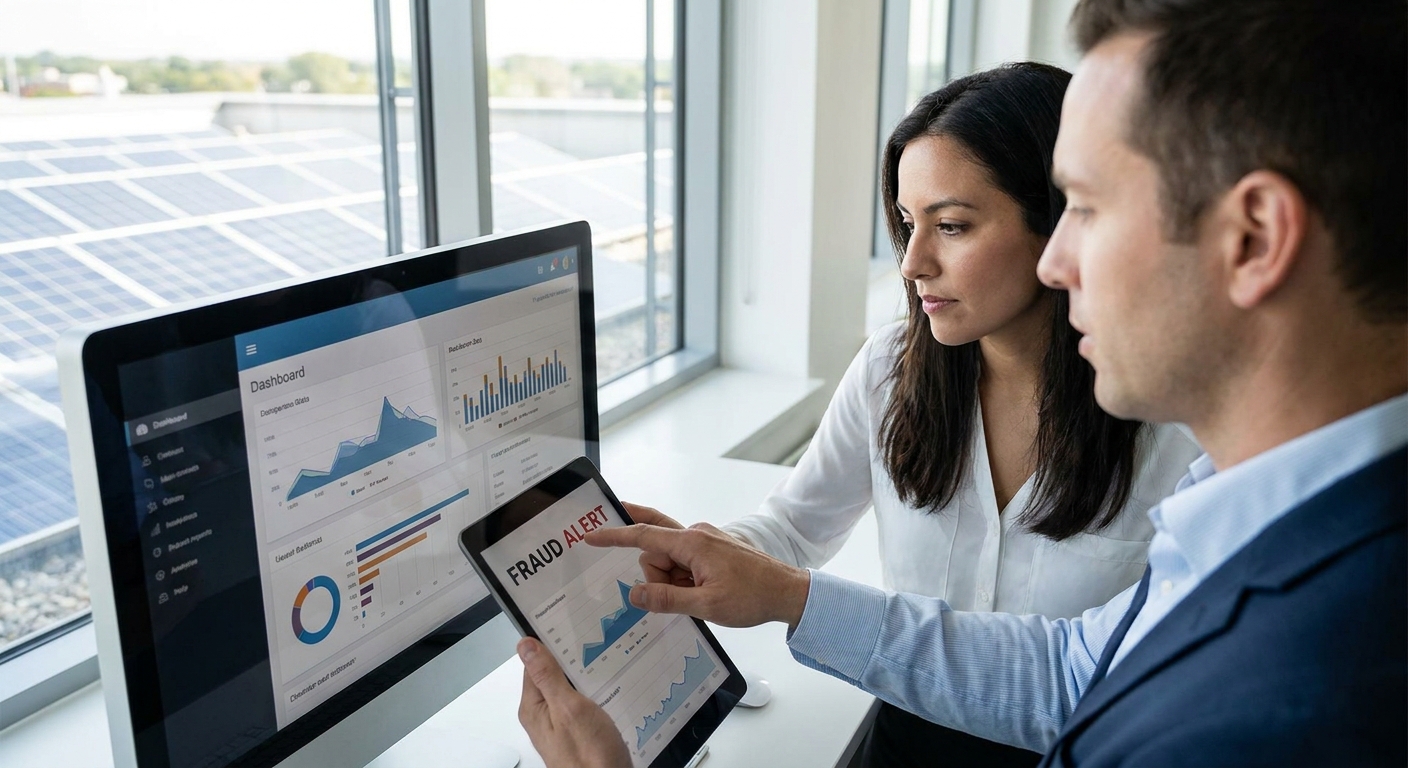
Solar financing companies approve six-figure installation loans from a tablet in someone's living room — and the fraud tools built for branch-based lending don't move fast enough to catch what's wrong before the ink dries.
- ClearStaq's bank statement parser flags doctored deposits in under 5 seconds — fast enough for a kitchen-table close.
- Synthetic identity detection matters more in solar than most lending categories because applications close over a tablet, not in a branch.
- Dealer-level duplicate submissions and inflated contract amounts are the fraud pattern most solar underwriters still catch manually in 2026.
- Manual-review-only workflows are the clearest thing to avoid for fraud detection software for solar financing companies this year.
Why This Matters
Solar loans and leases close differently than a car loan or a mortgage. A sales rep pulls out a tablet, walks a homeowner through a $20,000-plus system, and needs a credit decision before they leave the driveway. That compressed sales cycle is exactly where fraud slips through — doctored bank statements to hit a debt-to-income cutoff, synthetic identities approved for a system that defaults on the first payment, or a dealer submitting five near-identical applications in a week.
Fraud detection software for solar financing companies in 2026 has to run inside that same compressed window, not around it.
Who This Is For
This guide is built for solar loan originators, TPO (third-party ownership) providers, and PPA financing companies underwriting residential and small commercial installs — the teams approving credit in minutes off a bank statement upload and a soft credit pull, often through a ClearStaq-style parsing layer sitting inside their point-of-sale flow. If your underwriting still routes every file to a human reviewer before funding, the sales cycle mismatch described above is already costing you deals or costing you fraud losses — sometimes both on the same application.
What to Look for in Fraud Detection Software for Solar Financing Companies
Bank Statement Authenticity Detection
A homeowner short on the down payment threshold can edit a PDF from their banking app in ten minutes — add a deposit, alter a running balance, change a font nobody checks. Fraud detection software needs to catch metadata mismatches and altered balances automatically, because no underwriter is going to eyeball a statement pixel by pixel during a same-day close. This is the single highest-value check for solar underwriting because the fraud is cheap to fake and easy to miss.
Self-Employed and 1099 Income Verification
A disproportionate share of solar buyers are landlords, gig drivers, and small business owners — income that never shows up cleanly on a W-2. Software that only checks stated income against a pay stub misses the applicant smoothing irregular deposits into something that looks like steady income. This matters more in solar than in auto or personal lending because the applicant pool skews self-employed and seasonal.
Synthetic Identity Detection for Online Applications
Solar closings happen over a tablet or a link texted to a phone — there's no branch visit, no face-to-face ID check. A synthetic identity (a real Social Security number paired with a fabricated name and address) can pass a basic KYC check and get approved for a $25,000 system that defaults on payment one. Detection that cross-references claimed income against actual deposit history catches what a synthetic profile can't fake: a real transaction pattern.
Dealer and Installer Fraud Patterns
The fraud pattern most solar lenders still catch by accident: the same installer submitting multiple applications with near-identical contract language in a single week, or inflating the invoice amount to pocket the spread between the real install cost and the financed amount. Fraud detection tied to dealer ID, cross-referenced against deposit patterns across every application linked to that dealer code, surfaces this before funding — not after the chargeback.
Decision Speed and POS Integration
A fraud check that takes ten minutes kills a kitchen-table close. Sub-5-second processing means the credit decision lands before the sales rep packs up the tablet, and the software needs an API that plugs directly into the point-of-sale or loan origination system the sales team already uses — not a separate portal someone has to log into later.
Top Picks for Solar Financing Fraud Detection
1. The foundation pick: bank statement authenticity checks. Spec that matters: parsing across 900+ bank statement formats with 99.5% accuracy, flagging edited PDFs and altered balances in under 5 seconds. This is the baseline every solar financing company needs before anything else. Verdict: Buy.
2. The asset-financing analog: equipment-financing-style verification. Solar installs share the same large-ticket, asset-backed underwriting profile as equipment loans — the deposit and income patterns that matter for a $30,000 forklift financing deal are close cousins to a $30,000 rooftop system. Verdict: Buy.
3. Revenue-based underwriting for commercial installs. For PPA and lease deals financing commercial rooftop or ground-mount systems, cash-flow underwriting built around business revenue patterns fits better than personal income verification. This pick is narrower — most solar financing companies write consumer paper. Verdict: Consider.
4. Synthetic identity detection for online closings. For any solar financing company approving loans through a tablet-based application with no in-person ID check, this closes the gap that basic KYC leaves open. Verdict: Buy.
“If the fraud check takes longer than the sales rep's demo, the deal walks.”
What to Avoid
- OCR-only tools that extract text but don't flag anything. They look like verification because they pull numbers off a statement, but they don't check whether the statement itself is real.
- Manual review as the primary fraud control. A human reviewer taking 30 minutes or more can't keep pace with a same-day solar close, and the file gets funded on a deadline instead of a real decision.
- Identity-only checks that skip bank statement analysis. KYC passes a synthetic identity through the front door and never checks whether the income behind the application is real.
See fraud detection built for lending
27+ signals, sub-5-second parsing, 99.5% accuracy across 900+ formats.
Verdict Comparison
| Capability | What It Catches | Speed | Verdict |
|---|---|---|---|
| Bank statement authenticity | Edited PDFs, altered balances | Under 5 seconds | Buy |
| Equipment-financing-style verification | Overstated income for large-ticket approval | Under 5 seconds | Buy |
| Revenue-based underwriting | Cash flow gaps in commercial deals | Same-day | Consider |
| Synthetic identity detection | Fabricated identities, first-payment default | Under 5 seconds | Buy |
| Manual review only | Nothing in real time | Hours to days | Skip |
FAQ
What's the best fraud detection software for solar financing companies in 2026?
The best option combines bank statement authenticity checks with synthetic identity detection, both running in under 5 seconds so the decision lands during a same-day close. ClearStaq covers both with 27+ fraud signals across 900+ bank formats.
How do solar lenders catch fake bank statements?
Fraud detection software flags edited metadata, mismatched fonts, and altered running balances that a human reviewer would need minutes to catch manually. Parsers that cover 900+ bank formats can flag these edits in under 5 seconds.
Is synthetic identity fraud common in solar loan applications?
It's a higher risk in solar than in branch-based lending because most applications close over a tablet with no in-person ID check. Cross-referencing claimed income against real deposit history catches synthetic profiles that basic KYC checks miss.
How much does fraud detection software cost for solar financing companies?
Pricing varies by deal volume and integration depth, so check current rates directly with the vendor rather than relying on a published range. Most platforms price on a per-document or per-application basis.
Can fraud detection software integrate with solar point-of-sale platforms?
Yes — software with an API can plug directly into the loan origination or POS tablet flow the sales team already uses. This is what lets a fraud decision land before the sales rep leaves the driveway.
What documents get faked most often in solar financing fraud?
Bank statements are the most commonly altered document, usually to inflate available cash or smooth irregular deposits into what looks like steady income. Pay stubs and invoices from the installer are the next most common targets.
How fast should a bank statement fraud check run for a same-day solar close?
Under 5 seconds is the benchmark for 2026 — anything slower risks the sales rep losing the applicant's attention before the decision comes back.
Do solar financing companies need PEP or sanctions screening?
Smaller residential-only lenders typically don't need it, but companies financing commercial installs or working with foreign-owned entities should add it to the underwriting stack. It's a lower priority than bank statement and identity checks for most residential solar volume.
One Last Thing
The dealer ID field on a solar loan application is the fraud signal most underwriting teams still ignore in 2026. Cross-reference it against deposit patterns across every application tied to that dealer code, and duplicate-submission fraud — the same installer running five near-identical deals in a week — shows up before funding instead of after the chargeback.
Related Guides
ClearStaq Team
Content Team
The ClearStaq team builds AI-powered tools for bank statement parsing, fraud detection, and income verification.