Point-of-sale lenders approve credit in the two to five minutes a customer stands at checkout, which means fraud review has to happen faster than a human can read a bank statement — this guide breaks down what document fraud detection software for point-of-sale lenders actually needs to catch, and which approach fits which POS vertical.
- Document fraud detection software for point-of-sale lenders needs sub-5-second decisioning or the checkout flow dies. Buy for speed first.
- Synthetic identity fraud is the dominant risk in BNPL and dealer-floor POS lending, not doctored pay stubs. ClearStaq's platform flags 27+ signals in one pass.
- Generic OCR tools that only extract text without fraud scoring are a Skip for point-of-sale volume — they add a manual review step you don't have time for in 2026.
- Rent-to-own and medical financing lenders need income verification tuned for thin-file and gig-income borrowers, not W-2 assumptions.
Why this matters
Point-of-sale lending runs on approval speed. A customer standing in front of a dealership finance desk, a dental office counter, or a solar sales rep's tablet doesn't wait 48 hours for underwriting — they walk, and the deal dies with them.
That time pressure is exactly what fraud rings exploit. Fabricated bank statements, altered pay stubs, and synthetic identities built from stolen SSNs move faster through a rushed POS approval than they would through a traditional loan file that gets three days of scrutiny. ClearStaq's document fraud detection platform exists to close that gap — running fraud checks in the same window a human reviewer would spend just opening the PDF.
In 2026, POS lenders who still rely on manual document review or basic OCR are absorbing losses that format-aware, signal-based parsing catches automatically.
Who this is for
This guide is for point-of-sale lenders and the finance teams behind them — dealership F&I offices, dental and medical financing companies, solar and home-improvement installers offering in-house credit, rent-to-own operators, and the fintechs powering checkout financing behind any of them. If your underwriting decision happens in minutes, not days, and your fraud exposure comes through uploaded documents rather than a full credit file, the criteria below apply directly to you.
What to look for in document fraud detection software for point-of-sale lenders
Decision speed under 5 seconds
A POS approval flow can't tolerate a document parser that takes 30 seconds per file, let alone minutes. Anything slower than a few seconds per statement forces you to either slow the checkout or skip the check — both cost you money. Software built for point-of-sale lenders should return a fraud score in the same breath as the extracted financials.
Synthetic identity detection, not just document OCR
Text extraction alone doesn't catch a fabricated identity built from a real SSN, a fake name, and a synthesized credit history. POS lenders financing big-ticket items — vehicles, solar systems, elective procedures — are prime targets for synthetic identity fraud because the ticket size justifies the setup cost for fraud rings. Look for software that scores identity coherence across the document set, not just line-item accuracy.
Coverage across non-standard document formats
POS borrowers hand over whatever they have — a screenshot of a mobile banking app, a scanned pay stub from a staffing agency, a PDF from a credit union with no name recognition. Parsers built around the top five national banks miss a meaningful share of POS applicants. Format coverage in the hundreds, not dozens, is the difference between an automated decision and a manual escalation.
Income verification for thin-file and gig-income borrowers
A large share of POS lending — dental financing, furniture, rent-to-own — serves borrowers without a clean W-2 history. Software that assumes traditional payroll deposits will flag legitimate gig or seasonal income as anomalous, generating false declines. You need income verification logic tuned for irregular deposit patterns.
Fraud signal breadth, not a single red flag
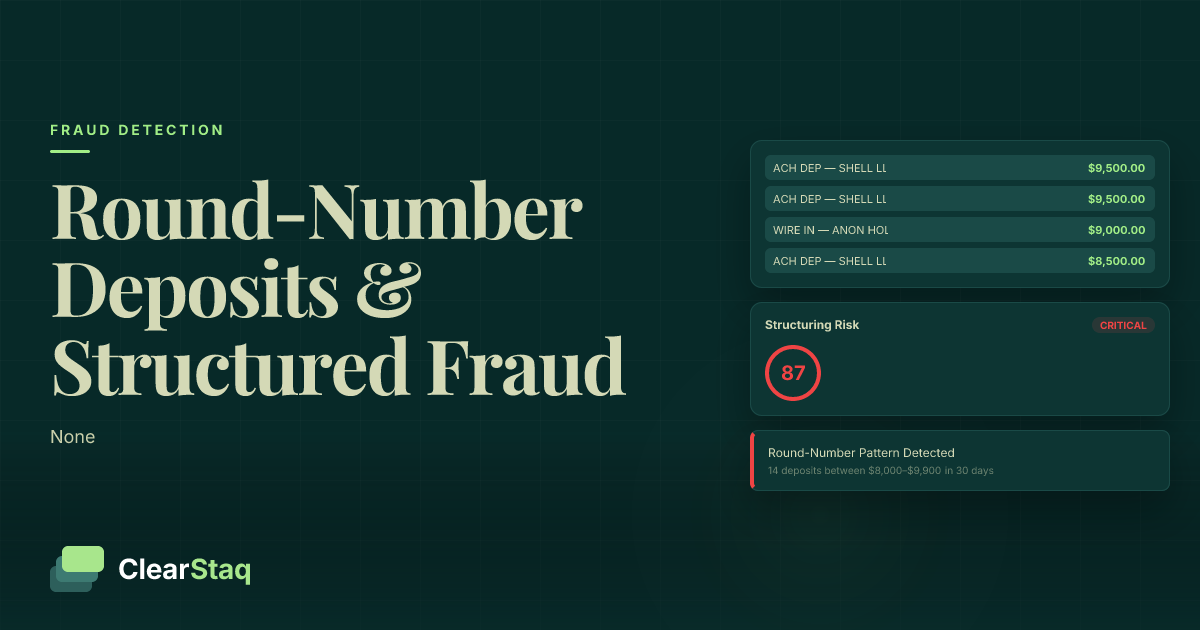
One suspicious metadata timestamp doesn't mean fraud — it might mean the applicant re-saved a PDF. Software scoring across a wide signal set (structuring patterns, doctored balances, inconsistent formatting, voided-check anomalies) gives you a defensible fraud score instead of a single trigger that generates constant false positives.
API-first integration into your existing checkout or LOS
POS lending decisions happen inside a point-of-sale system, a dealer DMS, or a loan origination platform — not in a separate portal your team has to tab over to. Fraud detection that plugs in via API keeps the decision inside the flow your finance team already uses.
Top picks by POS lending vertical
The all-in-one platform pick. ClearStaq runs bank statement and tax return parsing with 27+ AI fraud signals in a single pass, at under 5 seconds per document and a claimed 99.5% accuracy rate across 900+ supported formats. For a POS lender that needs one system covering identity, income, and document integrity checks without stitching together three vendors, this is the baseline. Buy.
The BNPL and checkout-financing pick. Buy-now-pay-later platforms see synthetic identity fraud at a scale traditional dealer financing doesn't — fraud rings test small approvals before scaling to bigger tickets. The synthetic identity fraud detection breakdown for BNPL platforms covers the specific signal combinations that separate a rushed real applicant from a fabricated one. Buy if checkout volume exceeds a few hundred applications a month.
The auto dealer POS pick. Dealership finance offices face a distinct pattern: doctored pay stubs and voided-check fraud tied to down payment verification. The document fraud detection guide for auto lenders walks through the checks that matter at the F&I desk specifically, including how format-aware parsing handles dealer-submitted scans. Buy for any dealership group processing in-house financing.
The rent-to-own pick. Rent-to-own underwriting runs on thinner applicant files and faster approval cycles than dealer or medical financing, which makes income smoothing and commingled funds harder to catch by eye. The rent-to-own fraud detection guide covers the income-pattern checks built for that borrower profile. Consider if your average ticket size is under $3,000 and manual review still pencils out; Buy above that threshold.
The medical and dental financing wildcard. Elective procedure financing sees a different fraud pattern again — applicants stretching income on statements to hit a ticket price rather than fabricating identity outright. This vertical needs the same signal breadth as auto or BNPL, but tuned toward income inflation detection rather than synthetic identity. Worth a dedicated look before you commit to a single vendor across all your POS verticals.
See the fraud signals in action
Check how 27+ signal detection runs on your document set.
What to avoid
- Document storage platforms marketed as fraud tools. Some loan management systems store and display uploaded documents but don't parse or score them — that's a filing cabinet, not fraud detection. If the product description leads with "centralize your documents" instead of "detect fraud signals," it's not built for POS speed.
- OCR-only tools with no fraud scoring layer. Text extraction without a fraud signal engine still requires a human to eyeball every statement for red flags. That defeats the point of automating a point-of-sale decision.
- Fraud tools calibrated for mortgage-length underwriting timelines. A parser built to run overnight batch jobs for a 30-day mortgage cycle won't perform the way a POS lender needs at checkout, even if its accuracy numbers look competitive on paper.
Verdict comparison
| Vertical | Dominant fraud risk | Signal focus | Verdict |
|---|---|---|---|
| BNPL / checkout financing | Synthetic identity | Identity coherence across documents | Buy |
| Auto dealer POS | Doctored pay stubs, voided checks | Income and check verification | Buy |
| Rent-to-own | Income smoothing, commingled funds | Deposit pattern analysis | Consider / Buy above $3k tickets |
| Medical / dental financing | Income inflation | Deposit consistency vs. stated income | Consider |
| General POS lending | Mixed | Broad signal coverage (27+) | Buy |
FAQ
What is document fraud detection software for point-of-sale lenders?
It's software that scores uploaded bank statements, pay stubs, and tax documents for signs of fabrication or synthetic identity during a checkout-speed lending decision. In 2026, the better tools run this in under 5 seconds per document rather than requiring manual review.
How fast does fraud detection need to run for point-of-sale lending?
Under 5 seconds per document is the practical bar for checkout-speed decisions. Anything slower forces lenders to either slow down the sale or skip the check, both of which increase fraud exposure or lost conversions.
Is synthetic identity fraud a bigger risk than doctored documents for POS lenders?
For BNPL and dealer-floor financing, yes — synthetic identities built from stolen SSNs are more common than altered PDFs because the ticket size justifies the setup effort. Medical and rent-to-own financing see more income-inflation-style document tampering instead.
Can OCR software alone catch loan document fraud?
No. OCR extracts text but doesn't score fraud signals like structuring patterns, doctored balances, or identity inconsistency. Point-of-sale lenders need a fraud-scoring layer on top of extraction, not extraction alone.
How many bank statement formats does fraud detection software need to support?
Software covering 900+ formats catches the credit unions, staffing agency pay stubs, and mobile banking screenshots that POS borrowers actually submit. Tools built around the top five national banks miss a meaningful share of real applicants.
What accuracy rate should point-of-sale lenders expect from parsing software?
Look for accuracy claims around 99.5% on statement parsing. Below that, false positives and false declines start eating into approval volume at checkout scale.
Does document fraud detection software work for thin-file or gig-income borrowers?
It should. Software tuned only for traditional W-2 payroll deposits will flag irregular gig or seasonal income as anomalous, which generates false declines common in rent-to-own and dental financing applicant pools.
How much does document fraud detection software cost for POS lenders?
Pricing varies by document volume and integration depth — check current terms directly with the vendor rather than relying on a flat industry number, since POS lending volume varies widely by vertical.
One last thing
The fraud pattern that catches most POS lenders off guard isn't a forged document — it's a real bank statement from a real person who's just stretching numbers to hit an approval threshold. Signal-based scoring catches income inflation the same way it catches outright fabrication, which is the actual argument for running every POS application through 27+ signals instead of a single red-flag check in 2026.
Related guides
ClearStaq Team
Content Team
The ClearStaq team builds AI-powered tools for bank statement parsing, fraud detection, and income verification.