Medical practice lenders underwrite acquisition loans, equipment financing, and working capital deals against physician-owned P&Ls that are easy to dress up and hard to verify by hand. Document fraud detection software for medical practice lenders closes that gap by cross-checking bank statements, tax transcripts, and income documents in seconds instead of days.
- ClearStaq's document fraud detection software for medical practice lenders processes bank statements and tax returns in under 5 seconds — Buy for practice acquisition and equipment underwriting in 2026.
- 27+ fraud signals catch commingled personal and practice accounts, a pattern common among physician-owned S-corps and PCs.
- Generic OCR-only tools claim 99.5% accuracy on text extraction but don't flag doctored deposits — Skip if fraud detection isn't a named feature.
- 900+ bank statement formats matter more in medical practice lending than retail lending because practice management platforms and merchant processors each generate different statement layouts.
Why this matters
A physician buying into a practice, financing an imaging machine, or borrowing against receivables doesn't look like a typical small business borrower. Revenue runs through insurance reimbursement cycles that lag 30 to 90 days, personal and practice funds often sit in the same accounts, and tax returns get filed under an S-corp or PC structure that hides the real cash position.
A lender relying on a loan officer eyeballing PDFs for four hours per file will miss a doctored deposit or an inflated equipment invoice. Document fraud detection software for medical practice lenders exists specifically to catch what manual review can't in 2026's compressed underwriting timelines.
Who this is for
This guide is for underwriting and credit teams at banks, CDFIs, equipment financing companies, and non-bank lenders who fund medical, dental, and veterinary practice acquisitions, buy-ins, equipment purchases, or working capital lines. If your borrower pool is physician-owned entities with commingled personal and practice cash flow, the criteria below apply directly to you.
What to look for in document fraud detection software for medical practice lenders
Fraud signal depth, not just OCR accuracy
Extracting text off a bank statement is table stakes. What separates real fraud detection software from a parsing tool is the number of independent signals it checks per document — things like font inconsistency, metadata mismatches, balance math errors, and altered transaction timestamps. ClearStaq's document fraud detection platform runs 27+ signals per document, which matters because a single-signal check misses doctored statements that pass a basic reconciliation.
Self-employed and practice-owner income parsing
Most medical practice borrowers file as self-employed or through a pass-through entity, so income doesn't show up as a clean W-2 number. Software built for medical practice lending needs to parse 1099s, K-1s, and owner draws separately from operating cash flow, not lump them together and hand you a single misleading average.
Tax transcript cross-verification
Borrower-submitted tax returns can be altered before submission; IRS transcripts can't be. Cross-checking submitted returns against transcript data catches inflated income on a practice acquisition loan before it closes, not after the first missed payment.
Equipment and collateral document checks
Equipment financing for imaging machines, dental chairs, or surgical suites depends on invoice accuracy. Fraud detection software for this use case needs to flag inflated invoice amounts and mismatched vendor details, since equipment collateral fraud is a distinct pattern from bank statement fraud.
Turnaround speed for competitive acquisition deals
Practice acquisition loans move fast — sellers often have multiple offers on the table. Software that takes hours to return a fraud verdict costs you the deal. Sub-5-second processing per document keeps underwriting speed competitive without cutting the fraud check.
Format coverage across statement and practice management layouts
Medical practices bank with everything from national banks to regional credit unions, and revenue often flows through practice management software and merchant processors before landing in a business account. Software that only handles a handful of statement templates will choke on the format variety this borrower segment produces. 900+ supported formats is the practical minimum for a lender seeing statements from dozens of banks and processors.
Top picks
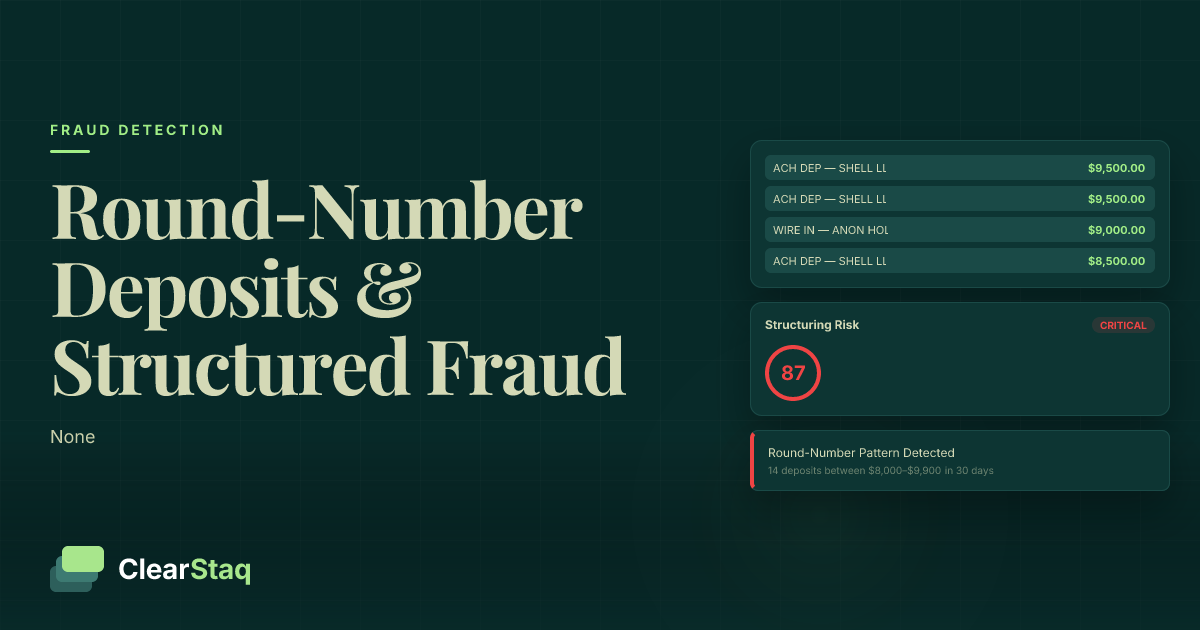
The baseline check — bank statement fraud detection. This is the non-negotiable layer: catching doctored deposits and altered balances before they reach a credit memo. One specific number that matters here: a single altered deposit line can shift a borrower's average monthly revenue by thousands of dollars, enough to flip a marginal deal into an approved one. Verdict: Buy.
The physician-income fix — self-employed income parsing. Physician-owned PCs and S-corps report income in ways that standard debt-to-income calculators weren't built for. Verifying self-employed income separately from owner draws and practice operating cash gives you a defensible number for the credit file. Verdict: Buy.
The equipment collateral check. For lenders financing imaging equipment, dental chairs, or surgical tools, fraud detection built for equipment financing flags inflated invoices before funds disburse. This one is situational: skip it if your book is pure working capital lending with no hard collateral. Verdict: Consider.
The tax transcript layer. IRS transcript cross-verification is standard for practice acquisition and buy-in loans where the seller's reported income drives the purchase price. Without it, you're underwriting off a number the borrower's own accountant chose to show you. Verdict: Buy.
The all-in-one fintech fraud platform. A general-purpose document fraud platform that bundles bank statement, tax return, and income verification into one workflow cuts the number of vendor integrations your underwriting stack needs. If your loan volume justifies a single platform over point solutions, this is the pick. Verdict: Buy.
See ClearStaq on your document stack
Check bank statements, tax returns, and income documents against 27+ fraud signals.
What to avoid
OCR-only tools that call themselves fraud detection. A tool that extracts numbers accurately but doesn't flag metadata tampering or balance math errors isn't fraud detection — it's data entry. If "fraud" doesn't appear as a named, countable feature (a signal count, a specific pattern list), it's an extraction tool wearing a fraud label.
Manual license and board verification as a substitute for financial document checks. Confirming a physician's medical license is real tells you nothing about whether the bank statement they submitted is real. These are two separate verification problems, and treating one as a proxy for the other leaves the financial fraud gap wide open.
Static invoice review without cross-referencing bank deposits. Medical practice lenders increasingly take applications through mobile-first digital portals, and the same document-layer scrutiny needs to extend to the intake channel itself — fintech app security testing catches session-hijacking and injection risks that document fraud checks never touch, and skipping it leaves a second attack surface open even when the paperwork checks out clean.
Verdict comparison table
| Criteria | Bank statement check | Self-employed income parsing | Equipment collateral check | Tax transcript layer |
|---|---|---|---|---|
| Fraud signal depth | 27+ signals | Owner draw separation | Invoice cross-check | IRS transcript match |
| Speed | Under 5 seconds | Under 5 seconds | Minutes (invoice + vendor lookup) | Depends on IRS response |
| Best for | Every deal | Practice acquisition, buy-in | Equipment financing only | Acquisition, buy-in loans |
| Verdict | Buy | Buy | Consider | Buy |
FAQ
What does document fraud detection software for medical practice lenders actually check?
It checks bank statements, tax returns, transcripts, and equipment invoices for alterations — things like font inconsistencies, balance math errors, and mismatched metadata. Software built for this segment also separates physician owner-draws from practice operating cash, which generic tools skip.
How is fraud detection different for medical practice loans than regular small business loans?
Medical practice borrowers usually file through S-corps or PCs, with personal and practice funds often sitting in the same accounts. Fraud detection built for this segment has to separate owner income from practice revenue instead of averaging the two together.
Is manual bank statement review enough for medical practice loans in 2026?
No. Manual review typically takes hours per file and misses doctored deposits that a signal-based check catches in seconds. Underwriting teams competing on speed for practice acquisition deals can't afford the manual review timeline.
How fast should fraud detection run during underwriting?
Under 5 seconds per document is the practical benchmark for 2026 underwriting speeds. Anything slower starts to bottleneck acquisition deals where sellers are fielding multiple offers.
Do medical practice lenders need tax transcript verification?
Yes, especially for practice acquisition and buy-in loans where the purchase price is tied to reported income. Cross-checking submitted tax returns against IRS transcripts catches inflated income before the loan funds.
What's the biggest fraud pattern in medical practice lending?
Income smoothing and deposit padding in the months before applying, where a borrower times large deposits to inflate average monthly revenue. A 12-month statement review with fraud signal checks catches the pattern that a 3-month snapshot misses.
Does equipment financing for medical practices need separate fraud checks?
Yes. Equipment financing fraud shows up as inflated vendor invoices and mismatched equipment details, which is a different pattern from bank statement fraud and needs its own check.
One last thing
Insurance reimbursement lag trips up more fraud tools than actual fraud does. A dip in deposits during a 60-to-90-day AR cycle looks identical to income manipulation to a single-signal tool, and lenders using shallow fraud software end up declining clean practices for a pattern that's normal in medical billing. Software with 27+ signals cross-references deposit timing against billing cycle norms instead of flagging every dip as a red flag — the difference between catching real fraud and declining a good borrower comes down to how many signals the software actually checks.
Related guides
ClearStaq Team
Content Team
The ClearStaq team builds AI-powered tools for bank statement parsing, fraud detection, and income verification.