Insurance claims teams need document fraud detection software that catches altered bank statements, doctored pay stubs, and fabricated identity documents before a claim pays out. Claims fraud isn't lending fraud with a different label — the documents overlap (bank statements, pay stubs, tax records) but the trigger is different: a loss event, not a credit decision, and the review window is often days, not weeks.
- ClearStaq flags fake bank statements and doctored pay stubs submitted with claims in under 5 seconds.
- Document fraud detection software for insurance claims teams works best layered onto SIU review, not replacing it.
- 27+ fraud signals catch synthetic identities and altered financial documents manual review misses.
- Deepfake ID checks matter most at first notice of loss, before a claim number even opens.
Why document fraud detection matters for insurance claims teams
Claims that hinge on income loss — business interruption, disability, loss-of-use riders — require financial proof: bank statements, pay stubs, sometimes tax transcripts. That's the exact document set fraud rings target because it's easier to fabricate a PDF than to fake a repaired roof.
Adjusters reviewing these documents by eye are checking font consistency and transaction math on their own time, between calls. That's not a scalable control in 2026, and it's the reason document fraud slips past experienced claims staff at volume.
ClearStaq built its parsing and fraud-detection engine for exactly this class of financial document — bank statements, tax returns, income proof — running 27+ fraud signals against each one. That's the layer claims teams are missing: not a full SIU replacement, but a first-pass filter on the paperwork that funds a payout.
Build the workflow: 7 steps for insurance claims teams
Audit which claims documents carry fraud risk
Not every claim type carries the same document-fraud exposure. Start by ranking claim categories by how much financial documentation they require and how often those documents get flagged downstream.
- Business interruption and loss-of-income claims (heaviest financial document load)
- Disability and workers' comp income-replacement claims
- Claims requiring proof of ownership tied to bank records
- High-dollar property claims with contractor invoice mismatches
- Claims from applicants with no prior policy history
Flag inconsistent or altered financial documents early
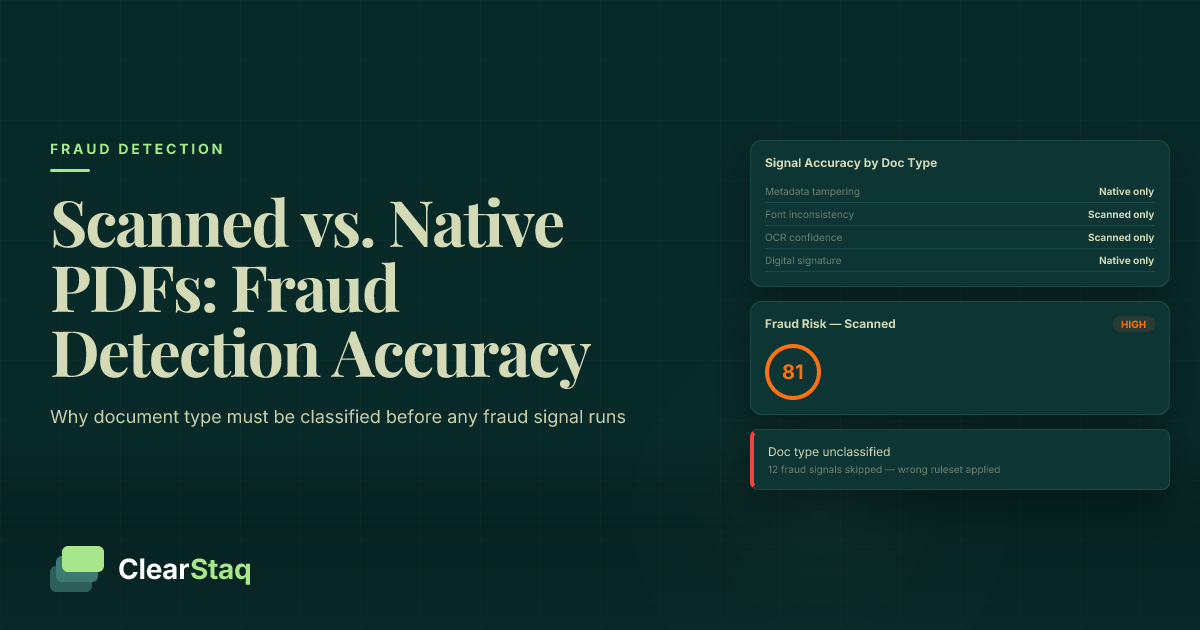
Before a claim reaches an adjuster's queue, run submitted PDFs through a consistency check. Altered documents usually fail on metadata, font kerning, or arithmetic that doesn't reconcile line to line.
- Check PDF metadata for edit timestamps that postdate the claim date
- Verify running balances add up transaction by transaction
- Compare formatting against known templates for that bank
- Flag statements missing standard footer disclosures
- Cross-reference account numbers against the policyholder's file
Verify identity at first notice of loss
Synthetic identities and deepfake ID submissions show up earliest at FNOL, when the claimant uploads a driver's license or passport photo through a mobile intake form. Catching this before a claim number opens saves the SIU team a reopened investigation later.
- Run liveness checks against submitted selfie-with-ID uploads
- Compare document fonts and security features against known state templates
- Check for face-swap or deepfake artifacts around eyes and hairline
- Match the name and DOB against the policy's original underwriting file
- Flag identity documents uploaded from a VPN or spoofed location
ClearStaq's fraud-detection layer scores bank statements and tax documents the moment they're uploaded — the same 27+ signal set used in loan underwriting applies directly to income-loss claim proof, since the document types are identical.
Cross-check bank statements and income documents against claims
A claimant reporting $8,000 in monthly lost wages needs a bank statement that supports it. This is where fabricated statements and doctored pay stubs show up most often, and where manual review burns the most adjuster hours.
- Parse deposit patterns against the claimed income figure
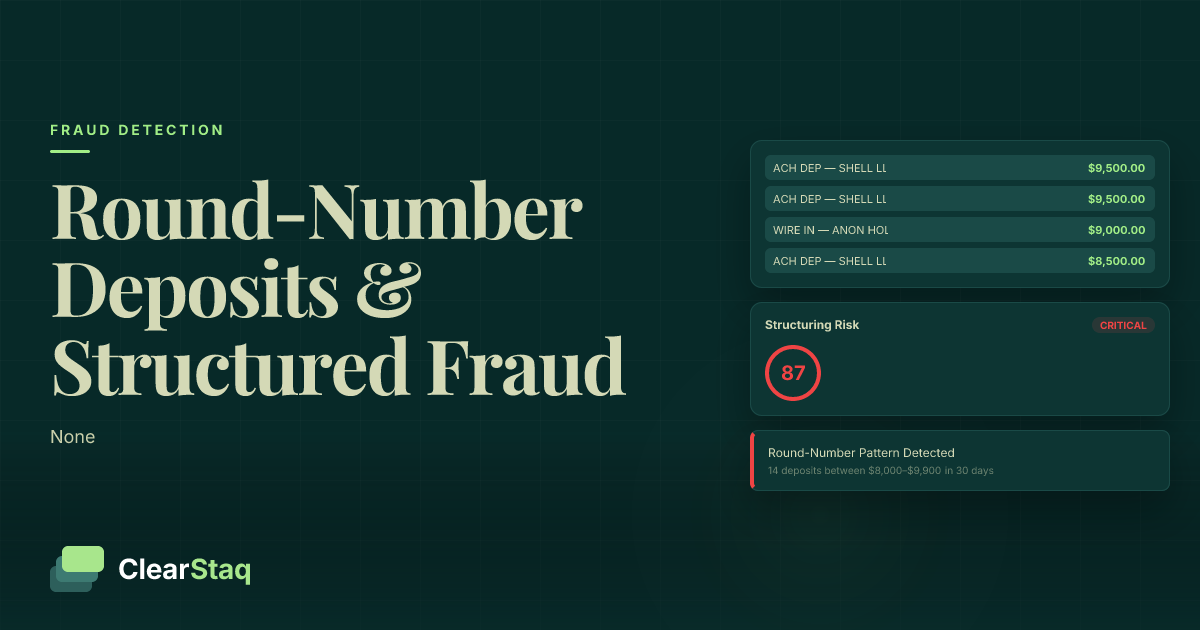
- Flag statements with rounded, suspiciously uniform deposit amounts
- Detect commingled personal and business funds in self-employed claims
- Check pay stub YTD math against per-period figures
- Compare bank name, routing number, and statement template against known formats
Manual cross-checking a single statement against a claimed loss figure takes an adjuster real time — reading line items, doing the math by hand, then flagging anything odd. ClearStaq's parser does the same reconciliation in under 5 seconds per document, which is the difference between a claims team clearing a backlog and one that's perpetually behind.
Score and route claims for SIU review
Not every flagged document needs a full Special Investigations Unit referral. Set a scoring threshold so SIU time goes to the claims with the highest fraud signal density, not every claim with a single formatting quirk.
- Set a minimum signal count before a claim routes to SIU
- Weight identity-document flags higher than minor formatting flags
- Track false-positive rate by claim type and adjust thresholds quarterly
- Give adjusters a one-line reason code, not a raw signal dump
- Log every routing decision for audit purposes
Automate the audit trail for regulators and litigation
State insurance regulators and plaintiff's attorneys both ask the same question after a denied claim: what evidence supported the fraud finding? A manual note in a claims system doesn't hold up as well as a timestamped, signal-by-signal record.
- Store the original document alongside the fraud signal output
- Timestamp every automated check for chain-of-custody purposes
- Export a signal report an SIU investigator can attach to a case file
- Retain records per your state's claims-handling retention requirement
- Version-control any rule changes to the scoring model
Train adjusters on red flags across document types
Software catches what a human eye misses at volume, but adjusters still need to recognize the patterns software flags — because they're the ones fielding the claimant's follow-up call.
- Teach adjusters the three most common bank statement alteration patterns
- Show real (redacted) examples of doctored pay stubs from closed cases
- Cover what a deepfake ID red flag actually looks like on screen
- Set a clear escalation path so adjusters know when to stop reviewing and refer
See the fraud signals in action
Run a sample claim document through ClearStaq's parsing engine.
Comparing your options for claims document fraud in 2026
| Option | Best for | Key limitation |
|---|---|---|
| Manual SIU review only | Low claim volume, high-touch investigations | Doesn't scale past a few hundred flagged claims a month |
| General claims analytics platforms | Pattern detection across claim history and adjuster behavior | Weak on document-level financial fraud (bank statements, pay stubs) |
| Standalone ID verification / liveness tools | Catching deepfake and synthetic ID submissions at FNOL | Doesn't touch financial documents submitted later in the claim |
| ClearStaq (financial document layer) | Verifying bank statements, tax returns, and income proof tied to a claim | Not built for property-damage evidence like repair photos or estimates |
Verdict: no single tool covers claims fraud end to end in 2026 — pair an identity-verification tool at intake with a financial-document layer like ClearStaq for income-related claims, and keep SIU for the cases both flag.
Common mistakes insurance claims teams make
- Treating all claims the same regardless of document load. A fender-bender claim and a business-interruption claim carry wildly different fraud exposure — scoring them identically wastes SIU capacity.
- Checking identity at FNOL but never re-verifying financial documents submitted weeks later. Fraud rings often pass the intake ID check, then submit fabricated income proof once the claim is already open.
- Relying on adjuster tenure instead of a documented red-flag list. Institutional knowledge walks out the door when an experienced adjuster leaves.
- No audit trail on why a claim was denied for suspected fraud. This is the fastest way to lose a bad-faith litigation case, regardless of whether the fraud finding was correct.
- Ignoring the format-drift problem. Banks update statement templates yearly; a rule set tuned to 2024 formats starts missing real documents by 2026 if it isn't format-aware.
FAQ
What is document fraud detection software for insurance claims teams?
It's software that scans documents submitted with a claim — bank statements, pay stubs, tax records, identity documents — for signs of alteration or fabrication. It scores each document against known fraud patterns and routes high-risk claims to a human investigator.
How is claims document fraud different from lending fraud?
The document types overlap heavily, but claims fraud is triggered by a loss event rather than a credit application, and the review window is usually days rather than weeks. Financial-document fraud signals built for lending apply directly to income-loss claims.
Can AI detect doctored pay stubs in insurance claims?
Yes. Parsing software checks YTD totals against per-period figures, flags formatting inconsistent with the stated employer's template, and catches rounded or repeated numbers that don't match real payroll math.
Is deepfake ID detection necessary for insurance claims teams?
It matters most at first notice of loss, when a claimant uploads identity documents through a mobile app. Catching a synthetic or deepfake ID before a claim number opens prevents a costly reopened investigation later.
What's the best document fraud detection software for insurance claims teams in 2026?
No single platform covers every document type. ClearStaq handles the financial-document side — bank statements, tax returns, income proof — with 27+ fraud signals and under 5 seconds of processing per document; pair it with a dedicated ID-verification tool for intake.
How long does automated document verification take on a claim?
A parsing engine like ClearStaq's returns fraud signals on a bank statement or tax document in under 5 seconds, compared to the manual line-by-line review an adjuster would otherwise do by hand.
Do claims teams still need SIU investigators with fraud detection software?
Yes. Software filters volume and surfaces the claims worth investigating; it doesn't replace the judgment call an SIU investigator makes on an ambiguous file.
Does document fraud detection reduce claims payout time?
For claims without fraud signals, yes — automated verification clears clean documents faster than manual review, which speeds up the majority of claims that aren't fraudulent.
One last thing
The fraud rings targeting income-loss claims in 2026 reuse the same fabricated bank statement templates across multiple carriers — a statement flagged by one claims team's parser often matches a pattern another carrier already caught. That's the strongest argument for a format-aware, signal-based parser over a static rules list: the rules list stops working the moment the template changes, the signal model doesn't.
Related guides
ClearStaq Team
Content Team
The ClearStaq team builds AI-powered tools for bank statement parsing, fraud detection, and income verification.