Litigation funders underwrite against a pending settlement, not a paycheck — but the plaintiff's bank statements still expose fraud, funder stacking, and cash flow gaps that can sink a deal after the advance is wired. This guide covers what to look for in bank statement analysis software for litigation funding companies in 2026, and which approach actually protects your capital before the case settles.
- Purpose-built bank statement analysis software for litigation funding companies catches doctored statements and stacked funders before disbursement — buy it.
- Manual review still runs 4-8 hours per file in 2026, too slow for intake deadlines under settlement pressure.
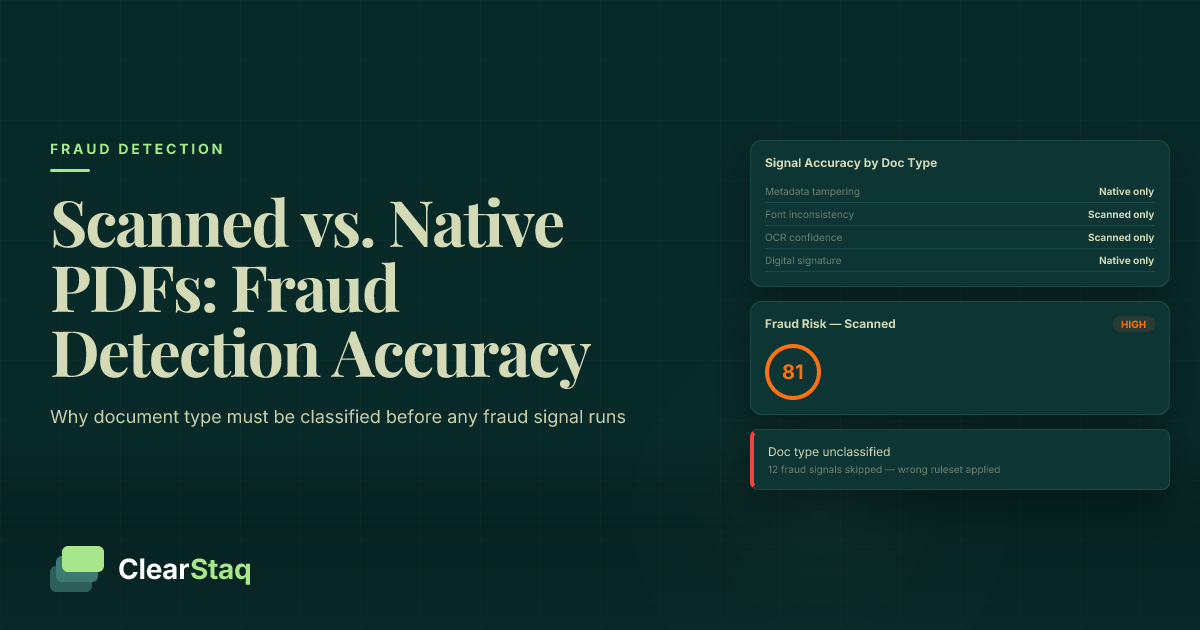
- 27+ fraud signals and sub-5-second processing beat generic OCR tools that only flag NSF fees.
- Skip free PDF parsers with no fraud detection layer — they miss structuring and commingled funds entirely.
Why this matters
Litigation funding runs on speed and trust in equal measure. A plaintiff waiting on a settlement needs cash in days, and the funder needs to know the bank statements handed over are real, unaltered, and not already pledged to a second or third funder.
Manual review of plaintiff and case-related bank statements still eats 4 to 8 hours per file at many shops in 2026, and that's before anyone catches a structuring pattern or a doctored PDF. A parsing layer that reads every format a plaintiff's bank might spit out, in under 5 seconds, changes the intake math entirely — the ClearStaq platform builds that layer specifically around fraud detection, not just data extraction.
The stakes are different from consumer lending. You're not scoring income — you're verifying hardship, spotting funder stacking, and defending your underwriting file if a dispute goes to a judge. Software that can't produce an audit trail is a liability, not a convenience.
Who this is for
This guide is for underwriting managers and ops leads at pre-settlement legal funding companies, commercial litigation finance shops reviewing plaintiff or law firm financials, and brokers who source deals for multiple funders and need a defensible review process before a case ever reaches a funding committee.
What to look for in bank statement analysis software for litigation funding companies
Format coverage across every bank a plaintiff uses
Plaintiffs don't bank with three national chains — they bank with whatever credit union or regional bank was nearby when they opened the account. Software that only parses Chase, Bank of America, and Wells Fargo cleanly will choke on the other half of your intake pile. Coverage across 900+ statement formats in 2026 means fewer manual exceptions and fewer files stuck in a review queue.
Fraud signal depth, not just NSF flags
A tool that only counts overdrafts is a spreadsheet with extra steps. Litigation funding fraud shows up as doctored balances, edited transaction dates, and statements stitched together in a PDF editor. Software built around 27+ distinct fraud signals catches what a single NSF check never will.
Structuring and funder-stacking detection
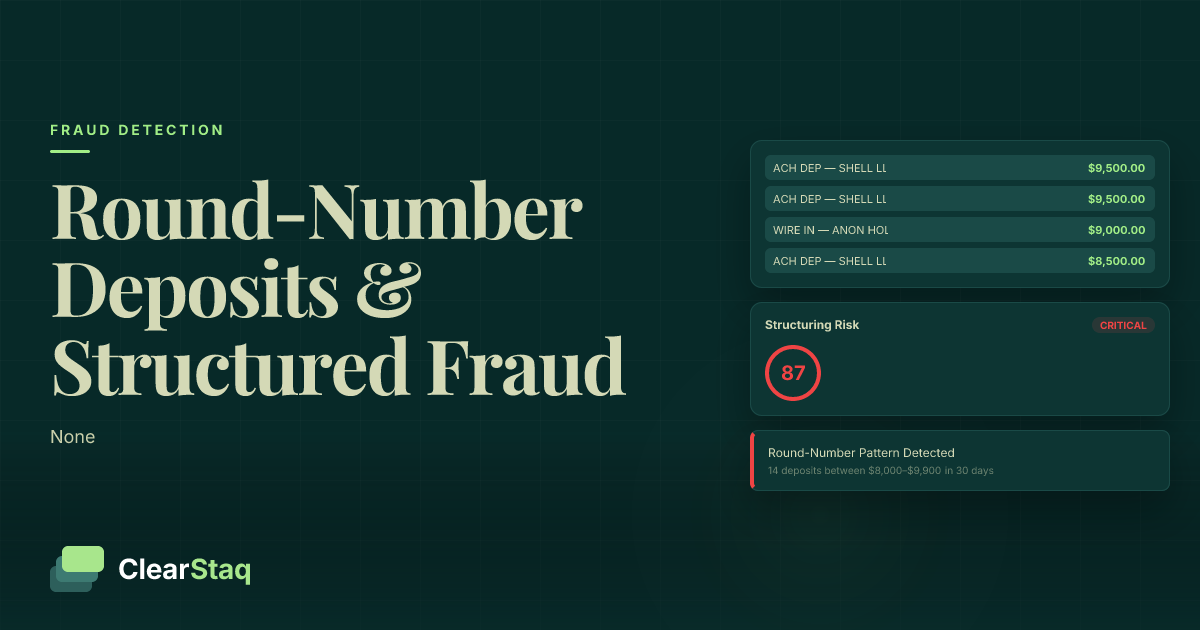
Multiple pre-settlement advances against the same case is one of the biggest loss drivers in legal funding. Deposits structured to stay under reporting thresholds, or recurring transfers that look like a second funder's disbursement, need automated pattern detection — a human skimming twelve months of statements will miss the rhythm. Software that spots structuring patterns flags this before the funding committee ever sees the file.
Processing speed against intake deadlines
A plaintiff facing eviction or a medical bill doesn't wait a week for underwriting. Sub-5-second parsing per statement means a 12-month history clears review in minutes instead of days, which matters when a competing funder is quoting the same case.
Audit trail for compliance and dispute defense
Litigation funding sits in a lighter regulatory lane than consumer lending in most states, but disputes over funding terms still land in court. A parsed, timestamped record of every flagged transaction is what your legal team pulls when a plaintiff's attorney challenges the funding agreement.
Integration with your case management workflow
Standalone parsing tools that require manual upload and download add friction back into the process they're supposed to remove. An API that feeds directly into your case management or loan origination system keeps the entire intake-to-funding pipeline in one place.
Top approaches — ranked
Generic OCR and template scrapers — the outdated pick. These tools handle a handful of major bank layouts and fall over on credit unions, faxed statements, and anything scanned at an angle. Accuracy on non-standard formats runs well below what a 2026 funding decision should rely on. Skip.
Manual underwriter review — the safe but slow pick. A trained underwriter reading statements line by line still catches things software misses on edge cases, and some shops keep a human in the loop for every file regardless of volume. At 4 to 8 hours per file, it doesn't scale past a handful of deals a week. Consider only if your intake volume stays under 10-15 cases a month.
Purpose-built fraud detection platform — the audit-ready pick. A tool built specifically for lending and funding fraud, running 27+ signals per statement at sub-5-second speed with 99.5% accuracy, is the closest thing to a defensible underwriting standard in 2026. The fraud detection software for litigation funding companies approach pairs parsing with the specific patterns legal funders see — stacking, structuring, and doctored statements. Buy.
API-embedded parsing inside your origination stack — the scale pick. For funders processing more than a few dozen cases a month, wiring parsing directly into the intake workflow via a bank statement parsing API built for origination systems removes the manual upload step entirely and keeps every flagged file inside your existing case record. Buy for funders scaling past manual review capacity.
See fraud detection built for legal funders
27+ signals, sub-5-second parsing, built for litigation funding intake.
What to avoid
- Tools that flag only overdrafts or NSF fees. They miss structuring, commingled funds, and doctored balances entirely — the exact patterns that cause litigation funding losses.
- "AI-powered" tools with no published accuracy or signal count. If a vendor won't state a specific accuracy percentage or fraud signal count for 2026, there's no way to benchmark the tool against a manual review baseline.
- Free PDF readers with no fraud layer. They extract text fine but have zero fraud detection logic, which means every flag still depends on a human catching it manually.
Verdict comparison
| Approach | Format coverage | Fraud signal depth | Speed | Verdict |
|---|---|---|---|---|
| Generic OCR scraper | Low — major banks only | Minimal (NSF only) | Fast but error-prone | Skip |
| Manual underwriter review | N/A (human judgment) | High but inconsistent | 4-8 hrs/file | Consider (low volume) |
| Purpose-built fraud platform | 900+ formats | 27+ signals | <5s/statement | Buy |
| API-embedded parsing | 900+ formats | 27+ signals | <5s/statement | Buy (at scale) |
FAQ
What is bank statement analysis software for litigation funding companies?
It's software that parses plaintiff or business bank statements to verify cash flow, detect fraud signals, and flag stacked funding before a legal funding advance is disbursed. In 2026, the strongest tools combine parsing accuracy above 99% with dedicated fraud detection layers rather than basic OCR.
How is litigation funding underwriting different from consumer loan underwriting?
Litigation funding is typically non-recourse and repaid from a settlement, not income, so underwriting focuses on hardship verification, funder stacking, and document authenticity rather than debt-to-income ratios. Bank statement fraud detection still applies directly to that review.
Can bank statement software detect if a plaintiff has multiple funding advances?
Purpose-built fraud detection platforms flag structuring and recurring deposit patterns consistent with stacked funder disbursements. Generic OCR tools that only extract transaction data won't surface this pattern without manual cross-referencing.
How much does bank statement analysis software cost for a legal funding company?
Pricing varies by processing volume and the number of fraud signals included, so check current terms directly with a vendor rather than assuming a flat rate. Volume-based pricing is standard across the category in 2026.
How fast can bank statement parsing software process a 12-month statement history?
Sub-5-second-per-statement processing is standard for purpose-built platforms in 2026, meaning a full 12-month history clears in well under a minute. Manual review of the same file typically takes 4 to 8 hours.
Does bank statement analysis software integrate with case management systems?
API-based parsing tools connect directly into loan origination and case management workflows, feeding flagged results into the existing case file automatically. Standalone upload-and-download tools require manual re-entry, which slows intake.
What fraud patterns matter most for litigation funding underwriting?
Structuring, commingled funds, doctored statement edits, and funder-stacking deposits are the highest-risk patterns specific to legal funding. A platform running 27+ fraud signals catches these beyond what a single NSF flag reveals.
One last thing
The gap between manual review and automated parsing isn't a convenience number — it's a risk number. A file that takes 4 to 8 hours by hand and clears in under 5 seconds per statement with software isn't just faster, it's the difference between catching a stacked funder before the wire goes out or finding out after. In 2026, that gap is the entire argument for switching off manual review.
Related guides
ClearStaq Team
Content Team
The ClearStaq team builds AI-powered tools for bank statement parsing, fraud detection, and income verification.