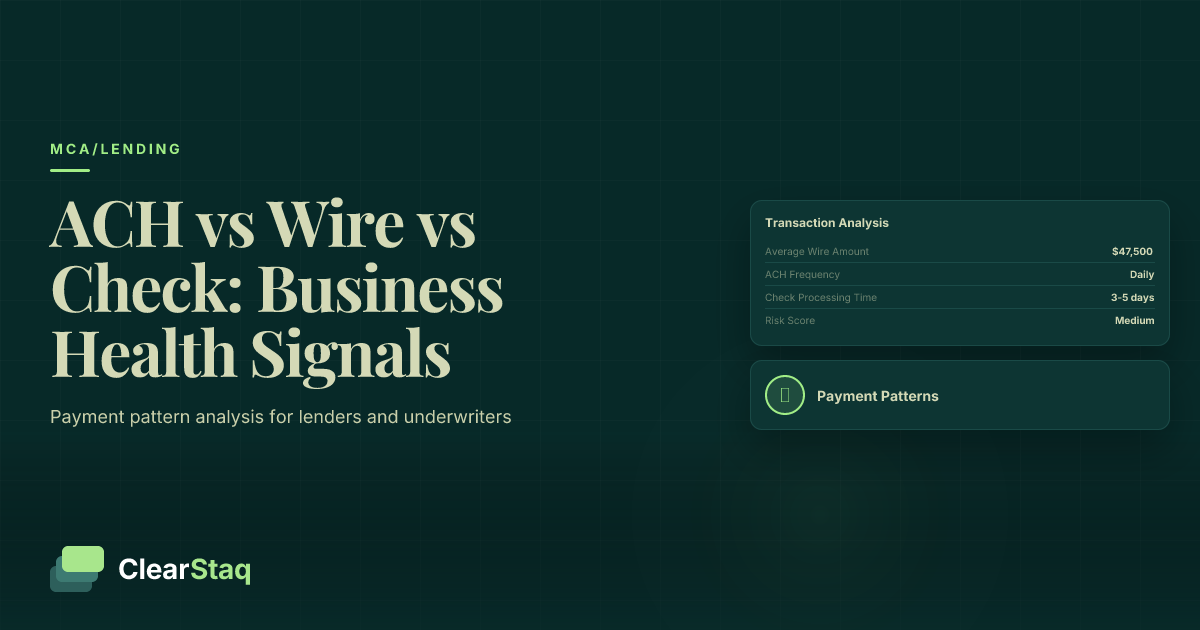
Business transaction types reveal critical health indicators: ACH payments signal established operations and automated processes, wire transfers indicate high-value transactions or cash flow urgency, while excessive check usage suggests operational inefficiencies. Payment method patterns help lenders assess business sophistication, cash flow stability, and potential fraud risk during underwriting.
What you'll learn
- ACH usage indicates operational maturity with 60-80% being optimal for established businesses
- Excessive wire transfers may signal cash flow urgency or operational inefficiencies
- Check usage above 30% can indicate technology adoption lag or industry-specific requirements
- Sudden payment method changes often precede cash flow problems or financial distress
- Automated transaction analysis achieves 99% accuracy in categorizing payment patterns
Business transaction types reveal critical health indicators: ACH payments signal established operations and automated processes, wire transfers indicate high-value transactions or cash flow urgency, while excessive check usage suggests operational inefficiencies. Payment method patterns help lenders assess business sophistication, cash flow stability, and potential fraud risk during underwriting.
Understanding Business Transaction Types
Every business payment tells a story. The way companies move money—whether through ACH transfers, wire transfers, or checks—reveals critical insights about their operational health, cash flow stability, and business sophistication. For lenders and financial analysts, understanding these payment patterns is essential for accurate risk assessment.
Payment method preferences aren't random choices. They reflect a business's operational maturity, vendor relationships, cash flow patterns, and financial constraints. A construction company that still writes checks for every supplier payment operates differently than a SaaS business that automates everything through ACH. These differences matter when assessing creditworthiness and business stability.
The Three Main Payment Methods
**ACH (Automated Clearing House) transfers** process electronically through a network that handles billions of transactions annually. ACH payments are cost-effective, automated, and ideal for recurring transactions like payroll, vendor payments, and customer collections. They typically process within 1-3 business days and cost pennies compared to other methods.
**Wire transfers** move money immediately between banks using the Federal Reserve's Fedwire system or international networks like SWIFT. They're expensive—often $15-50 per transaction—but provide same-day settlement and are irreversible once sent. Businesses use wires for urgent payments, large transactions, or international transfers.
**Checks** represent the traditional paper-based payment system. Despite digital alternatives, checks remain common in certain industries and for specific vendor relationships. They offer payment float but require manual processing and carry higher risk of bouncing due to insufficient funds.
Payment Methods as Business Health Indicators
Smart lenders analyze payment method distribution to gauge business operations. A healthy mix typically shows high ACH usage for regular operations, strategic wire usage for large or urgent transactions, and minimal check dependency. Deviations from these patterns can signal operational issues, cash flow problems, or business model constraints.
Industry patterns also matter. Construction businesses legitimately use more checks due to subcontractor preferences, while technology companies should show high ACH automation. Understanding these baselines helps identify when payment patterns indicate problems versus normal industry practices.
ACH Transactions: What They Reveal About Business Operations
ACH transaction analysis provides the deepest insights into business health. High ACH volume typically indicates operational maturity, established vendor relationships, and automated financial processes. These businesses have invested in systems that streamline payments and reduce manual intervention.
ACH Volume and Business Stability
Businesses with substantial ACH activity demonstrate several positive indicators. They've automated payroll, suggesting stable employment and predictable personnel costs. They've established electronic relationships with vendors, indicating mature procurement processes and reliable supplier networks.
Regular ACH patterns also reveal cash flow predictability. Businesses that can schedule automated payments weeks in advance show confidence in their cash position. This forward-planning capability suggests stable revenue streams and effective cash management.
The automation represented by ACH usage extends beyond simple cost savings. It demonstrates technological adoption, operational efficiency, and management sophistication—all positive indicators for lenders evaluating business risk.
ACH Timing and Cash Flow Health
ACH timing patterns reveal critical cash flow insights. Businesses with healthy cash flows maintain consistent payment schedules, processing payroll and vendor payments on predictable dates. Irregular timing or last-minute ACH processing can indicate cash flow management issues.
Failed ACH transactions deserve special attention in cash flow analysis. While occasional failures happen due to timing mismatches, frequent ACH returns suggest insufficient funds or poor cash flow forecasting. These patterns often precede more serious financial difficulties.
Seasonal patterns in ACH timing can also provide insights. Retail businesses might show seasonal payment timing shifts, while service businesses should maintain more consistent patterns. Understanding these variations helps distinguish normal business cycles from cash flow problems.
Types of ACH Transactions and Their Meanings
Payroll ACH transactions indicate employee count and compensation stability. Regular, predictable payroll suggests stable employment levels and consistent labor costs. Changes in payroll patterns—frequency, amounts, or timing—can signal business growth, contraction, or operational changes.
Vendor payment ACH patterns reveal supplier relationship quality. Businesses that pay vendors consistently through ACH have established electronic payment relationships, suggesting mature vendor management and reliable payment histories. These relationships often indicate better payment terms and supplier stability.
Customer collection ACH transactions suggest recurring revenue models. Subscription businesses, service providers, and other companies with predictable revenue streams often collect payments via ACH. High customer ACH volume can indicate stable, recurring revenue—a positive factor for lenders.
Wire Transfers: Indicators of Business Sophistication and Risk
Wire transfers present a more complex analysis challenge. While they're necessary for certain business operations, unusual wire patterns can signal cash flow urgency, operational inefficiency, or elevated risk factors that require deeper investigation.
When Wire Frequency Signals Problems
Excessive wire transfer usage often indicates cash flow urgency. Businesses that frequently wire funds to vendors or suppliers may be responding to urgent payment demands—a sign that normal payment timing has broken down. This urgency can suggest strained vendor relationships or cash flow timing problems.
The high cost of wire transfers makes frequent usage financially inefficient. Businesses paying $25-50 per wire when ACH would cost under $1 demonstrate either poor cash management or constrained payment options. This inefficiency can indicate operational immaturity or financial stress.
Frequency analysis should consider business type and transaction patterns. Construction companies might legitimately wire earnest money or time-sensitive supplier payments, while software businesses rarely need wire urgency for normal operations.
Wire Amounts and Business Scale
Large wire transfers can indicate business sophistication and scale. Real estate transactions, equipment purchases, or major contract payments legitimately require wire transfers due to amount and timing requirements. These transactions suggest significant business activity and capital deployment.
However, wire amounts should align with business scale and revenue. Small businesses frequently wiring large amounts might indicate pass-through transactions, factoring arrangements, or other complex financial structures that require investigation.
Multiple daily wires of varying amounts can suggest urgency-driven decision making rather than planned cash management. This pattern often indicates reactive rather than proactive financial management—a concerning indicator for lenders.
International Wires and Business Complexity
International wire transfers indicate global business operations but also introduce complexity and risk. Businesses with international suppliers, customers, or operations legitimately use international wires, but these transactions require additional scrutiny.
Currency considerations in international wires can indicate sophisticated treasury management or exchange rate exposure. Regular international wires to the same destinations suggest established global relationships, while sporadic international transfers might indicate expanding operations or unusual business activities.
Compliance implications of international wires require careful analysis. Businesses engaged in international transactions must navigate anti-money laundering regulations, export controls, and other regulatory requirements—factors that can affect operational complexity and risk profiles.
Check Payments: Traditional Methods in Modern Analysis
Check usage in business payments provides unique insights into operational efficiency and vendor relationships. While checks remain legitimate for certain transactions, excessive check usage can indicate operational inefficiencies or cash flow management issues.
When Check Usage Indicates Problems
High check volume in modern business operations often signals resistance to technological adoption or inability to establish electronic payment relationships. This resistance can indicate operational immaturity, limited resources for system improvements, or management that hasn't prioritized efficiency.
Check usage patterns also reveal cash flow management approaches. Businesses that rely heavily on check float—the time between writing and clearing—may be managing tight cash flows by maximizing payment timing. This strategy can indicate cash flow constraints or poor working capital management.
The manual nature of check processing creates operational inefficiencies that scale poorly. Growing businesses that maintain high check usage may struggle with scalability and operational leverage—factors that affect growth potential and operational risk.
Check Bounce Patterns and Risk Assessment
Check bounce patterns provide direct cash flow health indicators. Frequent returned checks due to non-sufficient funds (NSF) clearly indicate cash flow volatility and poor cash management. These patterns often precede more serious financial difficulties.
The analysis of NSF fees and overdrafts should include check bounce frequency and timing. Businesses that bounce checks at month-end might have cash flow timing issues, while random bounces throughout the month suggest more fundamental cash flow instability.
Banking relationship quality also appears through check handling patterns. Businesses with frequent check holds, extended clearing times, or restricted check privileges may have strained banking relationships due to past payment issues.
Industry-Specific Check Usage
Construction and trade businesses maintain higher check usage due to industry practices and vendor preferences. Subcontractors, material suppliers, and equipment rental companies often prefer checks, making this payment method necessary rather than inefficient.
Small vendor payments sometimes require checks when electronic payment minimums make ACH impractical. Businesses with many small, irregular vendor payments might legitimately use checks for amounts under $100 where ACH fees exceed practical limits.
Regulatory requirements in certain industries mandate specific payment documentation or approval processes that favor check usage. Government contractors, healthcare providers, and financial services companies might have compliance reasons for maintaining check-based payment processes.
Transaction Pattern Analysis for Lenders
Effective transaction pattern analysis requires understanding payment method ratios, seasonal variations, and how these patterns integrate into broader credit decisions. Lenders need systematic approaches to interpret payment data for underwriting purposes.
See Transaction Analysis in Action
Discover how automated transaction pattern analysis improves underwriting accuracy. Book a demo to see ClearStaq's business health scoring in real-time.
Analyzing Payment Method Ratios
Healthy payment method distributions typically show ACH comprising 60-80% of transaction volume for established businesses. Wire transfers should represent less than 10% of transactions unless business model justifies higher usage. Check usage above 30% of transactions may indicate operational inefficiencies or industry-specific requirements.
Industry-specific benchmarks help interpret these ratios. Technology and professional services businesses should show higher ACH percentages, while construction and retail might maintain higher check usage. Understanding these baselines prevents misinterpretation of normal industry patterns.
Evolution patterns over time provide additional insights. Businesses moving toward higher ACH usage demonstrate operational maturation and improved efficiency. Conversely, increasing check or wire dependency might indicate operational degradation or cash flow pressures.
This business demonstrates strong financial health with consistent cash flow and minimal overdraft activity. Recommended for approval with standard terms.
Seasonal and Cyclical Patterns
Business cycle impacts on payment methods reveal cash flow patterns and operational constraints. Retail businesses might show seasonal wire transfer increases for inventory purchases, while service businesses should maintain more consistent payment patterns throughout the year.
Economic indicator correlations help distinguish business-specific issues from broader market conditions. During economic stress, businesses might increase wire transfer usage for urgent vendor payments or show more irregular ACH timing due to cash flow constraints.
Seasonal payment timing changes can indicate cash flow seasonality or operational adaptations. Businesses that shift payment methods seasonally might have legitimate business reasons or cash flow management challenges that require investigation.
Using Patterns for Underwriting Decisions
Risk scoring integration should weight transaction pattern analysis alongside other financial indicators. Payment method efficiency, consistency, and evolution patterns contribute to overall business health scores that inform credit decisions.
Credit limit determinations can incorporate payment pattern insights. Businesses with efficient, automated payment processes might qualify for higher limits, while those showing payment inefficiencies or cash flow irregularities might require lower limits or additional monitoring.
The comprehensive underwriting checklist should include specific transaction pattern analysis requirements to ensure consistent evaluation across borrowers and decision-makers.
Red Flags in Payment Method Usage
Certain transaction patterns indicate elevated risk that requires immediate attention. These red flags help lenders identify potential problems before they impact repayment ability or business viability.
Sudden Pattern Changes
Dramatic shifts in payment method preferences often signal operational changes or financial stress. A business that suddenly increases wire transfer usage might be responding to vendor payment pressures or cash flow urgency that wasn't previously present.
Volume changes across payment methods can indicate business scaling issues or operational problems. Rapid increases in any payment type without corresponding revenue growth might suggest operational inefficiencies or changing business dynamics.
Timing disruptions in previously regular payment patterns often precede cash flow problems. Businesses that historically maintained consistent ACH schedules but begin showing irregular timing might be experiencing cash flow constraints or operational disruptions.
Fraud Indicators in Transaction Types
Suspicious wire transfer patterns include multiple daily wires to unusual destinations, round-dollar amounts that don't align with typical business operations, or international transfers inconsistent with business model. These patterns might indicate fraudulent activity or money laundering attempts.
The analysis of 27 fraud detection signals includes transaction pattern inconsistencies that suggest document manipulation or fabricated business activity. Unusual transaction type distributions can indicate manufactured bank statements.
Manufactured transaction patterns often show unrealistic consistency or patterns that don't align with typical business operations. Real businesses show natural variability in payment timing and methods, while fraudulent statements might display artificial regularity.
Cash Flow Distress Signals
Payment method degradation occurs when businesses shift from efficient ACH usage to expensive wire transfers or unreliable check payments. This degradation often indicates deteriorating vendor relationships or cash flow management capabilities.
Increasing wire transfer urgency appears as more frequent, smaller-amount wires that suggest reactive payment management. Businesses in financial distress often abandon planned payment schedules for urgent, individual wire transfers.
Rising payment failure rates across all transaction types indicate fundamental cash flow instability. When businesses show increasing ACH returns, bounced checks, and wire transfer complications, serious financial difficulties often follow.
How ClearStaq Analyzes Transaction Types
ClearStaq's automated transaction analysis provides comprehensive insights into business health through advanced pattern recognition and machine learning algorithms that process payment data in real-time for underwriting decisions.
Automated Transaction Classification
Machine learning algorithms automatically categorize transactions across ACH, wire, and check payment methods with over 99% accuracy. This classification includes identifying transaction purposes, amounts, timing patterns, and relationships to business operations.
Pattern recognition technology identifies subtle indicators that human analysis might miss. The system analyzes transaction frequency, timing consistency, amount distributions, and payment method evolution to assess business health comprehensively.
Real-time processing capabilities enable instant analysis during application review. Lenders can access transaction pattern insights immediately upon document upload, accelerating underwriting without sacrificing analysis quality.
Business Health Scoring
Payment pattern scoring integrates transaction type analysis with broader financial health indicators. The system weights ACH automation, payment consistency, and method efficiency alongside cash flow patterns and revenue stability.
Risk indicator weighting adapts to industry characteristics and business models. Construction businesses receive different payment pattern evaluations than technology companies, ensuring accurate risk assessment across diverse business types.
Industry benchmark comparisons provide context for payment pattern evaluation. ClearStaq's database enables comparison against industry peers to identify when payment patterns indicate problems versus normal sector characteristics.
Integration with Underwriting Workflows
API-based analysis seamlessly integrates transaction pattern insights into existing underwriting systems. Lenders can access comprehensive payment analysis without changing their current workflows or requiring additional manual processes.
Dashboard reporting provides visual summaries of transaction patterns alongside specific risk indicators and recommendations. This presentation enables quick decision-making while maintaining access to detailed analysis when needed.
Alert systems identify critical patterns that require immediate attention. When transaction analysis reveals significant risk factors or unusual patterns, the system flags these issues for manual review and investigation.
The integration with true revenue analysis ensures transaction patterns align with reported revenue sources and business operations, providing comprehensive verification of business financial health.
ClearStaq's comprehensive MCA lending solutions incorporate transaction pattern analysis as a core component of risk assessment, helping brokers and lenders make more informed underwriting decisions.
Frequently Asked Questions
What do ACH transactions tell you about a business?
ACH transactions indicate operational maturity, automated processes, and stable vendor relationships. High ACH volume typically signals an established business with recurring revenue models and efficient payment systems.
How can transaction types indicate business health?
Payment method patterns reveal cash flow stability, operational efficiency, and business sophistication. A healthy mix favors ACH for regular operations, strategic wire use for large transactions, and minimal check dependency.
What does frequent wire transfer usage suggest about a business?
Excessive wire transfers may indicate cash flow urgency, lack of payment automation, or high-cost transaction preferences. While occasional wires are normal, frequent usage can signal operational inefficiency or financial stress.
What are red flags in business transaction patterns?
Warning signs include sudden payment method shifts, unusual wire spikes, excessive failed payments, inconsistent transaction types for the business model, and patterns suggesting manufactured or fraudulent activity.
Transform Your Underwriting with Automated Analysis
Stop manually reviewing transaction patterns. ClearStaq's AI analyzes payment methods instantly, revealing business health insights that improve credit decisions. See how automated transaction analysis transforms underwriting accuracy.
Frequently Asked Questions
What do ACH transactions tell you about a business?
ACH transactions indicate operational maturity, automated processes, and stable vendor relationships. High ACH volume typically signals an established business with recurring revenue models and efficient payment systems.
How can transaction types indicate business health?
Payment method patterns reveal cash flow stability, operational efficiency, and business sophistication. A healthy mix favors ACH for regular operations, strategic wire use for large transactions, and minimal check dependency.
What does frequent wire transfer usage suggest about a business?
Excessive wire transfers may indicate cash flow urgency, lack of payment automation, or high-cost transaction preferences. While occasional wires are normal, frequent usage can signal operational inefficiency or financial stress.
What are red flags in business transaction patterns?
Warning signs include sudden payment method shifts, unusual wire spikes, excessive failed payments, inconsistent transaction types for the business model, and patterns suggesting manufactured or fraudulent activity.
ClearStaq Team
Product Team
The ClearStaq team builds AI-powered tools for bank statement parsing, fraud detection, and income verification.