Banks lose wire fraud money in minutes, not days — once a fraudulent wire clears, recovery rates drop fast, which is why wire fraud detection software for banks has moved from a nice-to-have to a line-item budget request in 2026.
- Wire fraud detection software for banks works best when it combines document authenticity checks with real-time transaction pattern analysis — buy both, not one.
- ClearStaq processes bank statements and tax returns in under 5 seconds with 27+ fraud signals — Buy for document-side fraud.
- Signature-matching tools alone catch under half of modern wire fraud attempts and should be treated as a Skip when used standalone.
- AML transaction monitoring tools are a Buy for compliance coverage but do not replace document verification at origination.
Why this matters
Wire fraud against banks in 2026 rarely looks like a forged signature anymore. It looks like a doctored bank statement supporting a fraudulent loan draw, a business email compromise redirecting a legitimate payment, or a synthetic identity that passed KYC six months ago and is now requesting a same-day wire. Software built for 2015-era check fraud misses all three.
The banks getting burned in 2026 are the ones running a single-layer defense — usually signature verification or a basic OFAC screen — against attackers who now stack multiple fraud vectors in one transaction. A wire fraud detection stack needs to catch document fraud, transaction pattern anomalies, and identity fraud in the same review, not three separate systems that never talk to each other.
Who this is for
This guide is for community banks, regional banks, and credit unions evaluating wire fraud detection software for banks in 2026 — specifically BSA officers, wire operations managers, and underwriting leads who need a system that catches fraud before a wire clears, not a forensic report after the money is gone. If your review team is manually cross-checking bank statements against wire requests, this is written for you.
What to look for in wire fraud detection software for banks
Document authenticity signals, not just OCR
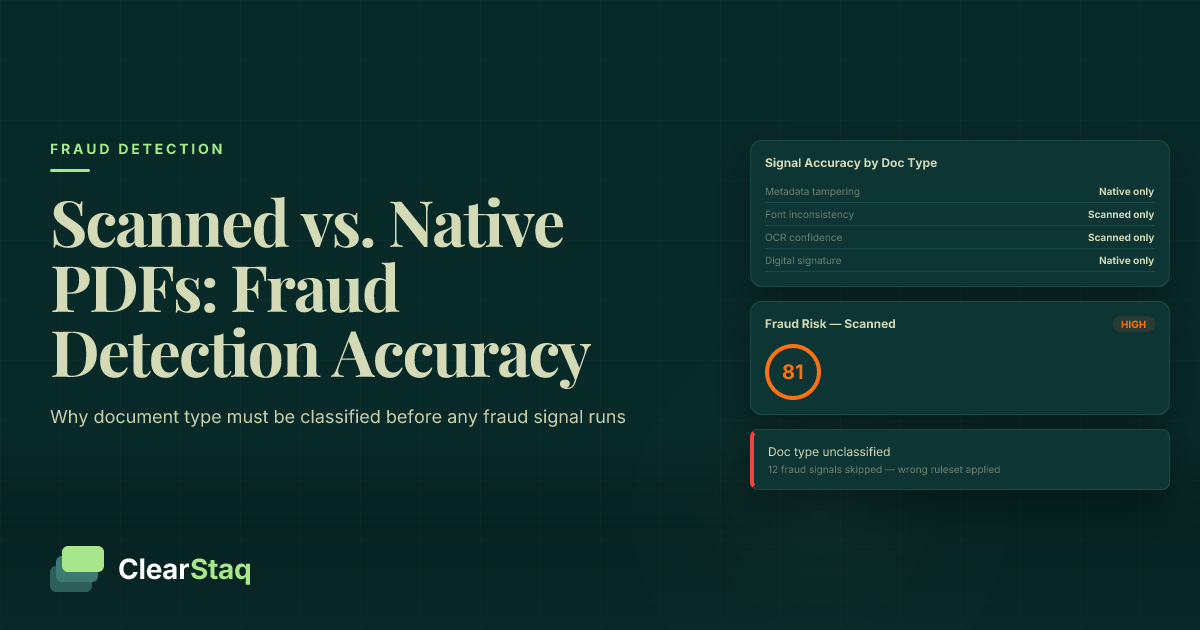
A scanner that reads numbers off a PDF is not fraud detection — it's data entry. Look for software that checks font consistency, metadata tampering, arithmetic reconciliation across pages, and formatting drift against known bank templates. ClearStaq runs 27+ of these signals per document and flags mismatches in under 5 seconds, which matters when a wire request is sitting on a 2-hour SLA.
Real-time transaction pattern analysis
Structuring, velocity spikes, and out-of-pattern wire amounts are the tells that separate a legitimate large wire from a fraud attempt. Software that only checks the wire against a static rules list — dollar thresholds, geography blocklists — misses attackers who deliberately stay under those thresholds.
Identity verification tied to the wire, not just onboarding
Synthetic identities frequently pass onboarding checks and then request a wire months later once trust is established. A system needs to re-verify identity signals at the point of the wire request, not rely on a KYC check performed at account opening.
Integration speed with core banking and loan origination systems
If fraud detection adds 20 minutes to every wire review, your wire ops team will route around it during high-volume periods — which is exactly when fraud attempts spike. Sub-5-second processing keeps the check inside the existing workflow instead of becoming a separate step someone skips under pressure.
Signal transparency and audit trail
A black-box fraud score with no explanation is a liability in an exam. Examiners in 2026 expect a documented list of which signals triggered and why, not a single risk number with no backing detail.
False positive rate and review time impact
A tool that flags 30% of legitimate wires for manual review isn't catching fraud — it's shifting the cost to your staff. Ask any vendor for their false positive rate before signing, and weight it against how much manual review time the tool actually removes.
Top picks for wire fraud detection software for banks
The foundation pick — bank statement and document authenticity detection. This layer catches doctored statements supporting fraudulent wire requests before the money moves. Check fraud detection software built for banks covers the signal set that separates a genuine statement from an edited one — arithmetic checks, font consistency, and metadata review in a single pass. Processing lands under 5 seconds per document in 2026 deployments. Buy.
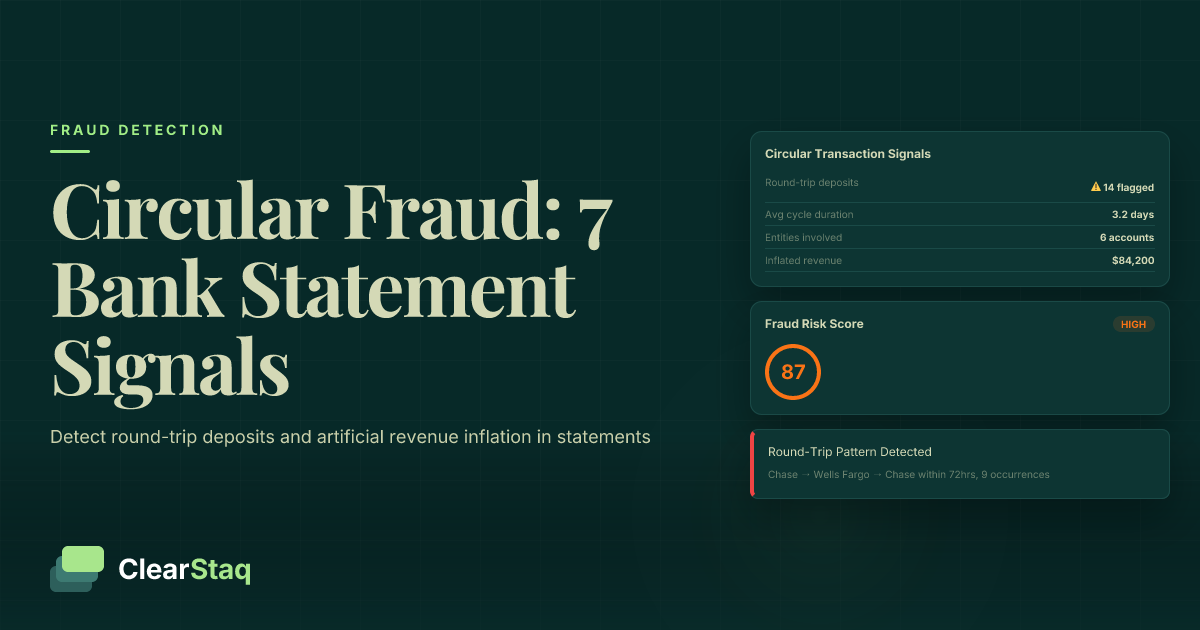
The compliance layer — AML transaction monitoring. This pick watches wire velocity and structuring patterns across accounts rather than reviewing documents one at a time. AML transaction monitoring software built for lenders applies the same pattern logic banks need for wire desks — flagging accounts with sudden velocity spikes above their 90-day baseline. Buy.
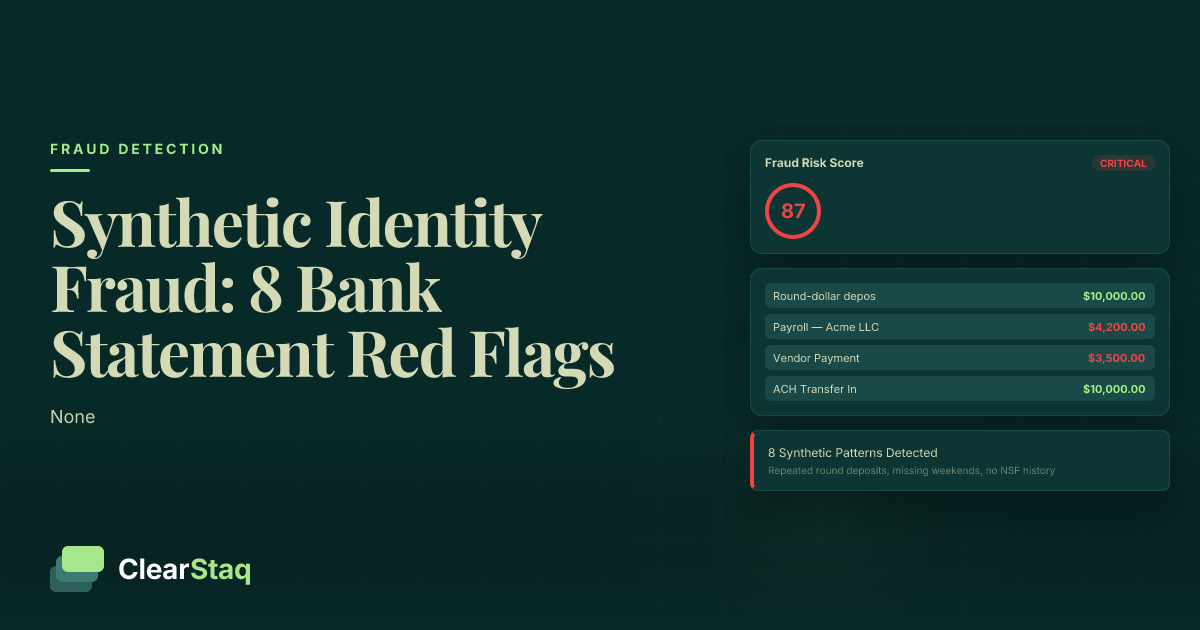
The emerging threat — synthetic identity checks at the wire, not just onboarding. Synthetic identities that clear KYC at account opening often surface months later when a wire request comes through. How to detect synthetic identity fraud in loan applications breaks down the signal combinations — SSN issuance date mismatches, thin credit file patterns — that flag these accounts before a wire clears. Consider for banks handling high-dollar commercial wires.
The wildcard — structuring pattern detection in business accounts. Structuring below reporting thresholds is a known evasion pattern in wire-adjacent fraud, and it shows up in the deposit history before the wire request ever gets filed. Banks running high volumes of business accounts should treat this as a Consider, particularly for commercial relationship managers reviewing new business wire requests.
The narrow tool — signature verification only. Software that checks only signature match against a static image on file is a Skip as a standalone system in 2026. It catches nothing on business email compromise, doctored statements, or synthetic identity — three of the fastest-growing wire fraud vectors this year.
What to avoid
Tools that store documents but don't parse them. A repository that lets your team eyeball a PDF isn't fraud detection — it's file storage with a search bar. If the tool can't flag a font mismatch or an arithmetic error on its own, your reviewers are still doing the fraud detection manually, just inside a nicer interface.
Callback-only verification protocols with no software backing. Manual callback procedures still matter for confirming a payment change came from the actual account holder, but banks that rely on memory and a phone number on file — instead of a documented process — are exposed when staff turnover breaks institutional knowledge. The same discipline that goes into training staff to verify supplier bank detail changes before releasing a payment needs software backing it up, not a sticky note on someone's desk.
Fraud scores with no signal breakdown. If a vendor won't show you which of their signals triggered on a flagged transaction, you can't defend the decision in an exam and your team can't learn from false positives. Walk away from any tool that hides its methodology behind a single risk number.
See the 27+ signal fraud check
Run a bank statement through ClearStaq and see the signal breakdown in under 5 seconds.
Verdict comparison table
| Layer | Catches | Processing speed | Verdict |
|---|---|---|---|
| Document authenticity (bank statements) | Doctored statements, arithmetic errors, font tampering | Under 5 seconds | Buy |
| AML transaction monitoring | Structuring, velocity spikes | Real-time | Buy |
| Synthetic identity checks | Fabricated identities passing onboarding | Real-time at wire request | Consider |
| Structuring pattern detection | Below-threshold deposit evasion | Batch or real-time | Consider |
| Signature-only verification | Signature mismatch only | Manual review | Skip |
FAQ
What is the best wire fraud detection software for banks in 2026?
The strongest setups combine document authenticity checks with real-time transaction pattern analysis rather than relying on one system. ClearStaq covers the document side with 27+ fraud signals and sub-5-second processing, paired with AML transaction monitoring for the pattern side.
Is signature verification enough to stop wire fraud?
No. Signature-only verification misses business email compromise, doctored bank statements, and synthetic identity fraud — three of the fastest-growing wire fraud vectors in 2026. Treat it as one layer, not the whole system.
How much does wire fraud detection software cost for a community bank?
Pricing varies by transaction volume and the number of fraud signal categories a bank needs, so get a quote based on actual wire volume rather than a published rate card.
Can wire fraud detection software integrate with a core banking system?
Most modern fraud detection tools built for lenders offer API-based integration designed to sit inside existing loan origination or core banking workflows without adding a separate manual step.
How fast should a bank statement fraud check run?
Under 5 seconds per document is the 2026 benchmark for tools built for wire and loan review workflows. Anything slower risks getting skipped during high-volume periods.
Does AML transaction monitoring replace document fraud detection?
No. AML monitoring watches transaction patterns across accounts, while document fraud detection checks the authenticity of statements and supporting paperwork. Banks need both layers, not one instead of the other.
What false positive rate is acceptable for wire fraud software?
Ask any vendor for their documented false positive rate before signing — a tool that flags 30% of legitimate wires for review shifts cost to your staff instead of catching fraud.
How many fraud signals should wire fraud detection software check?
Look for at least 20-27+ distinct signals covering document authenticity, transaction patterns, and identity verification rather than a single composite risk score.
One last thing
The wire fraud attempts that get through in 2026 almost never fail a single check — they pass the signature match, pass the KYC screen, and pass a quick document glance. They fail on the signal combination: a statement with a font mismatch on page 2, paired with a deposit velocity that's 3x the account's 90-day average. Software that only checks one signal at a time will never catch that combination, no matter how fast it runs.
Related guides
ClearStaq Team
Content Team
The ClearStaq team builds AI-powered tools for bank statement parsing, fraud detection, and income verification.