Loan stacking shows up as a pattern across bank statements and credit pulls, not a single red flag: look for multiple hard inquiries within a 30-day window, back-to-back ACH deposits from different lender names hitting the same account, and monthly debt payments that jump right after a new loan closes. The hidden cost underwriters miss is timing — a borrower can pass a single-bureau pull clean and still have three personal loans funded in the same week that haven't reported yet.
- Loan stacking detection in personal loan underwriting means cross-checking inquiry clusters, ACH deposit patterns, and post-funding DTI spikes together.
- Bureau data lags 30-60 days behind funding, so bank statement analysis catches stacking that credit pulls miss.
- ClearStaq flags stacking signals as part of a 27+ signal fraud check with sub-5-second processing.
- Round-number deposits from named lenders within the same statement cycle are the single strongest stacking tell.
Why this matters
A borrower who stacks three or four personal loans in the same week looks fine on paper at the moment of underwriting — the bureau hasn't caught up yet. By the time it reports, the loan is already funded and the debt-to-income ratio the underwriter approved is wrong. Personal loan underwriting in 2026 has to lean on bank statement evidence, not just credit bureau timing, because bureau reporting cycles are the exact gap stackers exploit.
The MCA and consumer lending space has run into this problem for years with merchant cash advances; personal loan lenders are seeing the same pattern accelerate as more borrowers apply to five or six lenders in a single sitting through comparison sites and lead aggregators.
How to detect loan stacking in personal loan underwriting
Run these checks in order — each one narrows the pool before the next:
- Pull a hard inquiry report and flag anything with 3+ inquiries in a rolling 30-day window. This is the cheapest first filter and it catches the obvious cases.
- Cross-reference 60-90 days of bank statement deposits against known lender ACH originator IDs. Named deposits like "OnDeck," "Upstart," or "LendingClub" hitting the account in the same statement cycle as the application is a direct signal, not an inference.
- Calculate debt-to-income before and after the most recent deposit spike. A DTI that jumps more than a few points in the same 30-day window the new deposits appear points to undisclosed debt.
- Check for round-dollar deposits with no invoice, payroll, or client reference attached. Legitimate revenue rarely lands in perfectly round numbers three times in one month.
- Compare the stated loan purpose against the deposit pattern. A borrower claiming debt consolidation whose statements show new loan deposits instead of payoffs is stacking, not consolidating.
| Detection method | What it catches | Blind spot |
|---|---|---|
| Hard inquiry pull | Recent credit shopping | Doesn't confirm funding, only interest |
| Bank statement ACH matching | Confirmed funded loans, even unreported ones | Requires format-aware parsing across statement layouts |
| DTI recalculation | Debt load hidden from the bureau | Needs accurate deposit-to-debt mapping, not just totals |
| Manual underwriter review | Context and judgment calls | Takes hours per file, doesn't scale |
Bank statement ACH matching wins for catching loans that haven't reported yet — bureau data lags 30 to 60 days, and stackers are counting on that gap.
Inquiry clustering: 3+ pulls in 30 days
Three or more hard inquiries inside a 30-day window is the standard trigger threshold most personal loan underwriters use before escalating a file for manual review. On its own it's a weak signal — plenty of legitimate shoppers pull three quotes before picking one lender. Pair it with deposit evidence before declining.
Deposit clustering: named lender ACH within one statement cycle
When two or more ACH deposits from identifiable lender originator names land in the same 30-day statement window, that's confirmed stacking, not suspected. This is the signal income verification software for personal loan lenders is built to flag automatically instead of requiring a human to scroll through 90 days of line items.
DTI spike after funding: recalculating post-deposit
A debt-to-income ratio that moves materially higher within the same window new deposits appear means debt the applicant didn't disclose. Underwriters who only calculate DTI once, at application, miss this every time — it has to be recalculated after the deposit review, not before it.
Why loan stacking detection accuracy varies
- Statement format coverage — a parser that only handles a handful of bank formats misses deposits buried in inconsistent PDF layouts from smaller regional banks.
- Lookback window length — 30 days of statements misses stacking that happened 45-60 days ago and hasn't reported to the bureau yet; 90 days is the safer minimum.
- Originator ID matching quality — lenders that don't standardize ACH originator names in their deposit descriptions make manual matching slow and error-prone.
- Manual review capacity — teams reviewing statements by eye typically spend hours per file, which limits how many files actually get the full 90-day cross-check.
- Cross-lender data sharing — consortium data helps but has coverage gaps, especially with newer fintech lenders that don't participate.
ClearStaq is built for personal loan underwriters who need bank statement evidence faster than a bureau refresh cycle — 27+ fraud signals run automatically against every uploaded statement in under 5 seconds, at 99.5% parsing accuracy across 900+ formats.
“Bureau data lags 30-60 days behind funding — that gap is exactly what loan stackers count on.”
Is loan stacking the same as synthetic identity fraud?
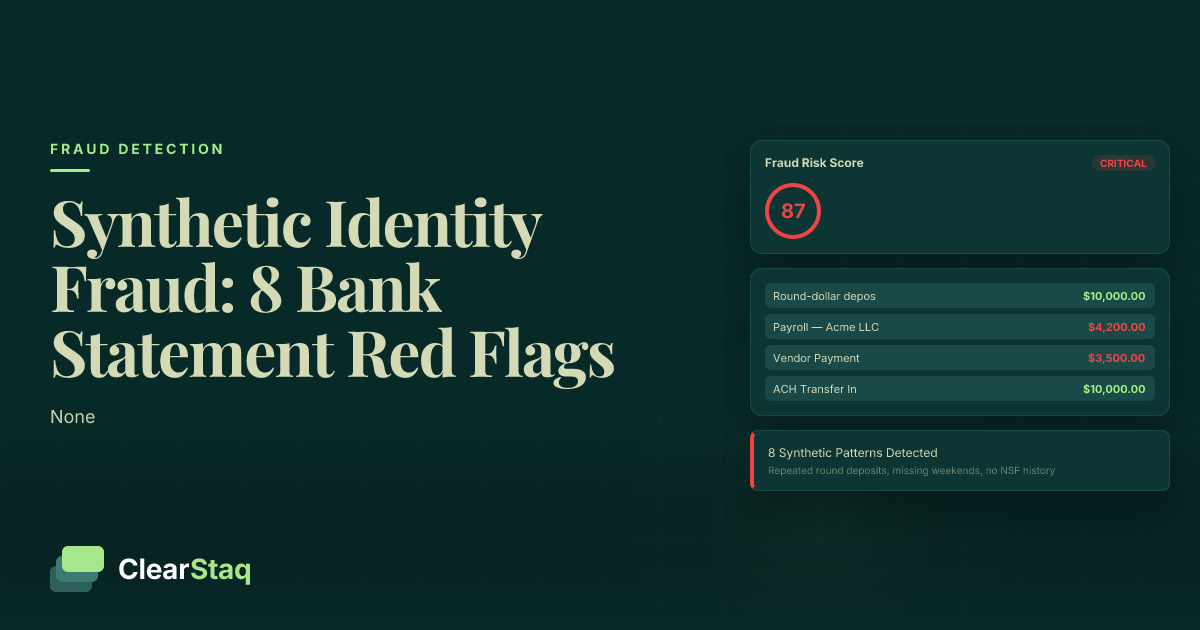
No — loan stacking is a real borrower taking on undisclosed debt across multiple lenders at once, while synthetic identity fraud involves a fabricated or blended identity that doesn't correspond to a real person. Both hide from single-bureau checks, but the underlying pattern is different: stacking shows up in deposit timing, synthetic fraud shows up in identity attributes that don't reconcile. Methods for catching synthetic identities are covered in how to detect synthetic identity fraud in loan applications.
How is loan stacking different from a straw borrower scheme?
A straw borrower scheme uses one person's clean credit profile to apply on behalf of someone who can't qualify, while loan stacking is a single borrower applying to multiple lenders simultaneously under their own name. Straw borrowing shows up as inconsistencies between the applicant and the stated use of funds; stacking shows up as inquiry and deposit clustering. Both require the same underlying discipline — reading the bank statements instead of trusting the application alone, detailed in how to detect straw borrower patterns in loan applications.
Can automated income checks catch stacking that manual review misses?
Yes — automated income verification catches deposits from named lender originators across a full 90-day lookback in seconds, something manual reviewers rarely have time to do consistently across every file. The approach for building this into a personal loan workflow is covered in how to automate income checks for personal loan underwriting.
Catch stacking before you fund
Run 27+ fraud signals on every bank statement in under 5 seconds.
FAQ
What is loan stacking in personal loan underwriting?
Loan stacking is when a borrower applies to and receives multiple personal loans from different lenders within a short window, often before any of them report to the credit bureau. It inflates real debt-to-income beyond what a single-bureau credit pull shows at approval time.
How many hard inquiries indicate loan stacking?
Three or more hard inquiries within a 30-day window is the standard threshold underwriters use to flag a file for deeper review in 2026. That number alone doesn't confirm stacking — it needs to be paired with bank statement deposit evidence.
Can credit bureau data alone detect loan stacking?
No — bureau data typically lags 30 to 60 days behind actual loan funding, so a stacked borrower can look clean on a bureau pull for weeks after multiple loans have already funded. Bank statement analysis closes that gap by showing deposits the bureau hasn't caught up to yet.
What does a stacked loan deposit look like on a bank statement?
It typically appears as a round-dollar ACH deposit from a named lender originator, with no matching invoice, payroll record, or client reference, landing in the same statement cycle as one or more similar deposits. Multiple named-lender deposits in one 30-day window is the strongest single indicator.
How long should the bank statement lookback window be for stacking checks?
A 90-day lookback catches stacking that a 30-day window misses, because bureau reporting delays mean recently funded loans may not show up in credit data for 30 to 60 days. Shorter windows increase the risk of approving a file with undisclosed recent debt.
Does loan stacking always mean fraud?
Not always — some borrowers stack loans out of financial distress rather than intent to deceive, but the effect on repayment risk is the same regardless of motive. Underwriters treat confirmed stacking as a decline or manual-review trigger either way.
What's the fastest way to check for loan stacking on a single file?
Running an automated bank statement parse that matches deposits against known lender ACH originator names is the fastest method, typically completing in under 5 seconds per document versus hours for manual line-by-line review. Pairing that with an inquiry report gives a complete picture in one pass.
One last thing
The deposit that gives away a stacked loan almost never shows up as a lump sum labeled "loan" — it shows up as a round number with a generic ACH descriptor, sitting one or two lines away from another round number three weeks later. Underwriters trained to look for that pattern catch stacking that inquiry reports alone will always miss, because the inquiry only proves interest, not funding.
Related guides
ClearStaq Team
Content Team
The ClearStaq team builds AI-powered tools for bank statement parsing, fraud detection, and income verification.