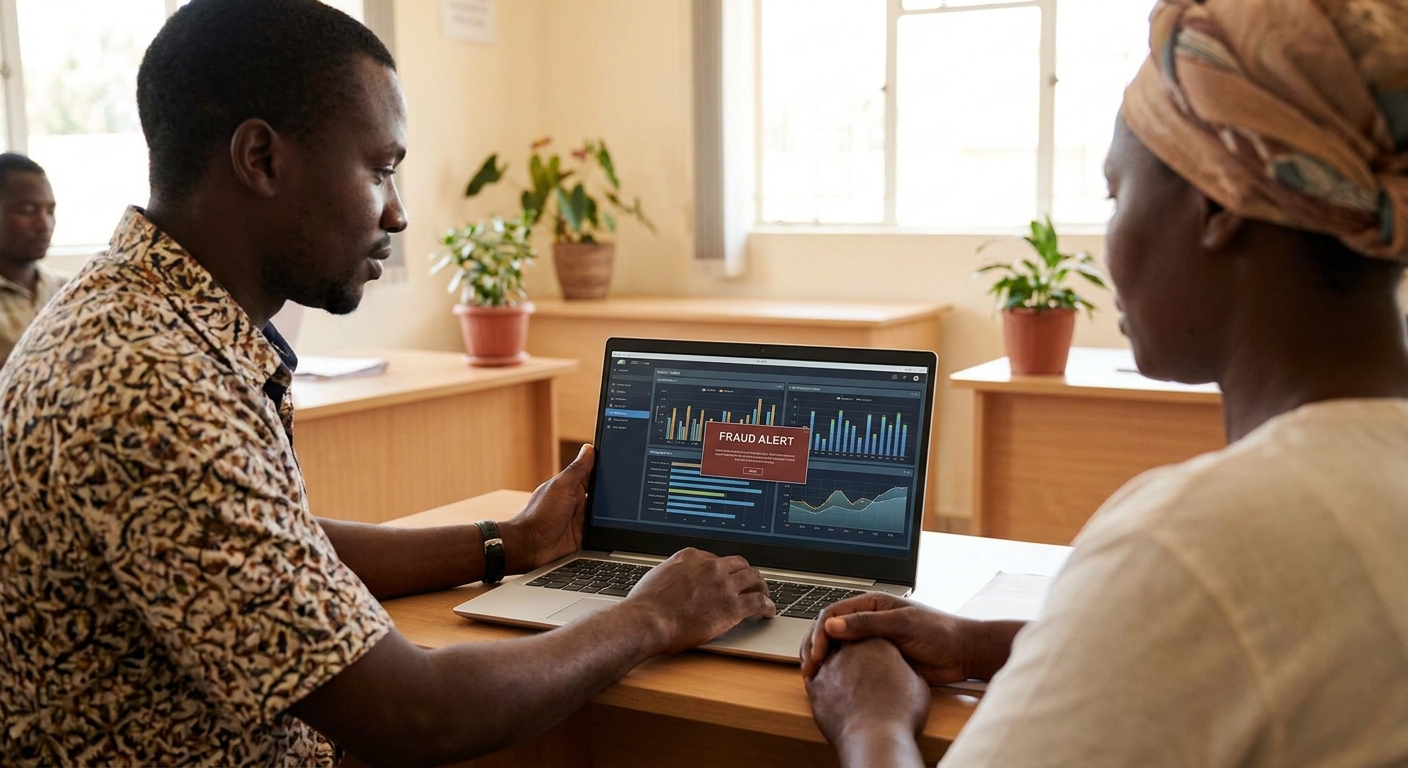
Microfinance institutions approve loans in days, not weeks, and most of their borrowers don't have three years of clean financials to hand over. That gap is exactly where doctored bank statements, inflated income, and synthetic identities slip through underwriting.
- Fraud detection software for microfinance institutions must parse informal, non-standard bank statement formats, not just major-bank PDFs.
- ClearStaq runs 27+ AI fraud signals and hits 99.5% accuracy on statement parsing — Buy for high-volume MFI underwriting.
- Skip tools that price per-seat instead of per-document; MFI volume economics break that model fast.
- Structuring and income-smoothing patterns are the two fraud types MFIs miss most because manual review can't catch them at scale.
Why this matters
Microfinance lending runs on thin margins and high transaction counts. A single underwriter reviewing 40-60 files a week can't manually flag altered PDFs, round-tripped deposits, or a borrower who used the same doctored statement at three different institutions.
The fraud rate on small-dollar, cash-heavy loans is structurally higher than on conventional commercial lending, and the loss per file is small enough that manual investigation rarely pencils out. Software has to catch it before disbursement, not after a charge-off.
Who this is for
This guide is for MFI credit teams, ops leads, and CPAs who underwrite group loans, micro-business loans, or agricultural loans against bank statements and tax records rather than traditional credit files. If your borrowers bank at community credit unions, regional banks, or cash-based businesses with irregular deposit patterns, generic KYC tools built for prime consumer lending won't cut it — you need a platform like ClearStaq built for statement-level fraud detection at volume.
What to look for in fraud detection software for microfinance institutions
Format coverage beyond the big four banks
MFI borrowers rarely bank at Chase or Bank of America. They use local credit unions, regional community banks, and neobanks with statement layouts that generic OCR tools choke on. A platform needs broad format coverage — 900+ formats is the benchmark to ask vendors for — or your rejection rate on legitimate borrowers climbs for the wrong reason.
Signal depth, not a single fraud score
A single risk score tells you nothing about why a file failed. Look for platforms running multiple independent signals — altered metadata, font inconsistencies, balance math errors, deposit timing anomalies — so your team can see the specific red flag and make a defensible decision. 27+ distinct signals is a reasonable floor for 2026.
Cost per document, not per seat
MFIs process high file volume against low loan sizes. Per-seat SaaS pricing built for enterprise commercial lenders doesn't map to a shop reviewing hundreds of small loans a month. Price the tool per document processed and model it against your actual monthly volume before signing.
Turnaround under a few seconds per file
Microloan decisions often happen same-day or next-day. A tool that takes minutes per statement stalls your whole pipeline when a loan officer is waiting on a verdict. Sub-5-second processing per document is achievable in 2026 and should be a hard requirement, not a nice-to-have.
Structuring and income-smoothing detection
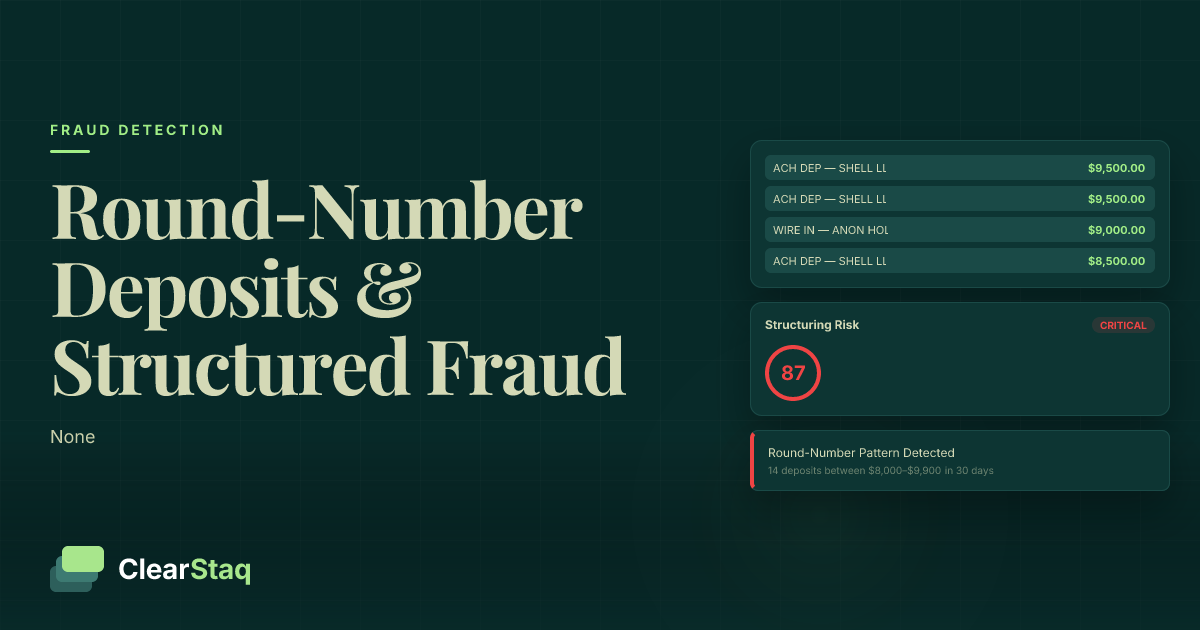
Borrowers with cash-heavy businesses sometimes structure deposits to stay under reporting thresholds or smooth income across months to look more stable than they are. These patterns are invisible to a human scanning a PDF but detectable in transaction-level data — confirm the vendor specifically flags this pattern class, not just document tampering.
Compliance fit for regulated lenders
If your MFI is subject to BSA/AML obligations or state lending licenses, the fraud tool needs to integrate with sanctions screening and adverse media checks rather than operate as an island. A tool that only catches doctored PDFs but ignores watchlist exposure leaves half the compliance job undone.
Top picks for microfinance fraud detection
The core engine — for teams that need signal depth
ClearStaq runs 27+ AI fraud signals against parsed bank statements and tax returns, hitting 99.5% accuracy with processing under 5 seconds per document across 900+ bank and format types. For an MFI processing high loan volume with a small underwriting staff, that combination of speed and signal count is the difference between catching fraud pre-disbursement and writing it off six months later. Verdict: Buy for any MFI processing more than a handful of files a week.
The volume play — for micro-lenders scaling loan count
If your bottleneck is underwriting throughput rather than fraud specifically, the commercial loan underwriting software for micro-lenders breakdown covers what automated cash-flow underwriting looks like at micro-loan scale — relevant because fraud detection and underwriting automation live in the same workflow for most MFIs. Verdict: Consider if your fraud losses are currently low but review time is the real cost center.
The doctored-statement catch — for compliance-first teams
Altered bank statements are the single most common fraud type in small-dollar lending, and they're also the easiest to miss with a manual glance. The how to detect fake bank statements in loan applications guide walks through the specific tampering signatures — metadata mismatches, font substitution, balance arithmetic errors — that automated parsing catches and human review usually doesn't. Verdict: Buy if doctored PDFs have shown up in your files before.
The identity layer — for platforms with growing loan volume
Synthetic identities built from real and fabricated data points are harder to spot than a doctored PDF because the identity itself passes basic KYC. Best synthetic identity fraud detection tools built for lenders combine document verification with behavioral and cross-reference signals rather than relying on a single ID scan. Verdict: Consider once your loan volume is high enough that manual identity checks stop scaling.
What to avoid
- Single-signal tools. A vendor that gives you one risk score with no breakdown leaves your underwriters guessing at the reason for a decline, which is a liability if a borrower disputes it.
- Generic KYC platforms with no statement-level fraud detection. Identity verification and bank statement fraud detection solve different problems — a tool that only does one leaves the other side of the file unchecked. Broader infrastructure decisions matter here too: lenders building out zero trust security for financial services around their lending stack reduce the surface area fraud tools alone can't cover, since document-level fraud checks don't protect the systems those documents move through.
- Tools priced for enterprise commercial lending. A per-seat license built for a 200-person commercial bank underwriting desk doesn't fit an MFI processing high volume at low loan sizes — the unit economics won't work.
See how ClearStaq flags fraud pre-disbursement
27+ signals, 99.5% accuracy, under 5 seconds per statement.
Verdict comparison
| Criteria | Core engine (ClearStaq) | Underwriting automation | Doctored-statement detection | Synthetic identity layer |
|---|---|---|---|---|
| Format coverage | 900+ formats | N/A | Format-aware parsing | Document + behavioral |
| Accuracy | 99.5% | N/A | Metadata/font checks | Cross-reference signals |
| Processing time | Under 5 seconds | N/A | Automated | Automated |
| Best for | High-volume fraud screening | Throughput bottlenecks | Prior doctored-PDF incidents | Growing loan volume |
| 2026 verdict | Buy | Consider | Buy | Consider |
FAQ
What is the best fraud detection software for microfinance institutions in 2026?
ClearStaq is built for high-volume statement fraud detection, running 27+ AI signals at 99.5% accuracy with under 5 seconds of processing per document. It fits MFIs underwriting against bank statements rather than traditional credit files.
How much does fraud detection software cost for a small MFI?
Cost depends on document volume rather than seat count for most modern platforms in 2026. Price per document processed and compare it against your actual monthly loan file count before signing.
Can fraud detection software catch structuring in bank statements?
Yes — transaction-level analysis flags deposits structured to stay under reporting thresholds, a pattern manual review almost always misses. This matters most for cash-heavy micro-business borrowers.
Is manual review enough for microfinance fraud detection?
No. Manual review scales poorly against high loan file counts and misses metadata-level tampering that automated parsing catches. Most MFIs underwrite too many files per underwriter for manual checks to be reliable.
Do MFIs need synthetic identity detection separately from bank statement fraud detection?
Yes, they solve different problems. Bank statement fraud detection catches doctored financial documents, while synthetic identity detection catches fabricated borrower identities that pass basic KYC.
What accuracy rate should fraud detection software hit in 2026?
99.5% accuracy is the current benchmark for statement-level fraud detection. Anything meaningfully below that leaves too many false negatives for high-volume MFI lending.
How fast should fraud detection processing be for same-day loan decisions?
Under 5 seconds per document is achievable in 2026 and necessary for same-day or next-day microloan disbursement timelines. Slower tools stall the underwriting pipeline.
One last thing
The fraud type MFIs underestimate most isn't the doctored PDF — it's income smoothing, where a borrower's bank statements show artificially stable deposits across months that were actually volatile. It requires transaction-level pattern analysis across a full statement history, not a glance at the bottom line, and it's the exact gap that separates format-aware parsing from a human reviewer skimming for red flags.
Related guides
ClearStaq Team
Content Team
The ClearStaq team builds AI-powered tools for bank statement parsing, fraud detection, and income verification.