Cash flow underwriting software for CDFIs has to do something consumer income verification tools were never built for: score borrowers who don't fit a FICO model, using bank statements as the primary evidence of repayment ability.
- ClearStaq parses CDFI borrower bank statements at 99.5% accuracy and returns results in under 3 seconds.
- Cash flow underwriting software for CDFIs must score thin-file borrowers on deposit patterns, not credit bureau data.
- 27+ fraud signals catch doctored statements and synthetic identity before a CDFI loan officer approves the file.
- Skip generic OCR tools built for mortgage income verification -- they miss the irregular deposit patterns common in CDFI lending.
Why this matters
CDFIs lend into gaps banks won't touch: startup businesses, borrowers with thin or no credit files, communities that traditional underwriting models flag as too risky to score fairly. That mission runs on manual review -- loan officers reading three to twelve months of statements line by line, looking for deposit patterns a credit score can't show.
That manual process is slow and it's inconsistent. Two underwriters reading the same statement can reach different conclusions about whether a borrower's revenue is stable enough to service debt. Cash flow underwriting software for CDFIs closes that gap by turning raw bank statement data into structured, repeatable analysis -- average monthly deposits, NSF frequency, revenue volatility, and fraud flags in one pass. ClearStaq builds this specifically for lenders working outside standard credit-bureau underwriting, which is most of what a CDFI does in 2026.
Who this is for
This guide is for CDFI loan officers, credit committees, and portfolio managers underwriting small business and community development loans where the borrower's credit file is thin, the revenue is seasonal or informal, and the decision has to hold up to CDFI Fund reporting requirements. If your 2026 loan files are dominated by sole proprietors, co-ops, or first-time borrowers without three years of tax returns, this is your buying decision.
What to look for in cash flow underwriting software for CDFIs
Format coverage across community bank statements
CDFI borrowers rarely bank with the top five national institutions. They bank with community banks, credit unions, and regional banks, each with its own statement layout. Software that only handles Chase, Bank of America, and Wells Fargo formats will kick back errors on a large share of your files. Format-agnostic parsing matters more here than in almost any other lending vertical.
Fraud detection depth for thin-file borrowers
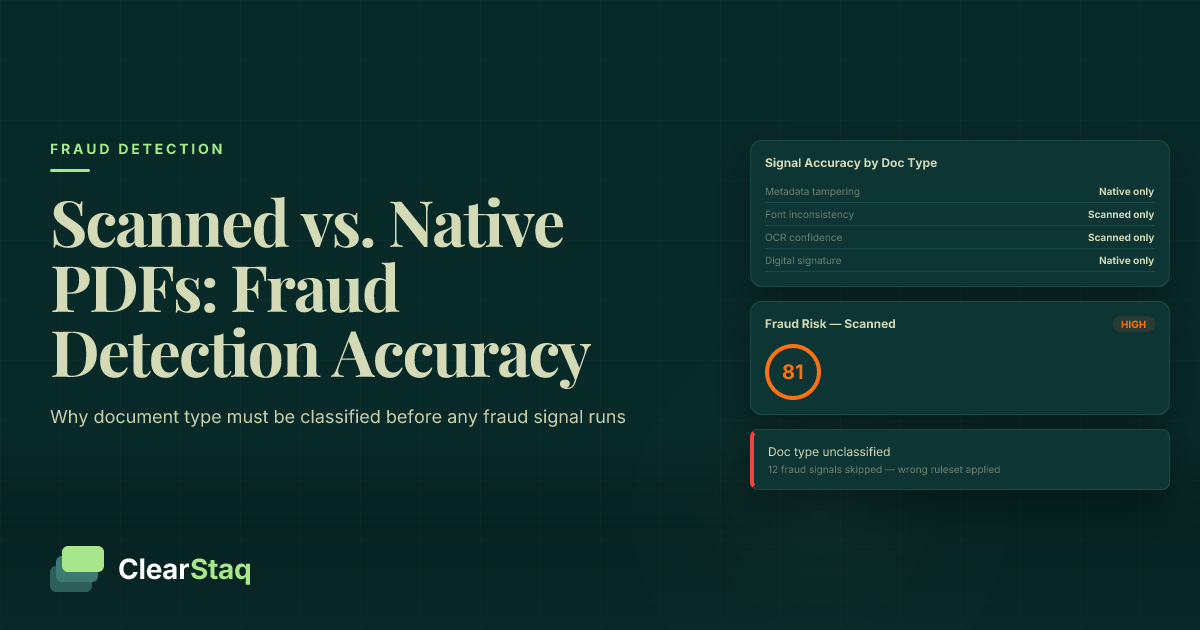
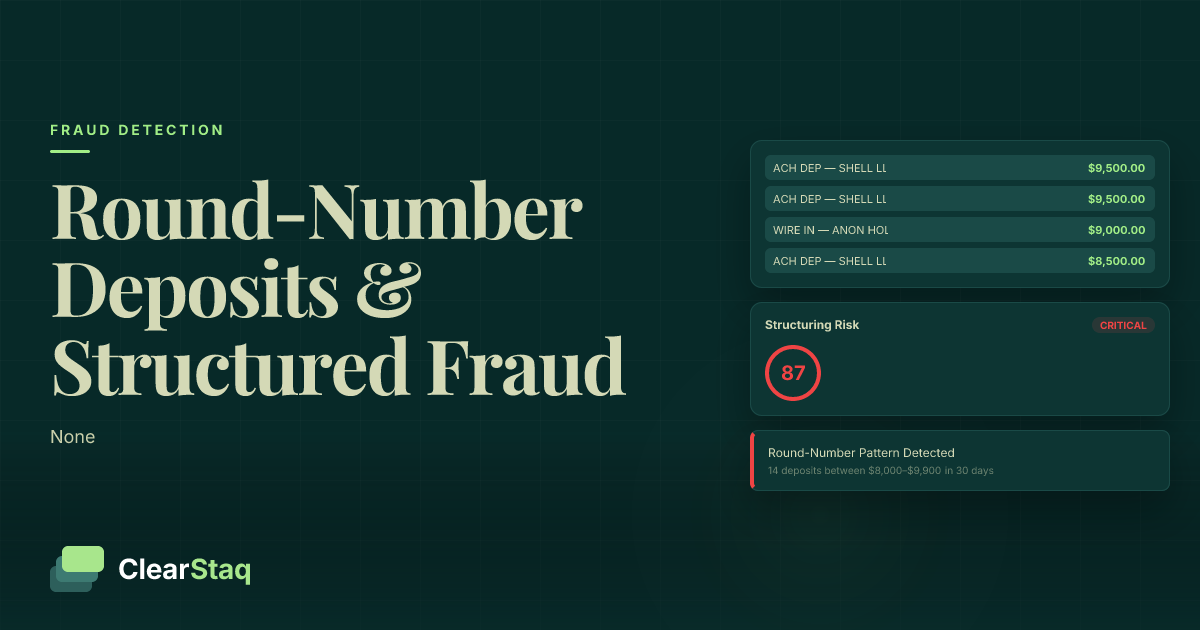
Borrowers without established credit history are exactly the population fraud rings target, because there's no bureau trail to cross-check against. Cash flow underwriting software for CDFIs needs to flag doctored PDFs, altered balances, and synthetic identity patterns automatically -- not just parse numbers and trust them. ClearStaq runs 27+ fraud signals against every statement, catching manipulation before it reaches a credit committee vote.
Alternative credit scoring, not bureau substitution
A cash flow tool that just repackages a credit score isn't solving the CDFI problem. It needs to build a repayment picture from deposit consistency, average daily balance, and revenue trend across the full statement period, independent of whether the borrower has a FICO score at all.
Processing speed for lean back-office teams
Most CDFIs run underwriting with a fraction of the staff a regional bank has. A tool that takes ten minutes per statement doesn't scale past a handful of files a day. Sub-3-second processing per statement is the difference between reviewing 20 files a week and reviewing 200.
Audit trail for CDFI Fund reporting
CDFI Fund compliance and impact reporting require documentation of how a lending decision was made, not just the outcome. Software that logs every fraud flag and every income calculation gives your compliance team something concrete to point to when a funder or examiner asks how a 2026 file was underwritten.
Top picks
Cash flow underwriting automation for CDFI loan files. The core workhorse in this category. It replaces line-by-line statement review with structured output -- average monthly revenue, NSF count, deposit volatility -- delivered in under 3 seconds per statement. Read the full breakdown of commercial loan underwriting software for CDFIs. Buy.
Alternative credit scoring for thin-file borrowers. The equity pick for mission-driven lending. It scores repayment ability on deposit history and cash flow trend instead of bureau data, which is the entire reason a CDFI underwrites differently than a bank. See alternative credit scoring tools for non-bank lenders. Buy.
Fraud detection across 27+ signals. The safe pick for protecting a small underwriting team from doctored files. ClearStaq flags altered balances and synthetic identity patterns automatically, before a loan officer spends an hour reviewing a fabricated statement. Buy.
Loan document automation for stipulation collection. The paperwork killer. It chases missing bank statements, tax transcripts, and voided checks so underwriters analyze files instead of hunting documents. Detail is in loan document automation software for CDFIs. Consider -- valuable once your parsing and fraud layer is live, less urgent as a first 2026 purchase.
What to avoid
- Generic OCR tools built for mortgage income verification. They're tuned for W-2 pay stubs and steady deposits, not the irregular, seasonal revenue patterns common in CDFI small business lending.
- Spreadsheet-based manual cash flow trackers. They look thorough because someone built formulas into them, but they don't catch a doctored statement and they don't scale past a handful of files a week.
- Tools that score off credit bureau data only. If the software needs a FICO score to function, it isn't solving the thin-file problem CDFIs exist to solve.
“If a cash flow tool can't tell you why a deposit looks synthetic, it isn't underwriting software -- it's a PDF viewer.”
Verdict comparison
| Capability | What it does | Key number | Verdict |
|---|---|---|---|
| Format coverage | Parses statements across bank layouts | 99.5% accuracy | Buy |
| Fraud detection | Flags doctored statements, synthetic identity | 27+ signals | Buy |
| Alternative credit scoring | Scores thin-file borrowers on cash flow | No FICO required | Buy |
| Processing speed | Returns structured output per statement | Under 3 seconds | Buy |
| Document automation | Collects stipulations automatically | Fewer manual chases | Consider |
FAQ
What is cash flow underwriting software for CDFIs?
It is software that analyzes borrower bank statements to score repayment ability without relying on a credit bureau file. CDFIs use it because most of their borrowers lack the multi-year clean credit history traditional underwriting expects.
Is cash flow underwriting better than credit score underwriting for CDFIs?
For CDFI lending, yes. Most CDFI borrowers are thin-file or no-file, so a credit score alone does not reflect repayment ability, while 3 to 12 months of bank statements show actual deposit behavior.
How much does cash flow underwriting software cost in 2026?
Pricing depends on file volume and integration scope. Check current pricing directly with the vendor, since most platforms in this category quote per volume tier rather than publishing a flat list price.
Can cash flow underwriting software detect fraudulent bank statements?
Yes. ClearStaq applies 27+ fraud signals per statement to catch altered balances and synthetic identity patterns before a loan is funded.
How fast does bank statement parsing run for CDFI loan files?
Format-aware parsers return structured output in under 3 seconds per statement. Manual review of the same statement typically consumes a large block of an underwriter's day across a full file.
Do CDFIs need different underwriting software than banks?
Yes. CDFIs need software that handles community bank and credit union statement formats and scores cash flow independent of a bureau file, because their borrower population differs from a typical bank's.
What does CDFI Fund reporting require from underwriting software?
CDFI Fund compliance expects documentation of how a lending decision was reached. Software with a logged audit trail of fraud flags and income calculations supports that reporting without extra manual work.
Can cash flow underwriting software handle seasonal business revenue?
Yes, when it analyzes the full statement period rather than single transactions. A 12-month view normalizes average monthly revenue so a seasonal peak does not inflate the approval decision.
One last thing
The CDFI borrowers most underwriting software gets wrong are not the fraud cases -- they are the legitimate seasonal businesses whose deposit pattern looks volatile on paper but is completely normal for their business type. A tool that flags every irregular deposit as risk without cash flow context rejects good borrowers as often as it catches bad ones. The fix is not more manual review. It is software that reads 3 to 12 months of pattern, not one flagged transaction, and that is the standard to hold vendors to in 2026.
Related guides
ClearStaq Team
Content Team
The ClearStaq team builds AI-powered tools for bank statement parsing, fraud detection, and income verification.