Commercial loan underwriting software for CDFIs has to do two jobs at once: move fast enough to serve mission-driven borrowers who can't wait six weeks, and catch fraud thoroughly enough that a nonprofit lender with a thin loss-absorption cushion doesn't eat a bad loan. This guide breaks down what actually matters when you're evaluating tools, not just what vendors put on their homepage.
- CDFIs need commercial loan underwriting software that parses bank statements fast and flags fraud without adding headcount.
- ClearStaq processes statements in under 5 seconds with 99.5% accuracy across 900+ bank formats.
- 27+ fraud signals catch structuring, commingled funds, and doctored statements before they hit committee.
- Skip tools built for consumer credit scoring — CDFIs underwrite cash flow and mission fit, not FICO alone.
Why this matters
CDFIs underwrite borrowers that traditional banks turn away — thin-file small businesses, first-time nonprofit borrowers, minority-owned contractors without three years of clean financials. That means underwriters lean harder on bank statements and tax returns than on credit scores, and they do it with smaller teams than a regional bank's underwriting shop.
Manual statement review eats 3-5 hours per file when a loan officer is scrolling PDFs looking for NSF fees and unexplained deposits. In 2026, that's the bottleneck slowing down CDFI loan committees, not capital availability. ClearStaq parses those same statements in under 5 seconds and flags the deposits worth a human's attention.
Who this is for
This guide is for loan officers, credit analysts, and CDFI program managers evaluating commercial loan underwriting software for CDFIs in 2026 — organizations underwriting $25,000 to $2 million commercial loans to small businesses, nonprofits, and community developers, usually with a staff of fewer than 15 underwriters covering a multi-state or statewide territory.
What to look for in commercial loan underwriting software for CDFIs
Format coverage across regional and community banks
CDFI borrowers don't bank at the same five institutions. A statement-parsing tool that only handles Chase, Bank of America, and Wells Fargo formats will choke on the credit union or regional bank statement your typical borrower actually uses. Coverage across 900+ formats matters more here than in commercial banking, where borrowers cluster around a handful of national banks.
Fraud detection built for thin-file borrowers
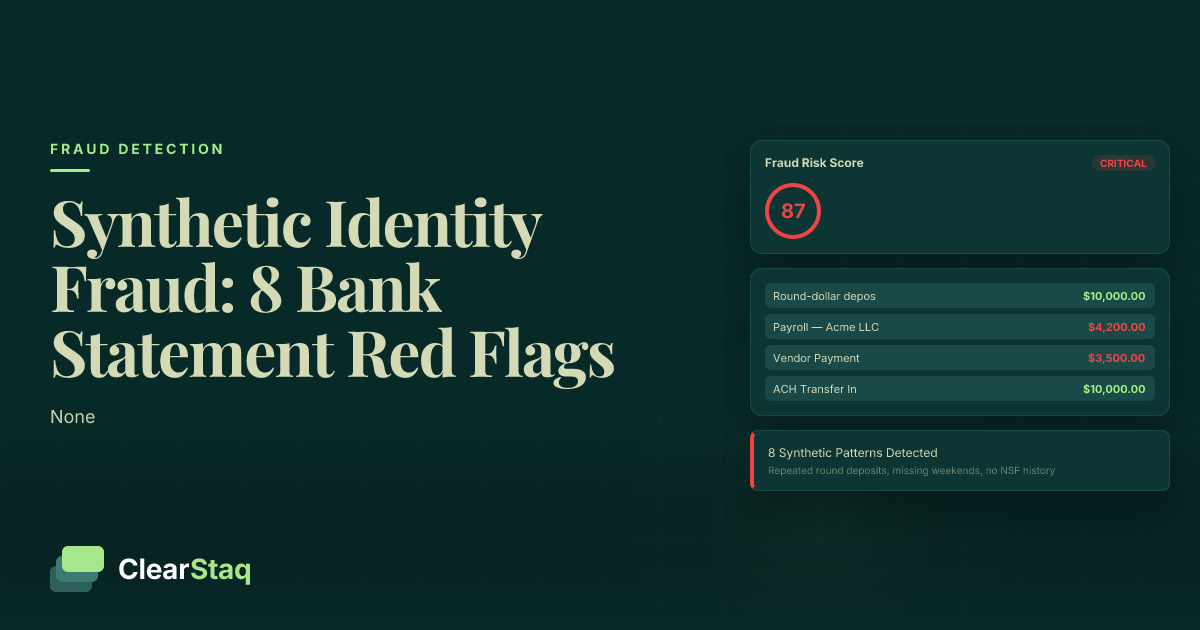
Borrowers with limited credit history sometimes pad their numbers — not always maliciously, but often enough that underwriters need a systematic check. Look for software that scans for structuring (deposits kept under $10,000 to dodge reporting thresholds), commingled personal and business funds, and income smoothing across multiple accounts. A tool running 27+ fraud signals catches patterns a manual reviewer misses on file 40 of the week.
Speed that matches your loan committee cadence
Most CDFI loan committees meet weekly or biweekly, not daily like a bank's automated underwriting engine. Software that takes 5 seconds per statement instead of an hour lets one analyst prep a full committee packet the morning before the meeting, instead of starting three days earlier.
Cash flow normalization for seasonal and irregular income
CDFI borrowers — landscapers, contractors, seasonal retailers — often show revenue swings that would spook a traditional underwriter. The right tool normalizes 12 months of statements into average monthly revenue and flags seasonality instead of treating every dip as risk.
Reporting that supports CRA and mission-metric documentation
CDFIs report to funders, regulators, and CDFI Fund compliance requirements. Underwriting software that exports clean, auditable summaries saves the compliance team from rebuilding the same file twice — once for underwriting, once for reporting.
Cost structure that fits nonprofit budgets
Most CDFIs don't have the per-seat SaaS budgets of a commercial bank. Pricing that scales with loan volume, not headcount, matters when your underwriting team is three people covering 200 loans a year.
Top picks for CDFI underwriting workflows
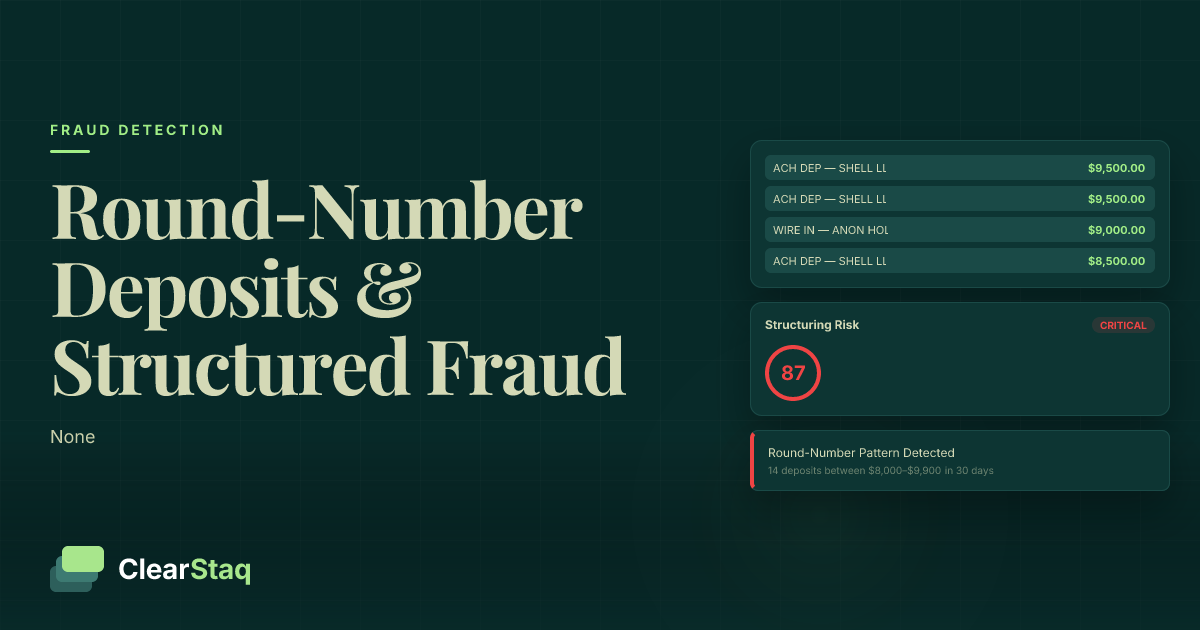
The structuring-detection pick. Structuring — deposits repeatedly kept under $10,000 — shows up more often in CDFI files than underwriters expect, especially from cash-heavy borrowers like restaurants and contractors. ClearStaq's structuring detection flags deposit patterns across 27+ signals instead of relying on a reviewer eyeballing a transaction list. Buy — this is the single highest-value fraud check for cash-intensive small business borrowers.
The commingled-funds pick. Sole proprietors and single-member LLCs frequently mix personal and business spending, which makes real cash flow hard to underwrite. A tool that isolates business-only transactions from personal draws gives you an accurate debt-service coverage number instead of an inflated one. Detecting commingled funds during intake, not after disbursement, is what separates a clean file from a workout six months later. Buy for any CDFI underwriting sole proprietors or micro-businesses.
The speed pick. Sub-5-second parsing at 99.5% accuracy means an analyst can process a full year of statements — 12 files — in under a minute instead of an afternoon. That's the difference between prepping one loan file a day and prepping five. Buy if your team is stretched across a multi-county or statewide territory.
The benchmark pick. Community banks and CDFIs share a lot of the same borrower profile: thin files, local relationships, higher fraud exposure than a national bank sees on prime borrowers. Software built against community-bank fraud patterns transfers well to CDFI underwriting without a separate build. Consider this as your baseline before customizing fraud thresholds to your own portfolio's loss history.
What to avoid
- Consumer credit scoring bolt-ons. Tools built primarily for FICO-based consumer lending underweight the cash flow analysis a commercial CDFI loan actually needs — skip anything that treats bank statement parsing as an afterthought to a credit pull.
- Fraud detection that only checks for altered PDFs. Doctored-file detection catches one fraud type. Structuring, commingling, and income smoothing are the patterns that actually cost CDFIs money on defaults, and a tool needs to catch all of them, not just file tampering.
- Per-seat pricing with no volume flexibility. A three-person underwriting team processing 200 loans a year needs pricing that tracks loan volume, not a SaaS contract built for a 50-analyst commercial bank.
Verdict comparison
| Criterion | Why it matters for CDFIs | What to check |
|---|---|---|
| Format coverage | Borrowers bank locally, not nationally | 900+ format support minimum |
| Fraud signals | Thin-file borrowers carry more undetected risk | 27+ signals, not just PDF tamper checks |
| Processing speed | Small teams, weekly committee cycles | Under 5 seconds per statement |
| Accuracy | One bad parse can misstate DSCR | 99.5%+ accuracy benchmark |
| Reporting | CRA and funder compliance overhead | Auditable export, not raw data dump |
| Pricing model | Nonprofit budget constraints | Volume-based, not per-seat |
FAQ
What is the best commercial loan underwriting software for CDFIs in 2026?
The best commercial loan underwriting software for CDFIs in 2026 combines fast bank statement parsing with fraud detection built for thin-file borrowers. ClearStaq processes statements in under 5 seconds at 99.5% accuracy and scans for 27+ fraud signals including structuring and commingled funds.
How is CDFI underwriting different from bank underwriting?
CDFI underwriting relies more heavily on cash flow analysis from bank statements because borrowers often lack the credit history traditional banks require. Underwriters also weigh mission fit and community impact alongside repayment capacity.
Does bank statement parsing work for credit unions and small regional banks?
Yes, format-aware parsers built to cover 900+ bank formats handle regional and community bank statements, not just the largest national banks. This matters for CDFIs since most borrowers don't bank at Chase, Bank of America, or Wells Fargo.
What fraud patterns should CDFI underwriters watch for?
Structuring (deposits kept under $10,000), commingled personal and business funds, and income smoothing across multiple accounts are the three most common patterns in small business and nonprofit borrower files. Software running 27+ fraud signals catches all three systematically.
How much time does automated bank statement parsing save underwriters?
Manual statement review typically takes 3-5 hours per file; automated parsing at under 5 seconds per statement cuts that to minutes. A 12-month file that took an afternoon to review manually processes in under a minute.
Can commercial loan underwriting software help with CRA reporting?
Software that exports auditable, structured summaries from parsed statements reduces the duplicate work of rebuilding files separately for underwriting and compliance reporting. This matters most for CDFIs reporting to the CDFI Fund and mission-based funders.
Is commingled funds detection important for micro-loans?
Yes, sole proprietors and single-member LLCs frequently mix business and personal spending, which distorts debt-service coverage calculations if not isolated. Detecting commingled funds during intake prevents underwriting on an inflated cash flow number.
One last thing
Most CDFIs still underwrite structuring risk manually, if they check for it at all — it's the fraud pattern most likely to slip through a reviewer scanning 40 statements a week by eye. Automating that one check, on top of speeding up parsing, is usually the fastest path to cutting review time without adding a hire.
Related guides
ClearStaq Team
Content Team
The ClearStaq team builds AI-powered tools for bank statement parsing, fraud detection, and income verification.