Credit unions face NCUA exam scrutiny on OFAC compliance every cycle, and picking the wrong sanctions screening tool means either missed hits or a compliance team drowning in false positives. This guide ranks the sanctions screening options credit unions actually deploy in 2026, plus where fraud detection needs to sit alongside list-matching.
- Verafin remains the credit union incumbent after Nasdaq's $2.75B acquisition in 2021 — Buy for core AML/BSA bundling.
- Best sanctions screening software for credit unions in 2026 pairs OFAC/UN/EU list matching with document-level fraud checks, not either alone.
- ComplyAdvantage wins on API speed for digital-first credit unions — Consider if you're building in-house.
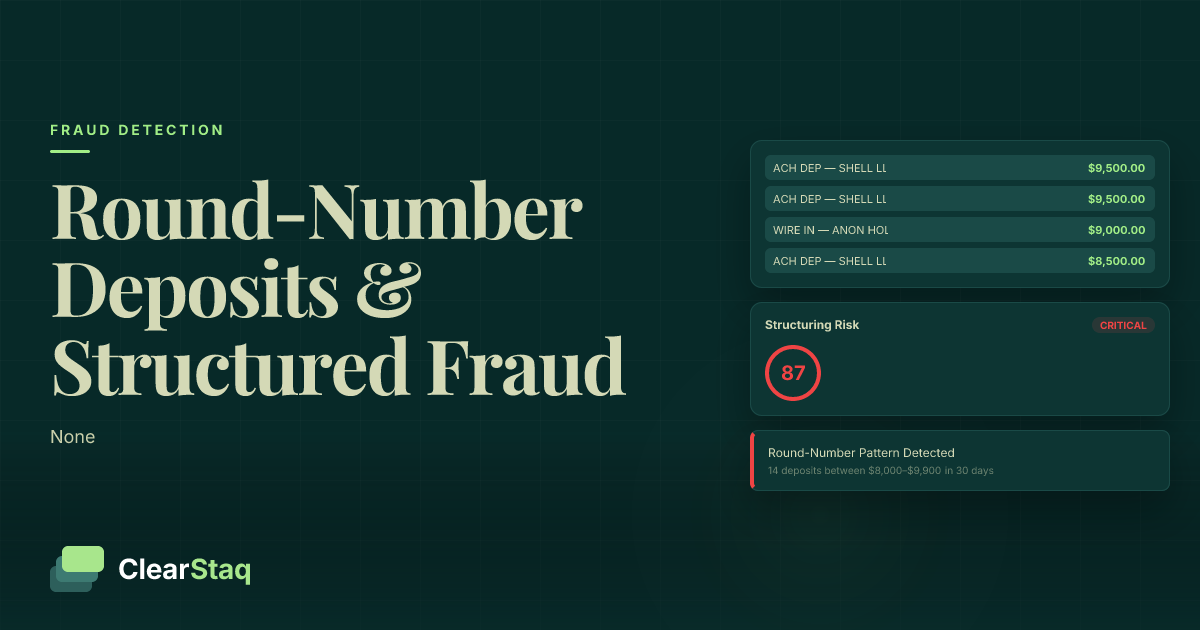
- ClearStaq isn't a list-matching tool — its 27+ fraud signals catch the doctored statements that pass sanctions checks clean.
Why this matters
NCUA examiners check two things during BSA/OFAC reviews: did the credit union screen every member and transaction against sanctions lists, and can staff prove it. A tool that generates too many false positives buries analysts in alerts they can't clear fast enough — a tool that misses real hits creates regulatory exposure that shows up in the next exam letter.
Sanctions screening software alone doesn't solve the whole problem. A member can clear every OFAC, UN, and EU sanctions list check and still be running a synthetic identity or submitting a fabricated bank statement to qualify for a loan. Credit unions that treat sanctions screening and document fraud detection as one decision end up understaffed for the actual risk. Screening loan applicants against sanctions lists is table stakes — catching what happens after the name comes back clean is where most 2026 losses originate.
How this list was ranked
Each tool below is scored against five factors credit unions actually care about: coverage of OFAC SDN, UN, and EU consolidated sanctions lists; integration depth with core processors credit unions run (Fiserv, Jack Henry, Corelation); false-positive rate management; exam-readiness reporting for NCUA reviews; and fit for credit union budgets versus enterprise bank pricing. Rankings draw on aggregated vendor documentation and publicly reported acquisition and integration data reviewed through 2026 — not first-party lab testing.
The ranked list
1. Verafin — the credit union incumbent
Verafin was acquired by Nasdaq for $2.75 billion in 2021, and it remains the most-deployed AML/BSA platform among U.S. credit unions in 2026. It bundles sanctions screening with transaction monitoring and case management in one workflow, which matters for smaller compliance teams that can't run three separate systems. The tradeoff: it's built for the full BSA suite, so if you only need sanctions list-matching, you're paying for more than that. Buy if your credit union wants one system for OFAC screening, SAR filing, and transaction monitoring together.
2. Jack Henry BSA/AML suite — the core-processor bundle
If your credit union already runs Jack Henry's core, its BSA/AML module screens against sanctions lists without a separate integration project. The advantage is procurement speed — no new vendor contract, no new data feed to build. The limit is flexibility: customization for list-matching thresholds is narrower than a standalone AML vendor. Consider if you're already a Jack Henry core customer and want to avoid a second integration.
3. Fiserv Financial Crime Risk Management — the incumbent's add-on
Fiserv-core credit unions get a comparable path: sanctions screening ships as part of Fiserv's financial crime suite, reducing the integration lift. It covers the same OFAC/UN/EU list requirements as standalone tools, but reporting customization for NCUA exam prep tends to require Fiserv professional services. Consider for Fiserv-core credit unions prioritizing speed to deployment over configurability.
4. LexisNexis Bridger Insight XG — the compliance standard
Bridger Insight XG has been a compliance-team standard for over a decade, with sanctions list coverage that extends past OFAC into global watchlists many smaller vendors don't maintain. It's a strong fit for credit unions with cross-border member activity or SBA lending programs that trigger broader watchlist checks. Pricing and implementation timelines run longer than newer API-first tools. Buy if your credit union screens members with international ties or handles SBA-adjacent lending.
5. ComplyAdvantage — the API-first challenger
ComplyAdvantage built its product around a real-time API rather than a batch-upload workflow, which appeals to credit unions modernizing digital onboarding in 2026. It updates sanctions and PEP data continuously rather than on a fixed refresh schedule, cutting the lag between a name entering a watchlist and your system catching it. It's a newer entrant to the credit union space compared to Verafin or LexisNexis, so ask for credit-union-specific references before signing. Consider if you're rebuilding digital onboarding and need real-time list checks in the flow.
6. Alessa — the mid-market flexible option
Alessa positions itself for credit unions that outgrew a core-processor bundle but aren't ready for enterprise AML pricing. Its rules engine lets compliance teams tune false-positive thresholds without vendor tickets, which smaller teams value. Coverage and integration depth trail Verafin and LexisNexis on paper, but the configurability narrows that gap for mid-size credit unions. Consider for credit unions in the $500M-$3B asset range outgrowing core-bundled screening.
7. ClearStaq — the fraud layer, not a replacement
ClearStaq doesn't run sanctions list-matching — it parses bank statements and tax returns and flags document fraud for credit unions using 27+ signals, with results back in under 5 seconds at 99.5% accuracy. The reason it belongs on this list: a member can clear every sanctions check and still submit an altered statement to qualify for a loan the sanctions tool was never built to catch. Pair it with whichever list-matching vendor above fits your core, and the document layer closes the gap sanctions screening leaves open. Buy as the fraud detection layer alongside your sanctions screening system, not instead of it.
Comparison table
| Tool | Best for | Core integration | Verdict |
|---|---|---|---|
| Verafin | Full BSA/AML bundle | Core-agnostic | Buy |
| Jack Henry BSA/AML | Jack Henry core customers | Native Jack Henry | Consider |
| Fiserv Financial Crime | Fiserv core customers | Native Fiserv | Consider |
| LexisNexis Bridger Insight XG | Cross-border/SBA lending | Core-agnostic | Buy |
| ComplyAdvantage | Digital-first onboarding | API-first | Consider |
| Alessa | Mid-market flexibility | Core-agnostic | Consider |
| ClearStaq | Document fraud layer | Core-agnostic | Buy (as add-on) |
Where to buy
- Run any shortlisted vendor through a sandbox test with real (anonymized) member data before signing — false-positive rates vary more in practice than in vendor demos.
- Ask for credit-union-specific references, not just bank references; screening volumes and member risk profiles differ enough that bank case studies won't predict your experience.
- Confirm NCUA exam-readiness reporting is included, not a paid add-on — this is the deliverable examiners actually ask to see.
Catch what sanctions screening misses
ClearStaq flags document fraud in under 5 seconds, before a loan ever closes.
FAQ
What is the best sanctions screening software for credit unions in 2026?
Verafin leads for credit unions wanting one bundled BSA/AML and sanctions screening system, while LexisNexis Bridger Insight XG fits credit unions with cross-border or SBA-adjacent lending. The right choice depends on your core processor and member risk profile.
Do credit unions have to screen against OFAC lists?
Yes, credit unions are required to screen members and transactions against the OFAC SDN list along with UN and EU sanctions lists as part of BSA/AML compliance. NCUA examiners check this documentation during routine exams.
Is sanctions screening software enough to catch loan fraud?
No, sanctions screening only checks names against watchlists and won't catch a doctored bank statement or synthetic identity that clears the list check clean. Document-level fraud detection has to run alongside sanctions screening to close that gap.
How much does sanctions screening software cost for a credit union?
Pricing varies by asset size and screening volume, with core-processor bundles like Jack Henry or Fiserv often costing less upfront than standalone enterprise tools. Get vendor quotes based on your actual member count rather than published list pricing.
Can Jack Henry or Fiserv core systems handle sanctions screening natively?
Both Jack Henry and Fiserv offer BSA/AML modules with sanctions screening built into their core banking platforms, cutting integration time for existing customers. Configurability for false-positive tuning is narrower than standalone AML vendors.
What's the difference between sanctions screening and adverse media screening?
Sanctions screening checks names against government watchlists like OFAC, while adverse media screening searches news and public records for negative coverage tied to a member or applicant. Most compliance programs run both checks together.
How do credit unions reduce false positives in sanctions screening?
Tuning match thresholds and using fuzzy-matching logic that accounts for name variants cuts false positives without missing real hits. Vendors like Alessa let compliance teams adjust these rules directly instead of filing vendor support tickets.
One last thing
Most sanctions screening failures that show up in NCUA exams aren't list-matching misses — they're document fraud that never touched a sanctions check at all. A synthetic identity with a clean name and a fabricated bank statement sails through OFAC screening every time; the fraud shows up in the document, not the name. Credit unions running sanctions screening without a document fraud layer are checking half the risk in 2026.
Related guides
ClearStaq Team
Content Team
The ClearStaq team builds AI-powered tools for bank statement parsing, fraud detection, and income verification.