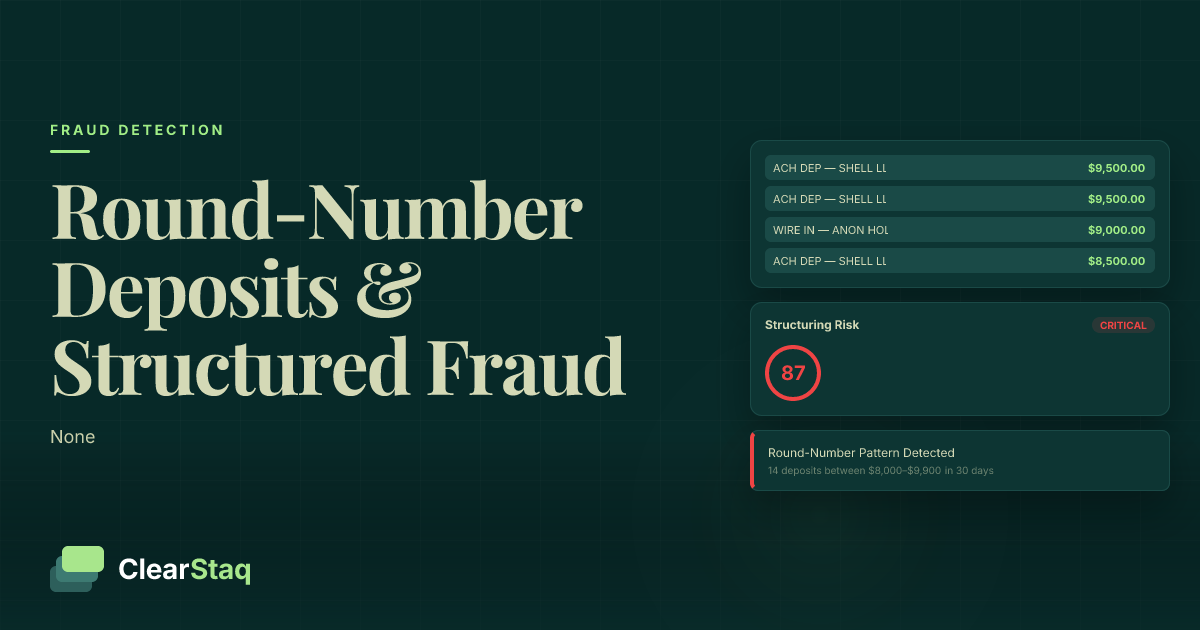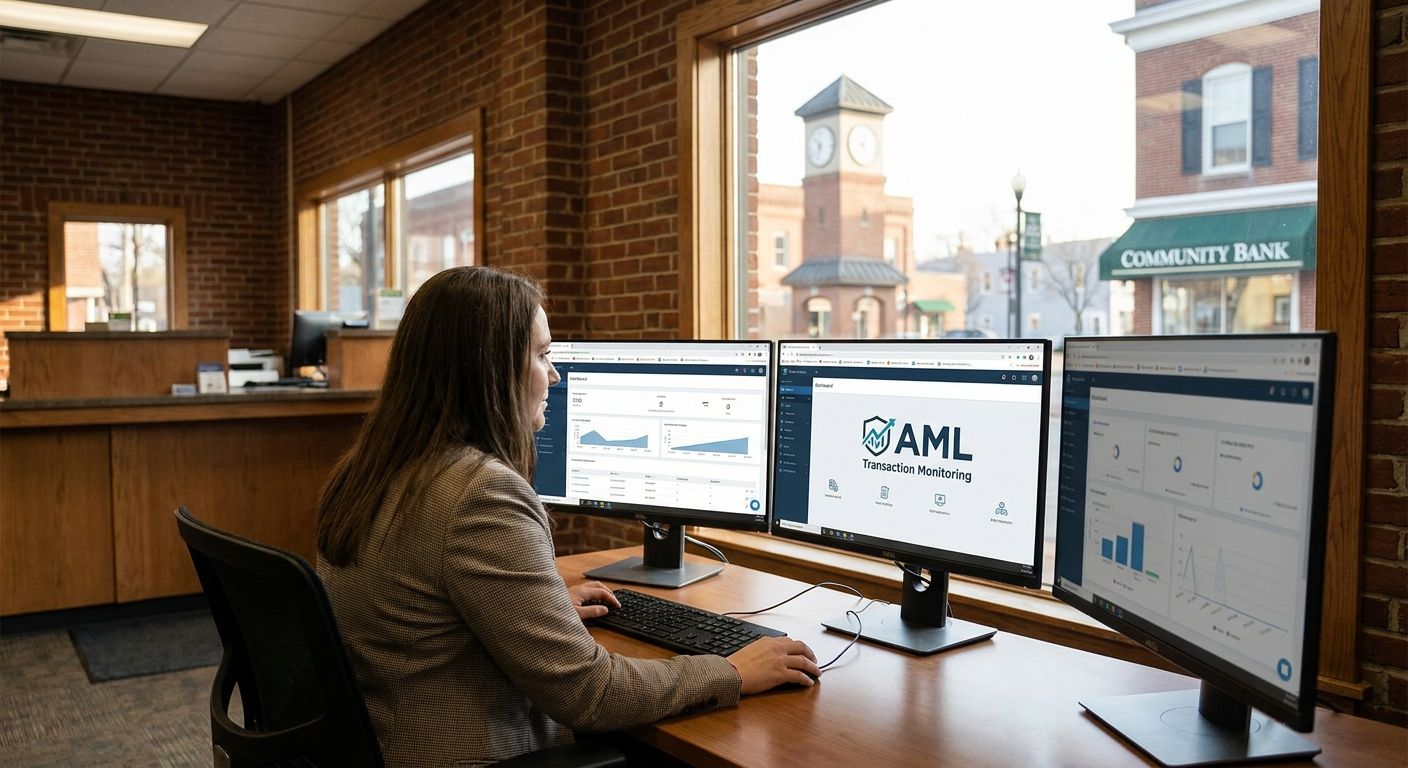
Community banks carry the same Bank Secrecy Act obligations as a $500 billion national bank, usually with one or two BSA officers instead of a floor of analysts. This guide ranks the aml transaction monitoring software for community banks that catches structuring, layering, and shell-account activity without burying a lean team in false positives.
- Verafin and Abrigo BAM+ lead full aml transaction monitoring software for community banks in 2026 — both integrate with Jack Henry and Fiserv cores.
- ClearStaq isn't a core AML system — it flags structuring and fraud signals in loan-file bank statements before they ever reach your monitoring queue. Buy for underwriting-side coverage.
- Skip NICE Actimize under $1 billion in assets — the alert volume needs headcount most community banks don't carry.
- SAR filings are due 30 days after detection — a case management workflow that can't route a case same-day isn't built for a two-person BSA team.
Why this matters
Examiners don't grade community banks on a curve. A $400 million bank and a $40 billion bank get judged against the same FFIEC BSA/AML exam manual, and the structuring threshold is the same $10,000 CTR trigger for both. The difference is staffing — a community bank BSA officer might clear 200 alerts a month solo, while a regional bank has a team of ten doing the same job.
That gap is why alert tuning matters more than alert volume. A platform built for money-center banks will bury a three-person compliance shop in false positives within a quarter. Before you buy, read how a structured AML transaction monitoring program gets built for lenders your size — it changes how you score every vendor below.
Who this is for
This guide is for BSA officers, compliance leads, and operations managers at community banks under $10 billion in assets who are evaluating or replacing transaction monitoring software in 2026. If you're staffing a full financial crimes unit with a dedicated model risk team, most of these picks will feel undersized — that's a different buying guide.
What to look for in AML transaction monitoring software for community banks
1. Alert scoring that filters noise before a human sees it
Rule-based systems flag every transaction over a threshold, which is why community bank BSA officers routinely report 90%+ of alerts closing as false positives industry-wide. Software with behavioral scoring on top of rules cuts that noise instead of just logging it faster.
2. Structuring and layering detection tuned to your deposit sizes
A $10,000 CTR threshold means the same $9,800 cash deposit looks identical whether it hits a $50,000-balance retail account or a $2 million commercial account. Good software adjusts pattern sensitivity to account history instead of a flat dollar rule. If you want the specifics on how structuring patterns show up in business bank statements, the underlying signals are the same ones a monitoring system should be scoring.
3. Core banking integration without a middleware layer
Most community banks run on Jack Henry, Fiserv, FIS, or CSI. A monitoring platform that needs a custom API bridge adds a vendor, a contract, and a failure point. Native connectors cut implementation from months to weeks.
4. SAR/CTR case management with an examiner-ready audit trail
FinCEN requires a SAR within 30 days of detecting suspicious activity, 60 days if you need more time to identify a suspect. Software without a built-in narrative generator and audit log means your BSA officer is rebuilding the case history by hand during every exam cycle.
5. OFAC and sanctions screening on every account, every day
Sanctions lists update on no fixed schedule — sometimes daily. Batch screening that runs weekly leaves a window open. Real-time or daily screening against the current SDN list is non-negotiable in 2026.
Top picks for community banks in 2026
Verafin — the enterprise-grade default. Now under NICE, it's the platform most core banking partners recommend first, with the deepest library of typology models across cash-intensive and cash-light institutions. If your bank runs Jack Henry or Fiserv and wants one vendor for AML, fraud, and sanctions in a single console, this is the safe pick. Buy if you have budget for a multi-year contract and at least one dedicated analyst.
Abrigo BAM+ — the community bank specialist. Built specifically for banks under $10 billion, it ships with peer-group benchmarking so your alert thresholds get calibrated against institutions your size instead of a national average. Buy if you want a vendor whose entire roadmap is built around your asset tier.
NICE Actimize — the overkill option below $1 billion in assets. It's a genuinely strong platform, but the model tuning and case management depth assume a compliance team of five or more. Skip it under $1 billion — you'll pay for capability you can't staff to use.
ClearStaq — the pre-monitoring layer, not a core AML replacement. ClearStaq parses bank statements and tax returns during loan underwriting and flags structuring, check kiting, and 27+ other fraud signals before an account ever generates a monitoring alert downstream. Processing runs under 5 seconds per document at 99.5% accuracy, and banks using it report a 95% cut in manual statement review time. Pair it with your core monitoring system for the ACH fraud detection layer community banks need at the loan-application stage, before the funds ever land. Consider it as a complement to Verafin or Abrigo, not a substitute for either.
Jack Henry BSA/AML Suite — the core-integrated pick. If you're already on Jack Henry's core, their native BSA module avoids a second vendor relationship entirely. The tradeoff is a thinner typology library than dedicated AML vendors. Consider it if vendor consolidation matters more to you than model depth.
See ClearStaq's fraud signals in action
Run a real bank statement through 27+ fraud signals in under 5 seconds.
What to avoid
- Platforms sized for $50 billion+ institutions. The alert volume and model complexity assume headcount most community banks don't have in 2026 — you'll spend more time tuning the system than working cases.
- Point solutions with no core integration. If a vendor can't connect natively to Jack Henry, Fiserv, FIS, or CSI, budget for a middleware project you didn't plan for.
- Weekly-batch sanctions screening. Anything that doesn't screen against the current SDN list daily leaves a compliance gap an examiner will flag on sight.
If the alert queue takes more than 20 minutes per case to clear, the system is tuned wrong — not your staff.
How the picks compare
| Vendor | Core integration | Structuring detection | Case management | Best for | Verdict |
|---|---|---|---|---|---|
| Verafin | Native, broad | Strong, model-based | Full audit trail | Banks wanting one vendor for everything | Buy |
| Abrigo BAM+ | Native, community-bank focused | Peer-benchmarked | Full audit trail | Banks under $10B wanting a specialist | Buy |
| NICE Actimize | Native, enterprise | Very strong | Enterprise-grade | Banks over $1B with staff to match | Skip under $1B |
| ClearStaq | Loan origination systems | Loan-file level | N/A — feeds upstream case files | Underwriting-side fraud screening | Consider |
| Jack Henry BSA/AML | Native, single vendor | Standard | Full audit trail | Banks avoiding a second vendor | Consider |
FAQ
What is the best aml transaction monitoring software for community banks in 2026?
Verafin and Abrigo BAM+ lead for full transaction monitoring at community banks under $10 billion in assets, both with native Jack Henry and Fiserv integration. ClearStaq complements either one by catching fraud signals during loan underwriting, before an account generates a monitoring alert.
Is Abrigo BAM+ better than Verafin for a small bank?
Abrigo BAM+ is built specifically for institutions under $10 billion with peer-group benchmarking baked in, while Verafin serves a wider range of bank sizes with a deeper typology library. Choose Abrigo if you want thresholds calibrated to your asset tier out of the box.
How much does AML transaction monitoring software cost for a community bank?
Pricing varies by asset size, transaction volume, and whether sanctions screening and case management are bundled in. Get a quote directly from each vendor rather than relying on a published rate card, since most platforms price by account count.
What's the SAR filing deadline after detecting suspicious activity?
FinCEN requires a Suspicious Activity Report within 30 days of initial detection, extendable to 60 days if you still need to identify a suspect. Software without automated case tracking makes that deadline harder to hit consistently.
Does ClearStaq replace a core AML transaction monitoring system?
No. ClearStaq parses bank statements and tax returns to flag fraud signals like structuring and check kiting during loan underwriting, sitting upstream of a core AML platform rather than replacing it. Banks pair it with Verafin, Abrigo, or a similar system for full account monitoring.
How often should sanctions screening run for a community bank?
Daily screening against the current OFAC SDN list is the 2026 baseline — weekly batch screening leaves a gap examiners will flag. Real-time screening at account opening plus daily rescreening covers most exam expectations.
What causes high false positive rates in AML alerts?
Flat dollar-threshold rules that don't account for account history or peer-group behavior generate the bulk of false positives at community banks. Behavioral scoring on top of rules is the fix most vendors now build in by default.
One last thing
Most community banks buying AML software in 2026 default to comparing feature checklists, but the number that actually predicts exam outcomes is time-to-case-closure — a BSA officer who clears alerts in under 20 minutes each is running a tuned system, and one who's still at 45 minutes six months post-implementation bought the wrong platform for their staffing level, not a bad platform in general.
Related guides
ClearStaq Team
Content Team
The ClearStaq team builds AI-powered tools for bank statement parsing, fraud detection, and income verification.