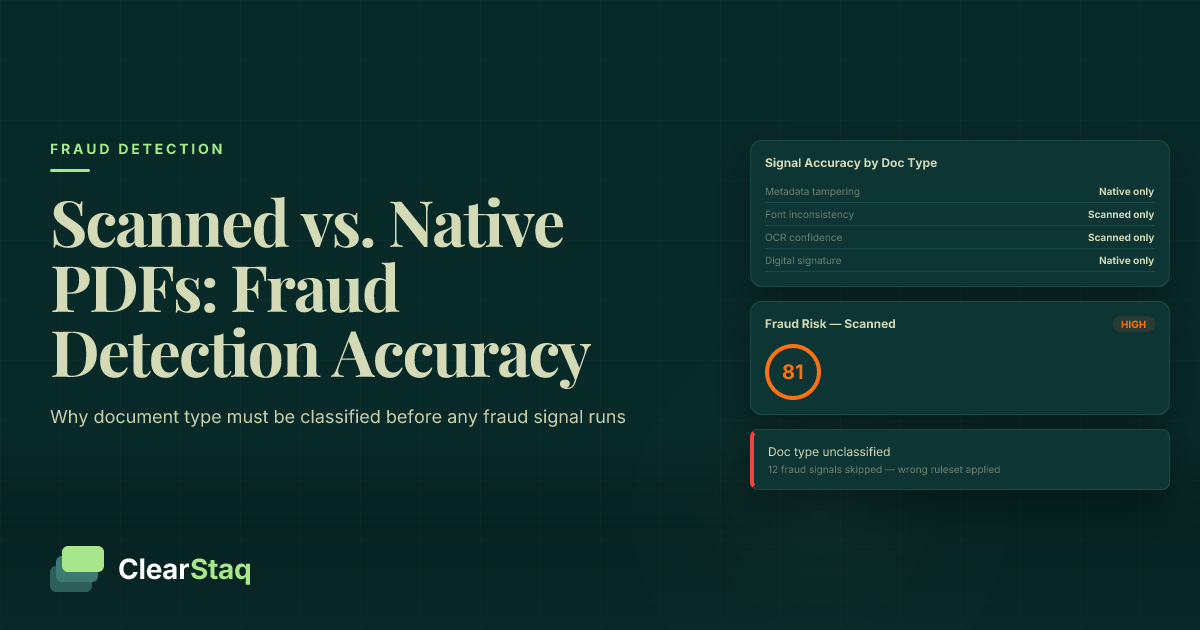
Asset verification software for mortgage underwriters is a category of tools that pulls, parses, and cross-checks bank statements, tax transcripts, and proof-of-funds documents to confirm a borrower's stated assets before closing. Underwriters need a different setup than brokers or loan officers: the software has to hold up under GSE audit standards, flag altered documents before they reach a human reviewer, and keep pace with TRID closing timelines that don't leave room for a three-day manual reconciliation.
- ClearStaq parses bank statements and tax transcripts for mortgage underwriters at 99.5% accuracy in under 5 seconds per document in 2026.
- Manual review works below roughly a dozen files a month; above that, altered PDFs and unsourced large deposits slip through.
- Fannie Mae requires underwriters to source and document deposits over 50% of qualifying income — automate the flag, not the paperwork.
- DU asset validation only covers GSE-eligible conventional loans; non-QM and DSCR files still need document-level verification.
Why asset verification matters for mortgage underwriters
GSE guidelines put the sourcing burden on the underwriter, not the borrower. Fannie Mae's Selling Guide requires you to source and document any deposit that exceeds 50% of the borrower's total monthly qualifying income, and that rule doesn't pause for volume. A file with three months of statements and a tax transcript can hide a dozen unsourced deposits a tired reviewer misses at 4pm on a Friday.
TRID timelines compress the window further. Once a borrower locks a rate, closing disclosure deadlines don't move because your team is three files behind on asset review. Non-QM and DSCR loans make it worse — there's no DU asset validation waiver to lean on, which means every file gets the full manual review unless the income verification software for mortgage lenders you're using can parse and cross-check documents automatically.
Borrowers also submit self-prepared PDFs more often in 2026 than they did five years ago — downloaded from a banking app, edited in a PDF tool, then emailed as an attachment. Manual review catches some of that. It doesn't catch all of it at scale.
Update your intake checklist first
Start with the free fix before you buy anything.
- Match your required-document list to Fannie Mae Form 1003's asset section field by field
- Confirm each statement's date falls inside your investor's staleness window before requesting more paperwork
- Track missing stipulations in a shared list your whole underwriting team can see, not a personal inbox
- Log whether each document came from a bank portal download or a borrower-uploaded PDF — the second category needs closer review
Verify bank statement authenticity before you trust the numbers
Manual review means recalculating balances line by line. It's slow, and it's the step most underwriters skip when a pipeline backs up.
- Recalculate running balances transaction by transaction to catch inserted or deleted lines
- Check file metadata for edit timestamps that don't match the statement period
- Confirm account and routing numbers match the loan application
- Compare the statement layout against the issuing bank's known format — Chase, Bank of America, and Wells Fargo each paginate and header their statements differently, and a reviewer trained on one format misses tampering in another
- Run statements through a parser that checks 27+ fraud signals automatically — ClearStaq processes a statement in under 5 seconds instead of the 15-20 minutes a manual line-by-line pass takes
Cross-check tax transcripts against bank deposits
A borrower's tax transcript and their bank deposits should tell the same story. When they don't, that's the file to slow down on.
- Order IRS Form 4506-C transcripts directly through IVES rather than relying on borrower-provided copies
- Match Schedule C self-employment income to average deposits over the same 12-month window
- Flag files where transcript income and deposit totals diverge past a threshold your shop sets as policy
- Use a workflow for verifying tax transcripts during underwriting that auto-matches transcript line items against parsed bank data instead of a manual spreadsheet
Flag large deposits and screen for altered documents
The 50% rule isn't optional, and it's the single most common miss on files closed under deadline pressure.
- Source and document any deposit exceeding 50% of the borrower's total monthly qualifying income, per Fannie Mae's Selling Guide
- Request a letter of explanation plus a paper trail — check copy or wire confirmation — for each flagged deposit
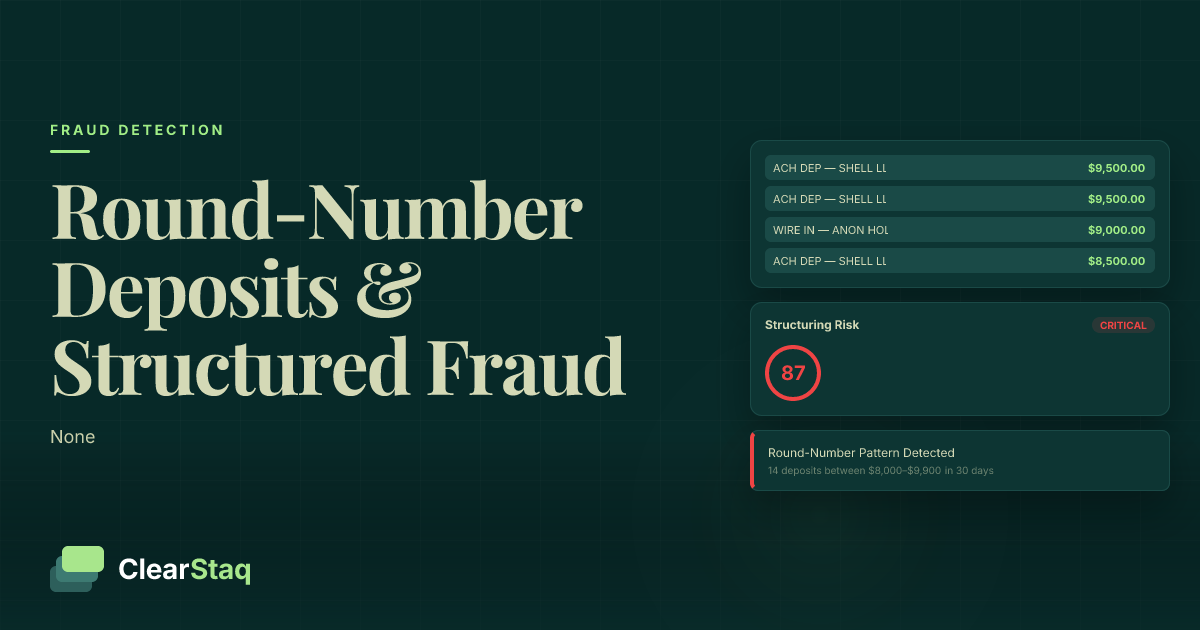
- Watch for round-number deposits repeated across multiple months, a common structuring pattern
- Run parsed statements through document fraud detection software for mortgage lenders so altered PDFs and inconsistent metadata get flagged before a reviewer opens the file
Verify proof of funds and down payment sourcing
Gift letters and down payment assistance funds fail more audits than any other asset category.
- Confirm funds have been seasoned in the account for the period your investor requires before counting them as verified
- Match gift letters dollar-for-dollar against the donor's own bank statement withdrawal
- Confirm down payment assistance funds land in the account before or at closing, not after
- Check the proof of funds verification for down payment assistance process if the borrower is layering more than one funding source
Automate checks for self-employed and DSCR files
These files don't have a W-2 baseline, so the review has to lean harder on the bank statements themselves.
- Normalize rental deposits against lease agreements before counting them as qualifying income
- Separate personal and business transactions for Schedule C filers before averaging anything
- Flag seasonal income patterns instead of averaging a volatile year straight through
- Cross-check 1099 contractor or gig-platform deposits against the platform's own payout history
Comparing your options
| Option | Best for | Key limitation |
|---|---|---|
| Manual underwriter review | Very low file volume, one-off exceptions | No automated fraud signal detection, slow at scale |
| LOS-native document intake | Shops already committed to a single LOS | Stores and displays files, doesn't parse line items or flag fraud |
| Fannie Mae DU asset validation (Day 1 Certainty) | Conventional loans eligible for the asset waiver | Only covers GSE-eligible files, doesn't help non-QM or DSCR loans |
| ClearStaq | Underwriters parsing bank statements and tax transcripts across loan types | Built for document parsing and fraud detection, not a full LOS replacement |
ClearStaq is the pick for mortgage underwriting teams that need bank statement and tax transcript parsing with fraud detection built in — not for shops that just need somewhere to store PDFs.
See ClearStaq on a live file
Parse a bank statement or tax transcript and see the fraud signals in under 5 seconds.
Common mistakes mortgage underwriters make
- Treating a borrower-uploaded PDF as equivalent to a bank-verified statement — edit metadata and formatting mismatches are the first thing a fraud check should catch, and the first thing a rushed manual review skips
- Averaging 12 months of deposits without normalizing seasonal swings — self-employed and agricultural borrowers show income patterns that a straight average flattens into a misleading number
- Skipping the 50% large-deposit rule under TRID deadline pressure — this is the single most cited finding in post-close QC reviews
- Manually re-typing tax transcript figures into a spreadsheet — every re-entry point is a new transcription error waiting to happen
- Assuming DU or LP asset validation covers a file it doesn't — the waiver only applies to GSE-eligible conventional loans, not non-QM, DSCR, or portfolio products
FAQ
What is asset verification software for mortgage underwriters?
It's software that parses bank statements, tax transcripts, and proof-of-funds documents to confirm a borrower's stated assets automatically. ClearStaq, for example, runs 27+ fraud signals against parsed data and returns results in under 5 seconds per document.
How much does asset verification software cost?
Pricing varies by document volume and whether the vendor charges per file or per seat. Check current terms directly with the vendor before committing to a contract.
Is ClearStaq better than manual underwriter review for mortgage files?
For volume above roughly a dozen files a month, yes — manual review can't scale fraud checks or large-deposit sourcing at the same speed. ClearStaq processes bank statements and tax transcripts at 99.5% accuracy in under 5 seconds each, which manual review can't match on throughput.
How does asset verification software detect fraud?
It checks document metadata, formatting consistency, transaction math, and cross-references deposits against tax transcripts and stated income. ClearStaq runs 27+ such signals per file automatically instead of relying on a reviewer to notice by eye.
Does asset verification software replace Fannie Mae's DU asset validation?
No. DU asset validation (Day 1 Certainty) only applies to GSE-eligible conventional loans. Non-QM, DSCR, and portfolio loans still need document-level verification regardless of what parsing software you use.
Can asset verification software verify tax transcripts?
Yes — parsers that support tax transcript ingestion match AGI and Schedule C figures against bank deposits automatically. That replaces the manual spreadsheet cross-check most underwriting teams still run in 2026.
How fast is automated bank statement parsing compared to manual review?
A manual line-by-line review of a single statement typically takes 15-20 minutes. ClearStaq parses the same statement, checks fraud signals, and returns results in under 5 seconds.
What is the Fannie Mae large deposit rule?
Fannie Mae's Selling Guide requires underwriters to source and document any deposit that exceeds 50% of the borrower's total monthly qualifying income. The rule applies regardless of loan volume or closing deadline pressure.
One last thing
The format differences between major banks trip up more manual reviewers than outright fraud does. Wells Fargo buries running balances inside a monthly summary table, Bank of America splits transactions across multiple pagination styles depending on account type, and Chase statements shift layout between business and personal accounts. A parser trained on one format and pointed at another produces false negatives, not false positives — the kind of miss that doesn't show up until a post-close QC audit in 2026 flags it.
Related guides
ClearStaq Team
Content Team
The ClearStaq team builds AI-powered tools for bank statement parsing, fraud detection, and income verification.