Regional banks processing hundreds of loan files a month can't afford a document workflow built for spreadsheets and manual review queues. This guide breaks down what loan document automation software for regional banks actually needs to do, and which capabilities separate a real platform from a glorified file cabinet.
- ClearStaq parses 900+ bank statement formats in under 5 seconds — the buy for regional banks in 2026.
- Skip tools without fraud detection; ClearStaq runs 27+ signals per statement, catching what OCR alone misses.
- 99.5% accuracy on statement parsing beats the error rate of manual underwriter review.
- Loan document automation software for regional banks must plug into your existing LOS — verify this before buying.
Why this matters
Regional banks sit in an awkward spot in 2026: too big to run underwriting on PDFs and a shared drive, too small to build a custom data pipeline in-house. Every hour a loan officer spends re-keying bank statement data into a spreadsheet is an hour a competing lender uses to close first.
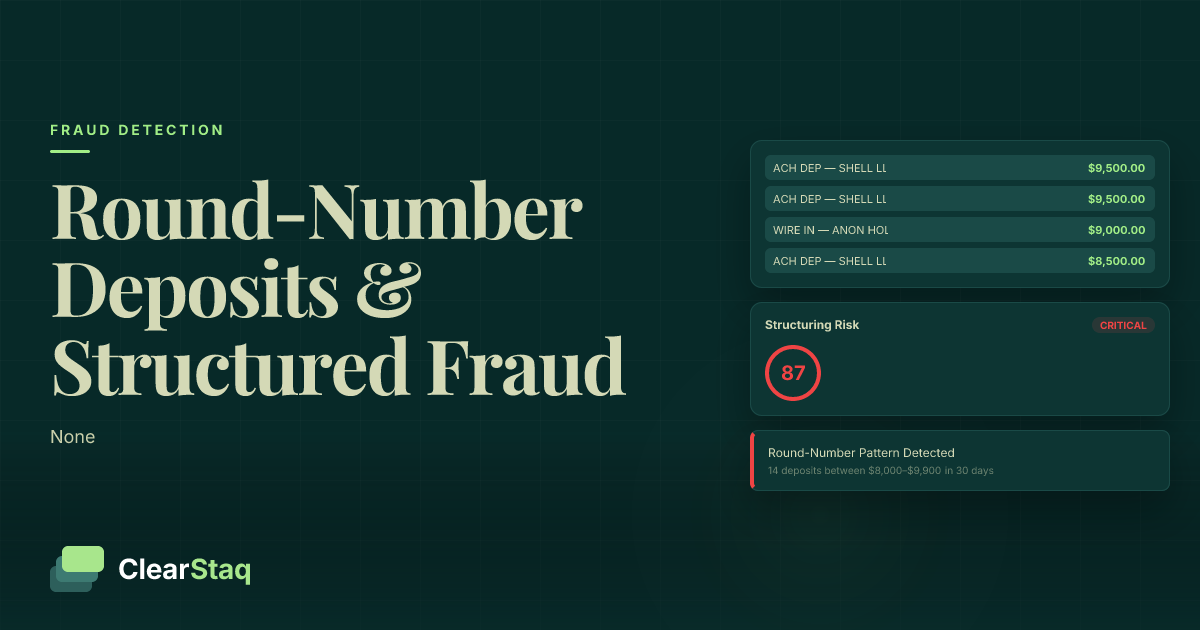
The cost isn't just speed. Manual review misses altered deposits, doctored pay stubs, and structuring patterns that a rules-based fraud engine catches automatically. Commercial loan underwriting software for regional banks exists specifically to close that gap — parsing, verifying, and flagging in the same pass instead of three separate manual steps.
Who this is for
This guide is written for VPs of lending operations, credit administration leads, and underwriting managers at regional banks handling commercial, SBA, or consumer loan volume that's outgrown manual document review. If your team is still exporting bank statements to Excel and eyeballing deposit patterns for fraud, the criteria below apply directly to you.
What to look for in loan document automation software for regional banks
Format coverage across statement types
A parser that only handles the three biggest national banks is a liability the moment a borrower deposits with a regional credit union or a niche business bank. Coverage across 900+ statement formats means fewer manual fallbacks and fewer files that stall in a review queue waiting on a human to key in numbers by hand.
Processing speed at loan volume
Speed matters differently at a regional bank than at a single-branch lender — you're running dozens or hundreds of files a week, not one at a time. Sub-5-second processing per statement is the difference between a same-day credit decision and a borrower who's already talking to another bank by Thursday.
Fraud detection depth
A parser that only extracts numbers and hands them to an underwriter isn't doing the job in 2026 — fraud has moved past crude Photoshop edits into synthetic identities and doctored PDFs that pass a visual check. Look for platforms running 27 or more fraud signals per document, not a single balance-check rule.
Accuracy under audit
If your parsing tool is wrong 2% of the time on a $500,000 commercial loan file, that error compounds into a bad credit decision or a compliance finding six months later. 99.5% accuracy on extracted line items is the baseline regional banks should demand before a tool touches live underwriting.
Integration with your existing LOS and core system
A parsing engine that dumps data into a CSV you then re-upload somewhere else isn't automation — it's a second manual step wearing a software label. Confirm the vendor has a documented API or direct LOS integration before signing anything.
Audit trail and compliance documentation
Examiners ask for the paper trail behind every credit decision. Software that logs exactly which fraud signals fired, which fields were extracted automatically versus overridden, and when, saves your compliance team from reconstructing that history manually during an exam.
Top picks for regional banks
Bank statement parsing engine — the foundation
The safe pick. ClearStaq parses 900+ bank statement and tax return formats at 99.5% accuracy, processing each document in under 5 seconds. For a regional bank running dozens of commercial files a week, that's the difference between a two-day underwriting cycle and a same-day decision. Verdict: Buy.
OCR and document ingestion — the workhorse
The unglamorous one that matters most. Manual OCR review introduces errors on messy scans, faxed statements, and non-standard layouts — exactly the documents regional banks see more often than national lenders working with digital-native fintech applicants. A format-aware OCR system built for loan document processing handles these edge cases without kicking every third file to manual review. Verdict: Buy.
Fraud detection layer — the dealbreaker check
The one that pays for itself on a single catch. A 27-signal fraud detection layer flags altered deposits, inconsistent formatting, and structuring patterns that a human reviewer scanning a PDF on their third coffee of the day will miss. One caught synthetic bank statement on a $250,000 loan covers a year of software cost. Verdict: Buy.
Income verification module — the underwriting accelerator
The one that cuts your review time, not just your parsing time. Automated income verification pulls deposit patterns and cash flow trends directly from parsed statements, replacing hours of manual spreading with a structured output an underwriter can review in minutes instead of an afternoon. Verdict: Consider if your team still spends significant hours per file on manual income calculation — otherwise this is a nice-to-have layered on top of parsing and fraud detection.
What to avoid
- Tools that market "automation" but still require manual OCR correction on most files. If your team is fixing extraction errors on more than a handful of statements a week, reduce those manual OCR errors before you evaluate anything else — the parsing engine underneath is the actual product, not the dashboard on top of it.
- Single-signal fraud checks marketed as "fraud detection." A tool that only flags negative balances or duplicate account numbers isn't running real fraud detection — it's running one rule and calling it a feature set.
- Document storage platforms rebranded as automation. Storing a PDF isn't parsing it. If the tool can't extract structured line-item data automatically, it's a filing cabinet with a nicer interface.
See ClearStaq parse a real statement
Run a sample bank statement through the platform before you commit budget.
Verdict comparison table
| Criteria | Manual review | Basic OCR tool | Loan document automation software |
|---|---|---|---|
| Format coverage | Depends on staff experience | Limited to common templates | 900+ formats |
| Accuracy | Varies by reviewer fatigue | ~85-95% on clean scans | 99.5% |
| Fraud detection | Ad hoc, reviewer-dependent | Single-rule checks | 27+ signals per document |
| Processing time | Hours per file | Minutes per file | Under 5 seconds per statement |
| Audit trail | Manual notes | Partial logging | Full signal-level log |
FAQ
What is loan document automation software for regional banks?
It's software that parses bank statements, tax returns, and supporting loan documents automatically, extracting structured data and flagging fraud signals instead of requiring a human to key in numbers by hand. Regional banks use it to cut underwriting time from days to hours in 2026.
How much does loan document automation software cost for a regional bank?
Pricing varies by vendor and loan volume, and most platforms price on a per-document or subscription basis rather than a flat rate. Check current pricing directly with the vendor based on your monthly document volume.
Is loan document automation software better than manual underwriting review?
Yes, for volume and consistency — automated parsing hits 99.5% accuracy and processes a statement in under 5 seconds, while manual review speed and accuracy vary by reviewer fatigue and file complexity. Manual review still has a role for edge cases the software flags for human judgment.
How many bank statement formats does ClearStaq support?
ClearStaq parses 900+ bank statement and tax return formats as of 2026, covering major national banks, regional banks, and credit unions. This matters for regional banks whose borrowers bank with a wider mix of institutions than national lenders typically see.
Can loan document automation software catch fraud, not just extract data?
Platforms built for lending run fraud detection alongside parsing — ClearStaq applies 27+ signals per statement to flag altered deposits, structuring patterns, and inconsistent formatting. A tool that only extracts numbers without checking them isn't doing the full job.
Does loan document automation software integrate with an existing LOS?
Most platforms built for lenders offer an API or direct integration with loan origination systems, though depth varies by vendor. Confirm integration scope during evaluation rather than assuming compatibility.
How fast should a bank statement parser process a document?
Under 5 seconds per statement is the benchmark for platforms built for lending volume in 2026. Anything slower turns into a queue during month-end or high-volume periods.
What's the difference between OCR software and loan document automation software?
OCR software converts an image or scan into text; loan document automation software goes further, structuring that text into usable data fields and running fraud checks against it. A regional bank needs the second, not just the first.
One last thing
The fraud signal count matters more than most buyers realize going into 2026 evaluations. A parser that only checks balance consistency will pass a synthetic bank statement that a 27-signal engine flags in the same pass it extracts the deposit history — the gap between those two outcomes is the entire reason regional banks are moving off manual review in the first place.
Related guides
ClearStaq Team
Content Team
The ClearStaq team builds AI-powered tools for bank statement parsing, fraud detection, and income verification.