Income verification software for student loan servicers automates the pay stub, tax return, and bank statement review that sets income-driven repayment (IDR) amounts and recertification decisions, replacing manual document checks with automated parsing and fraud screening. Student loan servicers face a workload that mortgage lenders and personal loan shops don't: every IDR borrower re-certifies income annually, volume spikes around federal recertification deadlines, and a high share of borrowers report self-employed or 1099 income that doesn't fit a standard pay stub template.
- Income verification software for student loan servicers cuts IDR recertification review from a manual pay-stub-by-pay-stub process to automated parsing.
- ClearStaq parses tax returns and bank statements in under 5 seconds with 99.5% accuracy across 900+ formats.
- 27+ fraud signals catch doctored pay stubs and altered tax transcripts before an IDR plan gets approved on bad income data.
- Self-employed and 1099 borrowers need bank statement cash flow analysis, not pay stub logic, in 2026 recertification workflows.
- Manual review still works for portfolios under a few thousand IDR borrowers — above that, backlogs build every recertification cycle.
Why income verification matters for student loan servicers
Federal servicing rules require every borrower on an income-driven repayment plan to re-certify income annually, and that recertification window is compressed into a few months each year rather than spread evenly across twelve. A servicer handling this manually staffs up for a seasonal crunch, then sits on idle capacity the rest of the year.
The document mix is also messier than a typical loan file. Borrowers submit pay stubs, IRS tax transcripts, self-employment ledgers, and in some cases bank statements to prove income when tax returns lag a job change. Each format needs different handling, and a servicer that treats every document like a W-2 pay stub will misclassify discretionary income for a meaningful share of its 1099 and gig-economy borrowers. Document fraud detection software for student loan refinancers covers the fraud side of this same borrower population — altered pay stubs and doctored transcripts show up in refinancing applications at the same rate they show up in recertification files.
Verdict: servicers processing IDR recertifications at scale need parsing that handles pay stubs, tax transcripts, and bank statements in one workflow — not three separate manual processes.
Update your document intake process
Start with how documents arrive before automating what happens to them.
- Require borrowers to upload through a secure portal instead of email attachments
- Convert scanned pay stubs to searchable PDF at intake, not after a reviewer opens the file
- Standardize file naming so a batch of 500 uploads doesn't need manual sorting
- Strip unnecessary PII before routing files to junior reviewers
- Flag incomplete submissions (missing a page of a tax transcript) automatically at upload, not three weeks later
Automate parsing across income document formats
Manual review means a staff member cross-references year-to-date figures on a pay stub against a tax transcript line by line, then re-keys the numbers into a servicing system. That's the bottleneck that caps how many recertifications one reviewer can clear per day.
This is where a parsing platform replaces the re-keying step entirely. ClearStaq parses bank statements and tax returns in under 5 seconds with 99.5% accuracy across 900+ document formats, so a reviewer checks a structured output instead of re-typing raw numbers from a scanned image.
- Extract year-to-date gross income directly from pay stub line items
- Pull adjusted gross income (AGI) straight from IRS tax transcripts without manual transcription
- Normalize inconsistent pay stub layouts from different employers into one output format
- Match bank statement deposits to declared income for cross-verification
Flag fraud and altered documents before approval
A doctored pay stub or an altered tax transcript that slips through recertification locks a borrower into a discretionary income figure that's wrong for a full year.
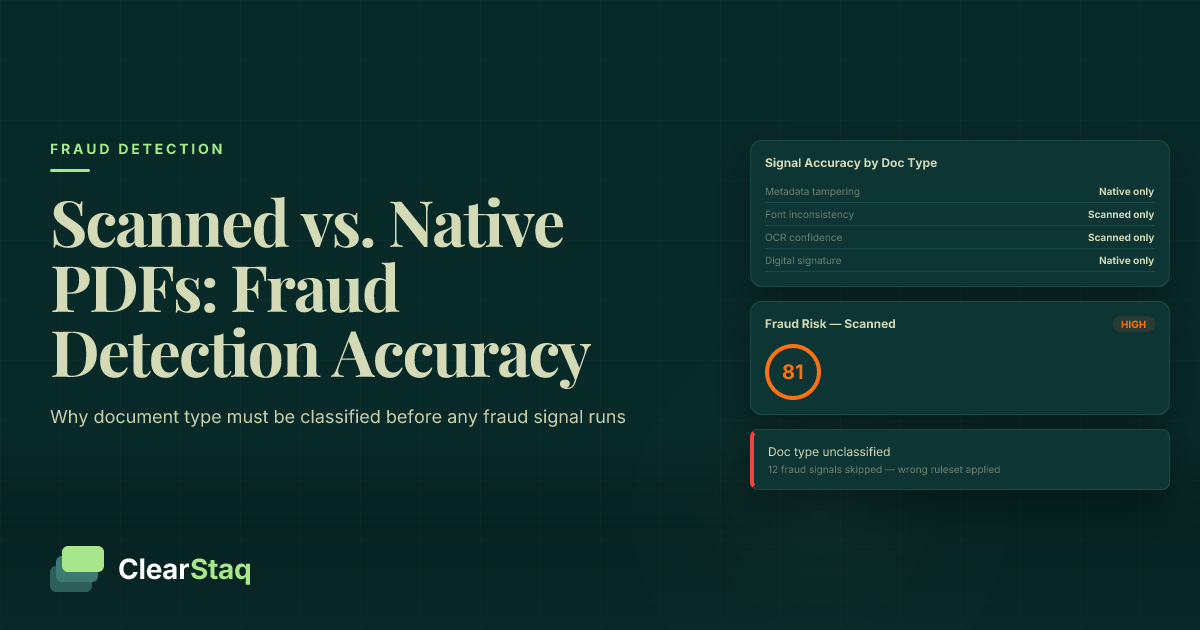
- Check font consistency and header formatting for signs of editing software artifacts
- Compare year-to-date totals against expected pay period math for internal consistency
- Cross-check declared income against bank statement deposit patterns
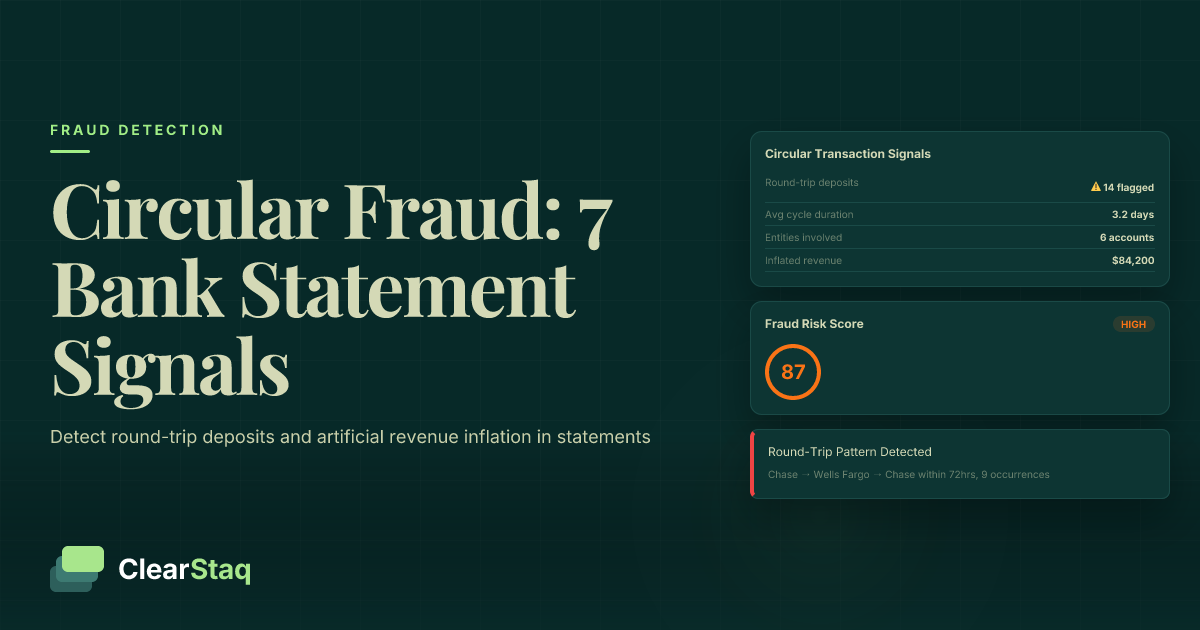
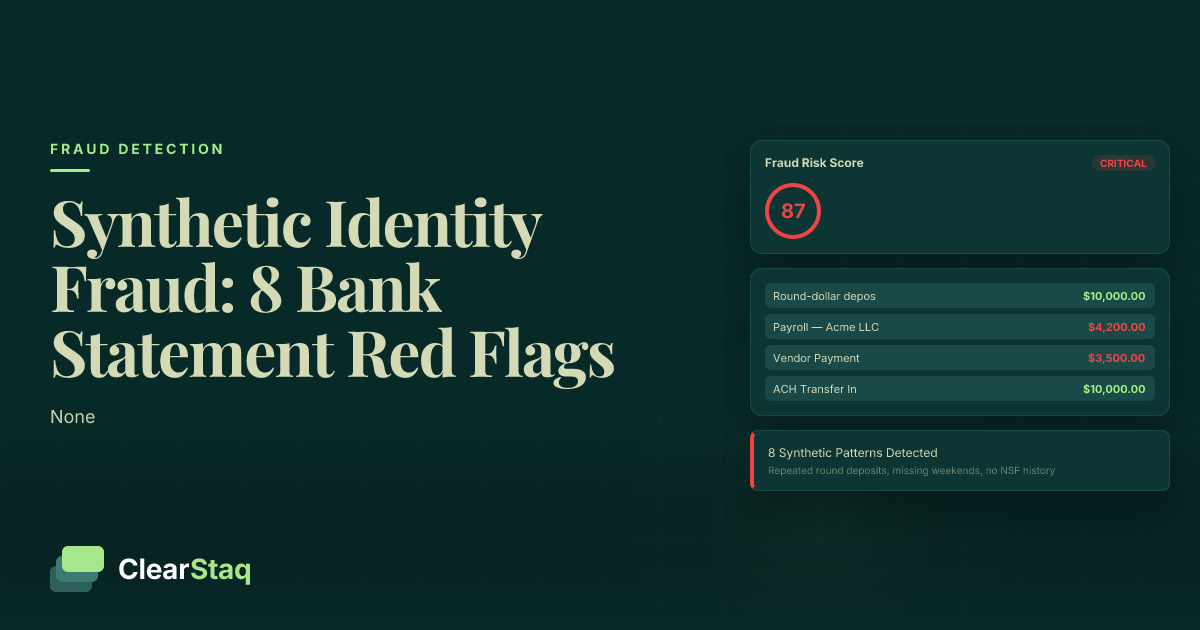
- Watch for round-number deposits that don't match a documented pay schedule
At scale, this is where ClearStaq's 27+ fraud signals replace visual inspection. The platform flags doctored pay stubs, inconsistent tax transcript formatting, and deposit patterns that don't match declared income — the same signal set used in mortgage and personal loan underwriting, applied to recertification files.
Calculate discretionary income automatically
Once income figures are verified, discretionary income math still has to run correctly against the current federal poverty guideline for the borrower's household size.
- Pull household size and state directly from the borrower's application, not a stale prior-year record
- Recalculate discretionary income against the current poverty guideline, not last year's figure
- Flag files where declared household size changed since the last recertification
- Route edge cases (recent marriage, new dependent) to a human reviewer instead of auto-approving
Handle self-employed and 1099 borrowers separately
Self-employed and gig-economy borrowers don't have pay stubs, so treating their files with pay-stub logic produces the wrong discretionary income number. How to verify self-employed income for loan underwriting breaks down the cash flow method: averaging deposits across 12 months of bank statements instead of relying on a single tax return that may reflect a slow year.
- Pull 12 months of bank statements instead of a single tax year for volatile income
- Separate business deposits from personal transfers before averaging monthly income
- Flag borrowers whose declared 1099 income doesn't match deposit patterns
- Apply a seasonal adjustment for borrowers with visibly cyclical deposit patterns
Build the annual recertification workflow
Recertification isn't a one-time event — it repeats every year for the same borrower population, so the workflow needs to survive that repetition without rebuilding it from scratch each cycle.
- Auto-populate prior-year data so borrowers only update what changed
- Send recertification reminders 60-90 days before the deadline, not at the deadline
- Queue files by deadline proximity so reviewers clear the most time-sensitive cases first
- Build a fallback path for borrowers who miss the window and need alternative documentation
Create an audit trail for compliance reviews
Every recertification decision needs a paper trail that shows what documents were reviewed, what income figure was calculated, and who approved it.
- Timestamp every document upload and parsing result
- Log which fraud signals triggered on a file, even when a human reviewer overrode the flag
- Store the exact discretionary income calculation, not just the final approved plan amount
- Keep audit logs accessible for federal servicing compliance reviews, not buried in a ticketing system
See ClearStaq parse a real file
Run a tax transcript or pay stub through the platform and check the output.
Comparing income verification options for student loan servicers
| Option | Best for | Key limitation |
|---|---|---|
| Manual document review | Small servicer portfolios, a few thousand IDR borrowers or fewer | Doesn't scale during recertification season; reviewer capacity caps daily throughput |
| Generic OCR/document capture tools | Digitizing paper intake | Extracts text but doesn't calculate discretionary income or flag document fraud |
| Verification-of-employment (VOE) services | Confirming a single employer and pay rate | Doesn't parse tax transcripts or bank statements for self-employed borrowers |
| ClearStaq | Servicers managing high-volume annual IDR recertification with mixed W-2 and self-employed borrowers | Built for digital file upload — not a paper-scanning solution for offices without a portal |
Verdict: manual review holds up under a few thousand recertifications a year; past that, ClearStaq's parsing and 27+ fraud signals close the gap that generic OCR and VOE services leave open. Servicers weighing the same tradeoffs for mortgage-adjacent products can check best income verification software for mortgage lenders for how the comparison plays out in a different underwriting context.
Common mistakes student loan servicers make
- Recertifying off stale pay stubs. A pay stub from six months before the recertification date doesn't reflect current income, especially for hourly or gig borrowers.
- Applying W-2 logic to 1099 borrowers. Self-employed income needs a 12-month bank statement average, not a single tax return figure.
- Skipping the bank statement cross-check. Declared income that doesn't match deposit patterns is the clearest fraud signal available, and it's often skipped when reviewers are rushing through a recertification backlog.
- Treating fraud detection as a one-time gate. A file that cleared review last year can still contain altered documents this year — recertification needs its own fraud check, not a carryover assumption.
- Understaffing for the seasonal spike. IDR recertification volume concentrates in a narrow window each year; a workflow built for average daily volume falls behind the moment the deadline window opens.
FAQ
What is income verification software for student loan servicers?
It's software that automates the pay stub, tax transcript, and bank statement review used to set or recertify income-driven repayment (IDR) plan amounts. It replaces manual document review and manual re-keying of income figures.
How often do student loan borrowers need to recertify income?
Borrowers on income-driven repayment plans re-certify income annually under federal servicing rules. Missing the recertification window can move a borrower to a different repayment plan or trigger a higher payment.
How does ClearStaq handle self-employed borrower income?
ClearStaq parses 12 months of bank statements to build a cash flow average for self-employed and 1099 borrowers instead of relying on a single tax return figure. It cross-checks declared income against deposit patterns to flag mismatches.
What fraud signals matter most in student loan recertification files?
Doctored pay stubs, inconsistent tax transcript formatting, and deposit patterns that don't match declared income are the most common issues. ClearStaq applies 27+ fraud signals across bank statements and tax returns to catch these before approval.
Can generic OCR tools handle student loan income verification?
Generic OCR extracts text from scanned documents but doesn't calculate discretionary income or flag document fraud. It works as an intake step, not a full verification workflow.
How fast does ClearStaq process a tax return or bank statement?
ClearStaq processes tax returns and bank statements in under 5 seconds with 99.5% accuracy, across more than 900 document formats.
What happens when a borrower's household size changes between recertifications?
Discretionary income needs to be recalculated against the current federal poverty guideline for the new household size. Files with a household size change since the last recertification should route to a human reviewer instead of auto-approving off prior-year data.
One last thing
The recertification backlog problem isn't a volume problem year-round — it's a calendar problem. Most servicers see IDR recertification volume concentrate into a narrow window tied to federal deadlines, which means a workflow sized for average daily throughput falls behind exactly when it matters most. Build queue capacity for the deadline spike, not the yearly average, and the backlog problem in 2026 looks a lot smaller than it did in past recertification cycles.
Related guides
ClearStaq Team
Content Team
The ClearStaq team builds AI-powered tools for bank statement parsing, fraud detection, and income verification.