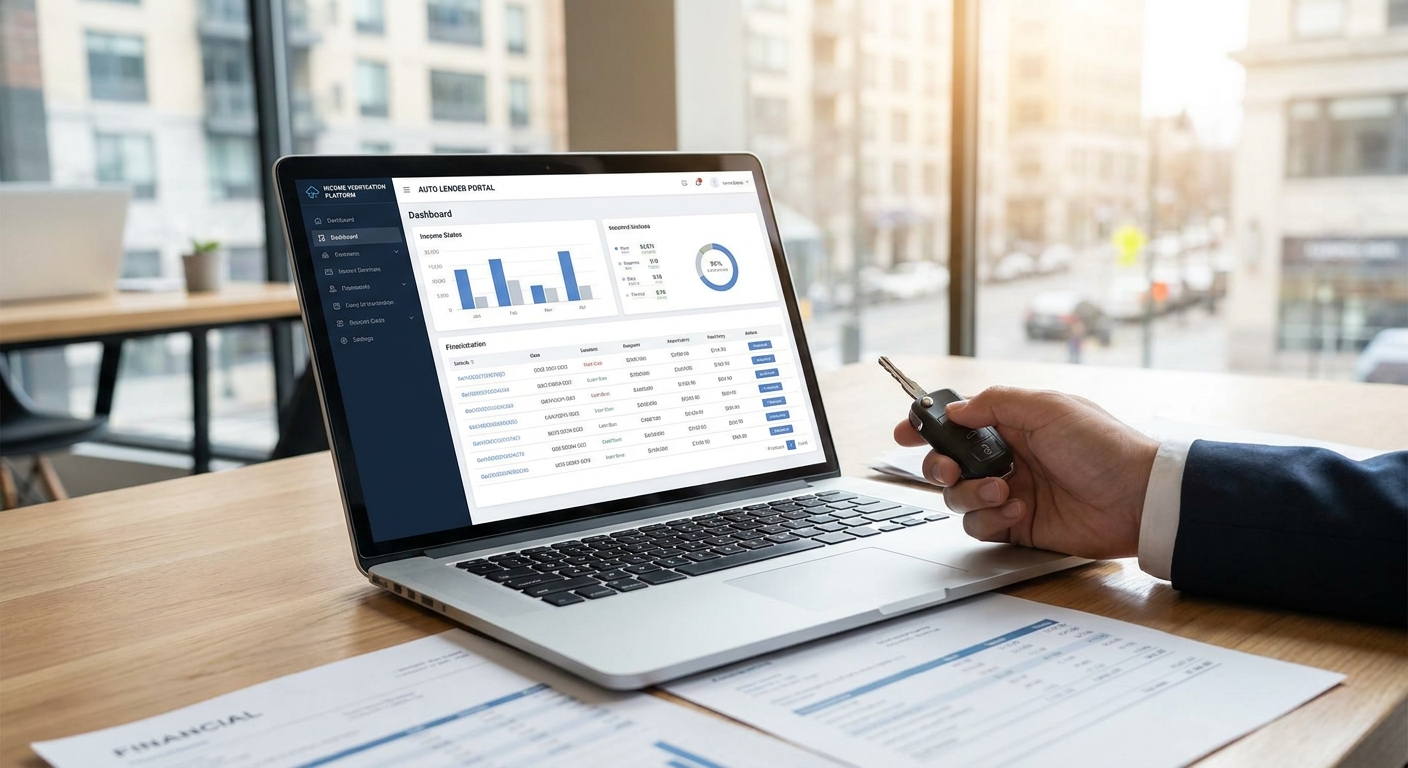
Auto lenders approving subprime and near-prime paper can't afford a 48-hour income check. Income verification software for auto lenders needs to catch a doctored pay stub or a fabricated bank statement in seconds, not after the car has left the lot and the borrower has missed payment two.
- ClearStaq's income verification software for auto lenders scans 27+ fraud signals in under 3 seconds — buy for subprime and BHPH underwriting.
- Manual pay stub review still eats hours per file in 2026; automated parsing cuts that review time by 95%.
- Gig and self-employed borrower income needs dedicated parsing, not a credit bureau pull alone — skip bureau-only stacks.
- 900+ bank statement format coverage matters more in auto lending than most verticals because subprime borrowers bank outside the big four.
Why this matters
Auto lending fraud doesn't look like it did five years ago. Applicants stack rideshare and delivery income across two or three apps, dealers front-load documentation to push deals through, and buy-here-pay-here shops underwrite borrowers with no W-2 at all. A pay stub can be edited in ten minutes with free software; a bank statement PDF takes a little longer but is just as easy to fake.
That's the gap ClearStaq is built to close: parse the actual bank data, run it against 27+ fraud signals, and flag what a human reviewer would miss on page three of a statement. In 2026, lenders still relying on stub-and-bureau underwriting are the ones eating the chargebacks.
Who this is for
This guide is for subprime and near-prime auto finance companies, buy-here-pay-here dealers running their own paper, indirect lenders underwriting through dealer networks, and credit union auto portfolios that need a funding decision the same day the borrower is standing at the desk. If your applicant pool skews toward gig drivers, self-employed dealership customers, or borrowers without a clean W-2 history, the criteria below apply directly to you.
What to look for in income verification software for auto lenders
Speed to decision
A dealer floor doesn't wait. If the software takes longer than the F&I manager's coffee break, it doesn't get used, no matter how accurate it is. Sub-3-second processing per statement is the bar in 2026 — anything slower pushes lenders back to gut-check underwriting.
Format coverage across banks and credit unions
Subprime and near-prime borrowers don't all bank at Chase or Wells Fargo. Regional banks, credit unions, and neobanks each format statements differently, and a parser that only handles the big four will kick a third of your applications to manual review. Coverage across 900+ formats is what keeps that number low.
Fraud signal depth, not just OCR
Extracting numbers off a PDF isn't fraud detection. You need signals that catch altered balances, inconsistent transaction spacing, and doctored deposit patterns — the kind of thing a reviewer scanning fast will miss. 27+ signals scanned per statement is the difference between a parser and a fraud tool.
Gig and self-employed income handling
Rideshare and delivery income shows up as scattered deposits from Uber, Lyft, DoorDash, and Instacart, sometimes across the same account in the same week. Software built for auto lending needs to recognize and aggregate that pattern automatically, not treat it as noise.
API access and LOS integration
A tool that only lets a reviewer open a document viewer isn't automating anything — it's digitizing a filing cabinet. You want a parsing and fraud layer that pushes structured data straight into your loan origination system, not a standalone portal your team has to log into separately.
Audit trail for compliance
Every flagged statement needs a record of what triggered the flag and when. Auto lenders get audited on fair lending and underwriting consistency; a tool that can't produce that trail creates more work than it saves.
See income verification for auto lending in action
Check how ClearStaq scans bank statements and flags fraud before funding.
Top picks for auto lenders in 2026
AI-powered bank statement parsing with fraud detection — the safe pick
This is the baseline every subprime and near-prime auto lender should have running before an application reaches an underwriter. It scans deposits, balances, and transaction patterns against 27+ fraud signals in under 3 seconds and flags altered statements automatically. For auto lenders specifically screening document fraud, this breakdown of document fraud detection for auto lenders covers the specific patterns to watch for. Buy.
Gig-economy income verification — the fast grower
Rideshare and delivery income is now a routine part of subprime auto applications, and treating it like a red flag instead of a data pattern slows down good deals. Software that aggregates multi-platform gig deposits into a single verified income figure gets you to a decision without manual spreadsheet work. How to verify gig economy driver income for auto financing walks through the deposit patterns that separate real income from a one-time transfer. Buy.
Self-employed and dealership-owner income parsing — the tricky one
Self-employed borrowers don't have a W-2 to lean on, and their bank statements mix personal and business deposits in ways that confuse a basic OCR tool. This requires software built to separate recurring business revenue from personal transfers over a full statement cycle. How to verify self-employed income for loan underwriting is the reference for how that separation should work. Consider — it takes more setup than a standard W-2 flow, but it's the only reliable path for this borrower segment.
BHPH-specific fraud screening — the niche pick
Buy-here-pay-here dealers underwrite without traditional credit data, which means the bank statement carries more weight than it does anywhere else in auto lending. A parser tuned to catch the specific fraud patterns that show up in BHPH files — commingled funds, structuring, and repeat-deposit padding — earns its keep fast. Fraud detection software for buy-here-pay-here auto dealers breaks down what to screen for. Buy if you're running BHPH paper.
Manual pay stub and voided check review — the legacy method
This is still how a lot of shops underwrite in 2026, and it's still the slowest option on this list. A reviewer eyeballing a stub or a voided check can't run 27 fraud signals in their head, and automated parsing has been shown to cut review time by 95% compared to this approach. Skip it as your primary method — keep it only as a backup for edge cases the parser flags for human review.
What to avoid
- Document storage mistaken for document parsing. A platform that lets you upload and view a statement isn't verifying income — it's filing it. If the tool can't extract structured deposit and balance data automatically, it's not doing the job.
- Credit bureau data as your only income signal. A bureau pull tells you about debt obligations, not cash flow. Gig income and self-employed revenue rarely show up cleanly on a credit report, and relying on it alone misses the borrowers most likely to need real verification.
- One-time stub uploads with no bank cross-reference. A pay stub can say anything. Without matching it against actual deposit history, you're underwriting on a document that took someone ten minutes to edit.
Verdict comparison
| Method | Speed | Fraud Depth | Gig/Self-Employed Fit | Verdict |
|---|---|---|---|---|
| AI bank statement parsing | Under 3 seconds | 27+ signals | Strong | Buy |
| Gig-income verification workflow | Under 3 seconds | Included | Built for it | Buy |
| Self-employed income parsing | Under 3 seconds | Included | Strong | Consider |
| BHPH fraud screening | Under 3 seconds | 27+ signals | Moderate | Buy for BHPH |
| Manual pay stub review | Hours per file | Analyst judgment only | Weak | Skip |
FAQ
What's the best income verification software for auto lenders in 2026?
AI-powered bank statement parsing that scans for fraud signals directly, rather than software that only stores or displays documents, is the strongest option in 2026. Look for tools that combine income parsing with at least two dozen fraud detection signals so speed doesn't come at the cost of catching altered statements.
How does income verification software catch doctored pay stubs?
It cross-references the stub's claimed income against actual bank deposit patterns rather than trusting the document on its own. If deposits don't match the stub's numbers or timing, the mismatch gets flagged for review before funding.
Is bank statement parsing better than a credit bureau pull for auto loans?
Bank statement parsing shows actual cash flow, which a bureau pull does not — a bureau report reflects debt obligations, not income. For gig workers and self-employed borrowers especially, statement parsing catches income that never shows up on a credit file.
How much does income verification software cost for auto lenders?
Pricing varies by lender volume and integration needs, so check current pricing directly with a vendor rather than relying on a generic figure. The cost comparison that matters is against manual review time, which automated parsing can cut by up to 95%.
Can income verification software verify gig economy driver income?
Yes — software built for this aggregates deposits from multiple platforms like Uber, Lyft, DoorDash, and Instacart into a single verified income figure. Without that aggregation, gig income often looks like noise instead of a recurring revenue pattern.
How fast does automated income verification work compared to manual review?
Automated parsing processes a bank statement in under 3 seconds, compared to hours of manual review per file. That speed difference is what lets dealers deliver a funding decision while the borrower is still on the lot.
Do BHPH dealers need different fraud detection than traditional auto lenders?
Yes — BHPH dealers underwrite without traditional credit data, so the bank statement carries more underwriting weight and needs screening tuned for patterns like commingled funds and deposit structuring. Standard bureau-based fraud checks don't apply the same way.
What bank statement formats does income verification software support?
The strongest tools in 2026 support 900+ bank and credit union formats, not just the largest national banks. That matters for auto lending because subprime and near-prime borrowers frequently bank at regional institutions and credit unions.
One last thing
Most income verification workflows still check a single pay period or a single month of deposits. The borrowers most likely to slip through are the ones stacking two gig apps in a slow month and one in a strong month — a pattern that only shows up when you pull a full statement cycle instead of a snapshot. Auto lenders that widen the review window catch more of that pattern than lenders that don't, and it costs nothing extra to look at more months of the same file.
ClearStaq Team
Content Team
The ClearStaq team builds AI-powered tools for bank statement parsing, fraud detection, and income verification.