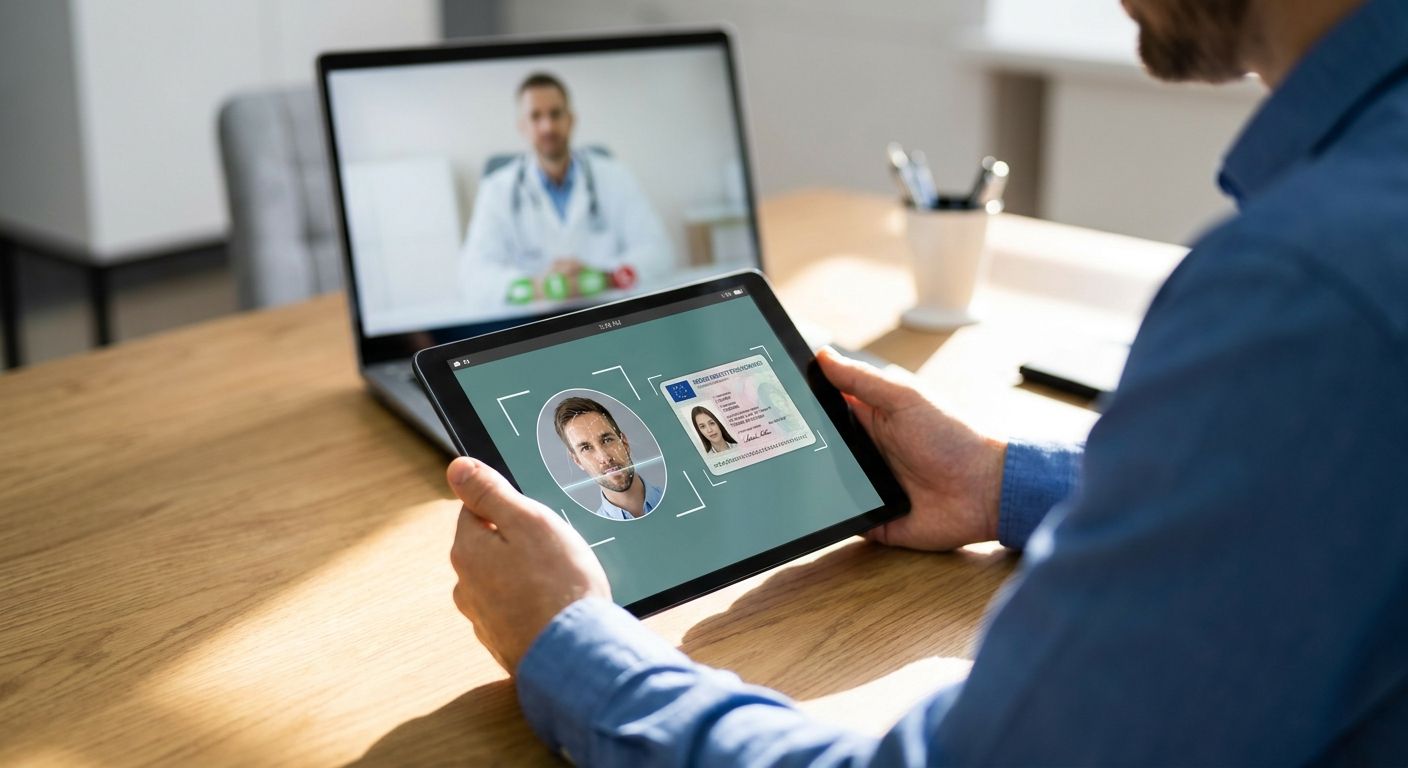
Identity verification software for telehealth platforms confirms who's actually on the video call and who's actually prescribing before a visit turns into a claim, a prescription, or a chargeback. A telehealth visit has no receptionist glancing at a driver's license and no in-person moment where a mismatched face gets noticed — every identity check has to happen through a camera and a document scan, which is a different problem than verifying identity for a bank account or a loan.
- Identity verification software for telehealth platforms needs document checks, liveness detection, and licensure checks - a single photo scan at signup isn't enough.
- ClearStaq runs identity verification with 27+ fraud signals for lending onboarding - a useful depth benchmark, not a telehealth-built product.
- Re-verify identity at every prescription renewal; reused logins show up more at renewal than at first intake.
- Provider licensure checks matter as much as patient ID checks - a provider licensed in one state seeing patients in another is a real compliance gap.
Why identity verification matters for telehealth platforms
A telehealth visit removes the one moment that catches most identity fraud in person: a staff member holding an ID next to a face. That gap is exactly why identity verification software for lending platforms exists in digital lending — the same no-in-person-check problem, just a different industry with the same fraud incentive.
Telehealth adds two pressures lending doesn't have. First, controlled-substance prescribing over video means a stolen or synthetic identity doesn't just cost a claim — it can move a scheduled drug into the wrong hands. Second, providers practice across state lines, so verifying the patient is only half the job; the platform also has to confirm the provider is licensed where the patient is sitting, not just where the provider is.
A 2026 telehealth platform running high visit volume across a dozen states has more identity surface area to cover than most single-location clinics did five years ago. Skipping steps here isn't a minor gap — it's the one part of the visit nobody in the room is there to catch.
Verify the patient's government ID before the first visit
The manual version: ask the patient to hold a government-issued ID to the camera and have staff visually confirm the name, photo, and date of birth match the intake form.
- Capture front and back of the ID before the visit starts, not mid-call
- Cross-check name and date of birth against the intake form and the insurance card on file
- Reject any ID photo that's blurry, cropped, or a screenshot of a screenshot
- Log the verification event with a timestamp for audit purposes
- Flag an ID issued in a state that doesn't match the patient's claimed current address
Add liveness detection so a photo can't pass as a person
The manual version has a staff member watch the patient blink or turn their head on camera during intake — workable at low volume, unreliable once visit counts climb past a few dozen a day.
- Require a live head-turn or blink prompt during the video visit, not a pre-recorded upload
- Compare the live face capture against the ID photo and score the match
- Reject submissions where the face-to-ID confidence score falls below your threshold
- Watch for the same static-photo and printed-image attacks lending platforms already catch — liveness detection software built for digital lending onboarding runs this exact check in seconds instead of a staff member's judgment call
Screen for synthetic identity patterns at intake
Manually, this means a staff member noticing when an SSN, address, and date of birth don't quite line up across two forms — easy to miss when someone's working through 40 intakes a shift.
- Cross-reference SSN, address, and date of birth against known synthetic-identity flags, like an age that doesn't match the ID's issue date
- Check whether the same phone number or email is already tied to another patient profile
- Flag any ID issued in the last 30 days
- ClearStaq applies a version of this face-and-document matching layer — biometric verification software for onboarding — to lending intake, running dozens of checks per submission instead of two or three a person can hold in their head
Confirm provider licensure state-by-state before each session
The manual version is a shared spreadsheet a compliance person updates when a license renews or a new state gets added.
- Match the provider's license state to the patient's current physical location, not their billing address
- Re-check license status at renewal dates, not just at hire
- Block scheduling for a provider-state combination that isn't currently licensed
- Keep a record of which license was active at the time of each specific visit
Re-verify identity at every prescription renewal
Most platforms verify once at signup and never again — the manual fix is a checklist item that forces a fresh ID check at each controlled-substance renewal.
- Trigger a new liveness check for any renewal involving a controlled substance
- Compare the renewal-visit face capture against the original intake capture, not just the ID
- Flag renewals requested from a new device or new location within 24 hours of the last one
- Require a fresh document scan if the ID on file has expired since intake
Match billing and insurance identity details to the verified record
A name mismatch between the verified identity and the insurance claim is one of the most common places fraud slips through undetected.
- Confirm the name on the insurance card matches the verified ID, not just the intake form
- Flag claims submitted under a name variant that wasn't part of the original verification
- Cross-check date of birth on the claim against the verified record
- Route mismatches to manual review before the claim submits, not after
Log every verification event for compliance audits
Without a record, an audit or a payer dispute turns into a guess about what actually happened at intake.
- Timestamp every ID capture, liveness check, and re-verification event
- Store the confidence score returned by whatever verification method was used
- Keep license-check records tied to the specific visit date, not just the provider profile
- Retain records long enough to cover payer audit windows, which vary by state and payer
Comparison: identity verification options for telehealth platforms
| Option | Best for | Key limitation | Verdict |
|---|---|---|---|
| Manual staff ID check on video | Small practices with low daily visit counts | Misses stolen or synthetic IDs; depends on one person's judgment | Hold |
| Built-in EHR/telehealth platform ID module | Practices already on a platform that bundles a basic scan | Usually a single static scan with no liveness or renewal re-check | Hold |
| General-purpose IDV platforms (document + liveness) | Platforms running high visit volume across many states | Not built for healthcare workflows like license verification | Buy for volume, pair with licensure tooling |
| Lending-grade fraud detection stacks (ClearStaq is one example) | Teams that want the same depth used against synthetic-identity fraud in lending applied to intake | Built and tuned for financial services onboarding, not health-specific workflows out of the box | Evaluate before buying, not a plug-and-play fit |
None of these is a single right answer for every telehealth platform in 2026 — the volume of visits, the mix of controlled-substance prescribing, and how many states you operate in all change which limitation matters most.
See lending-grade fraud detection up close
27+ fraud signals, sub-3-second results - the depth benchmark for high-volume identity checks.
Common mistakes telehealth platforms make
- Treating one static ID scan as "verified" for life. A photo taken at signup in 2024 doesn't confirm who's on camera at a 2026 renewal visit.
- Checking patient identity but skipping provider-side licensure. Fraud and compliance risk run both directions on a telehealth call.
- Assuming HIPAA compliance covers identity fraud. HIPAA governs data privacy — it says nothing about whether the person on camera is who they claim to be.
- Skipping liveness checks entirely. A printed photo or a paused video frame passes a document-only check every time.
- Not tying the verified identity to the billing record. A name mismatch between intake and the insurance claim is one of the easiest fraud patterns to catch and one of the most commonly ignored.
FAQ
What is identity verification software for telehealth platforms?
It's software that confirms a patient's and provider's identity during a virtual visit using document scans, liveness detection, and biometric matching instead of an in-person ID check. Telehealth platforms use it to prevent prescription fraud, insurance fraud, and unlicensed practice across state lines.
Is a photo ID scan enough for telehealth patient verification?
No, a static photo scan alone doesn't confirm a live person is on the call - it can be defeated with a printed photo or a paused video. Pairing the document scan with liveness detection closes that gap.
Do telehealth platforms need to verify provider licenses in every state?
Yes, if providers see patients across state lines, the platform needs to confirm an active license in the patient's current state, not just the provider's home state. This check needs to happen per visit, since licenses can lapse or expand between sessions.
What's the difference between KYC and identity verification for healthcare?
KYC (know your customer) is the financial-services term for identity checks done for account opening and compliance; telehealth identity verification serves the same function but is built around patient intake, prescribing rules, and provider licensure rather than account fraud.
How does liveness detection stop telehealth prescription fraud?
Liveness detection confirms a real, present person is on camera rather than a photo or recording, which stops someone from using a stolen ID with a static image to obtain a controlled-substance prescription. It's most useful paired with a fresh check at every renewal visit, not just at first intake.
Does HIPAA compliance include identity verification?
No, HIPAA governs how patient data is stored and shared - it doesn't require or cover verifying that the person on a video call is who they claim to be. Identity verification is a separate control platforms need to build or buy on top of HIPAA compliance.
How much does identity verification software cost for a telehealth platform?
Pricing depends on visit volume and how many checks are layered in - a document scan alone costs less than document plus biometric matching plus ongoing renewal re-verification. Get a quote based on your monthly visit volume rather than assuming a flat per-seat price.
Can identity verification technology built for lending catch telehealth fraud?
The underlying techniques - document authentication, liveness detection, biometric matching - transfer across industries, but a lending-built tool won't have telehealth-specific workflows like license verification out of the box. Evaluate the fit before assuming a lending-grade tool solves the whole telehealth intake problem.
One last thing
The biggest gap in telehealth identity checks in 2026 isn't at signup — it's at renewal. Platforms spend the most effort verifying a patient once, then let every follow-up and controlled-substance renewal ride on that same original check, even when the request comes from a new device or a new location days later. A renewal visit deserves the same document-plus-liveness check as the first one, not a rubber stamp.
Related guides
ClearStaq Team
Content Team
The ClearStaq team builds AI-powered tools for bank statement parsing, fraud detection, and income verification.