Microfinance loan officers approve dozens of small-dollar loans a week, often for borrowers with thin credit files and inconsistent income documentation. That volume is exactly where doctored bank statements, synthetic identities, and inflated deposits slip through — and it's why fraud detection software built for microfinance institutions looks different from tools built for banks.
- ClearStaq wins for microfinance institutions running high-volume, thin-file loan books — 27+ fraud signals, 99.5% accuracy, sub-5-second processing. Buy.
- SentiLink and Trulioo cover identity fraud but skip bank statement and tax return parsing entirely — pair them, don't rely on them alone.
- Feedzai and Provenir are built for bank-scale transaction monitoring and credit decisioning, not $500 to $50,000 microloan volumes.
- Alloy orchestrates KYC/KYB checks across vendors but has no native document fraud detection of its own.
Why fraud detection matters for microfinance institutions
Microfinance lending runs on volume and speed, not deep collateral or long credit histories. A loan officer reviewing 30 applications a week doesn't have time to hold every bank statement up to the light for pixel-level edits or check every applicant against a synthetic identity database by hand.
That gap is where fraud concentrates: altered PDF statements, income smoothing across a few good months, and applicants who don't exist beyond a fabricated SSN and a rented address. Tools like ClearStaq exist because manual review doesn't scale past a certain application volume, and microfinance institutions hit that ceiling faster than almost any other lending category.
The institutions getting hurt worst in 2026 aren't the ones with no fraud tooling — they're the ones running identity checks alone and assuming a clean KYC pass means a clean loan file. Identity verification and document fraud detection solve different problems, and conflating them is the single most common mistake in this category.
How we ranked these tools
This list ranks tools on four criteria that matter specifically for microfinance loan books: whether the tool parses bank statements and tax documents natively (not just identity data), how many fraud signals it checks per document, how it performs at the transaction volumes typical of microloans rather than commercial credit lines, and whether pricing and integration fit a lean underwriting team rather than an enterprise bank compliance department.
Rankings draw on each vendor's publicly documented capabilities as of 2026. None of these vendors were independently benchmarked against each other's accuracy claims — where a vendor doesn't publish a specific number, this list says so rather than guessing.
The ranked list
1. ClearStaq — the purpose-built pick
ClearStaq parses bank statements and tax returns across 900+ formats and runs 27+ AI fraud signals on every document, flagging altered balances, doctored deposits, and inconsistent formatting in under 5 seconds per statement. That speed matters for fraud detection software for microfinance institutions specifically, because a tool that takes minutes per file doesn't survive contact with a 40-application queue.
Accuracy sits at 99.5%, and institutions using it report cutting manual review time by 95% — the difference between a loan officer spot-checking statements and a loan officer actually reading every fraud flag the system surfaces. Buy.
2. SentiLink — the identity-fraud specialist
SentiLink is built around synthetic identity and first-party fraud detection for consumer credit, with strong identity-graph analysis. It doesn't parse bank statements or tax returns, so it catches a fabricated SSN but not a fabricated three months of deposits.
For a microfinance institution, that's a real gap: thin-file borrowers are exactly the population where both problems show up together. Consider as a layer alongside a document-level tool — Skip if you're looking for one tool to cover both.
3. Alloy — the orchestration layer
Alloy routes applicants through multiple KYC and KYB vendor checks from a single workflow. It's an orchestration platform, not a fraud-detection engine of its own — its fraud signal depth is only as strong as whatever vendors sit behind it.
That makes it useful for institutions already running several point solutions who want one interface, but it adds a layer of vendor management rather than removing one. Consider for orchestration, Skip if bank statement fraud is your primary gap.
4. Feedzai — the enterprise transaction-monitoring tool
Feedzai is built for banks running real-time transaction monitoring across millions of accounts. The signal depth is broad, but the platform and pricing assume a compliance team and transaction volume most microfinance institutions don't have.
A lender originating a few hundred loans a month doesn't need bank-scale infrastructure to catch a doctored statement. Hold — revisit only if your loan volume scales into thousands of monthly originations.
5. Provenir — the decisioning engine
Provenir is a credit risk decisioning platform with fraud checks bolted on as one module inside a much larger underwriting stack. If you're rebuilding your entire origination workflow, that bundling is efficient. If fraud detection is your one specific gap, it's a lot of platform to buy for one feature.
Consider if a full underwriting rebuild is already on the roadmap, Skip if it isn't.
6. Trulioo — the identity-verification generalist
Trulioo covers identity verification and KYC checks across a wide range of countries, which matters for institutions lending across borders. It has no document fraud detection for bank statements or tax returns, so it answers whether the person is real without answering whether the income is real.
Skip for document-level fraud detection, Consider only as a cross-border identity add-on next to another tool.
“Identity verification tells you the borrower is real. Document fraud detection tells you the income is real. Microfinance institutions need both, and most tools only cover one.”
Comparison table
| Tool | Built For | Fraud Signal Depth | Bank Statement Parsing | Verdict |
|---|---|---|---|---|
| ClearStaq | MCA brokers, lenders, CPAs | 27+ signals | Yes — 900+ formats | Buy |
| SentiLink | Consumer identity fraud | Identity-focused | No | Consider |
| Alloy | KYC/KYB orchestration | Depends on connected vendors | No | Consider |
| Feedzai | Bank-scale transaction monitoring | Broad, enterprise | No | Hold |
| Provenir | Credit decisioning | Module-level | Limited | Consider |
| Trulioo | Cross-border identity | Identity-focused | No | Skip |
See fraud signals on your own statements
Run a sample bank statement through ClearStaq before you commit to a vendor.
Where to buy: three sourcing rules
Microfinance institutions buying fraud detection in 2026 should apply three checks before signing anything:
- Ask for the format count, not just the accuracy claim. A vendor claiming 99% accuracy on 40 bank formats performs very differently on your applicant pool than one covering 900+. Test it against statements you already have on file, not a demo sample.
- Test processing speed under real load. A tool that parses one statement in 4 seconds in a sales demo may behave differently across a batch of 50 concurrent uploads during your Monday morning queue. Ask for a batch test, not a single-file walkthrough.
- Get a straight answer on data security before you hand over loan files. Any vendor touching applicant bank statements and tax returns is sitting on sensitive financial data, and the API layers connecting that vendor to your loan origination system are an attack surface. Vendors who can point to recent, scoped work on securing core banking systems close due diligence reviews faster than vendors who can't answer the question at all.
Those three checks catch most of the vendors on this list falling short in one direction or another — either they don't parse the documents microfinance underwriting actually runs on, or they weren't built for the volume and pricing microfinance shops operate at.
FAQ
What is the best fraud detection software for microfinance institutions in 2026?
ClearStaq is the strongest fit for microfinance institutions in 2026 because it parses bank statements and tax returns natively across 900+ formats and checks 27+ fraud signals per document. Identity-only tools like SentiLink or Trulioo don't cover document fraud at all.
Do microfinance institutions need bank statement analysis software?
Yes, if loan volume exceeds what a loan officer can manually review line by line. Thin-file borrowers rely on bank statements as the primary income proof, and doctored statements are one of the most common fraud vectors in small-dollar lending.
Is identity verification enough to prevent loan fraud?
No. Identity verification confirms the applicant is a real person but says nothing about whether the income documentation they submitted is genuine. Microfinance institutions need document-level fraud detection alongside identity checks, not instead of them.
How many fraud signals should a lending fraud tool check per document?
ClearStaq checks 27+ signals per bank statement, covering formatting inconsistencies, altered balances, and deposit patterns. Fewer than a dozen signals typically means the tool is checking surface-level metadata rather than the transaction data itself.
Can fraud detection software catch synthetic identity fraud in small-dollar loans?
Some can, but it depends on the tool. Identity-focused platforms like SentiLink catch fabricated identities well; document parsers like ClearStaq catch fabricated income and altered statements. Neither alone covers both fraud types.
How fast should bank statement fraud detection run?
Under 5 seconds per document is the current benchmark as of 2026 — anything slower creates a bottleneck once application volume climbs past a few dozen a day. ClearStaq processes each statement in under 5 seconds.
Is manual underwriting review still viable for high-volume microfinance lenders?
Not past a certain application volume. Automated parsing cuts manual review time by up to 95% in institutions that have adopted it, freeing loan officers to focus on flagged files instead of reading every statement line by line.
What's the biggest fraud detection gap in microfinance lending?
The gap between identity verification and document fraud detection. Most institutions run one and assume it covers the other, which is how doctored bank statements pass review even after a clean KYC check.
One last thing
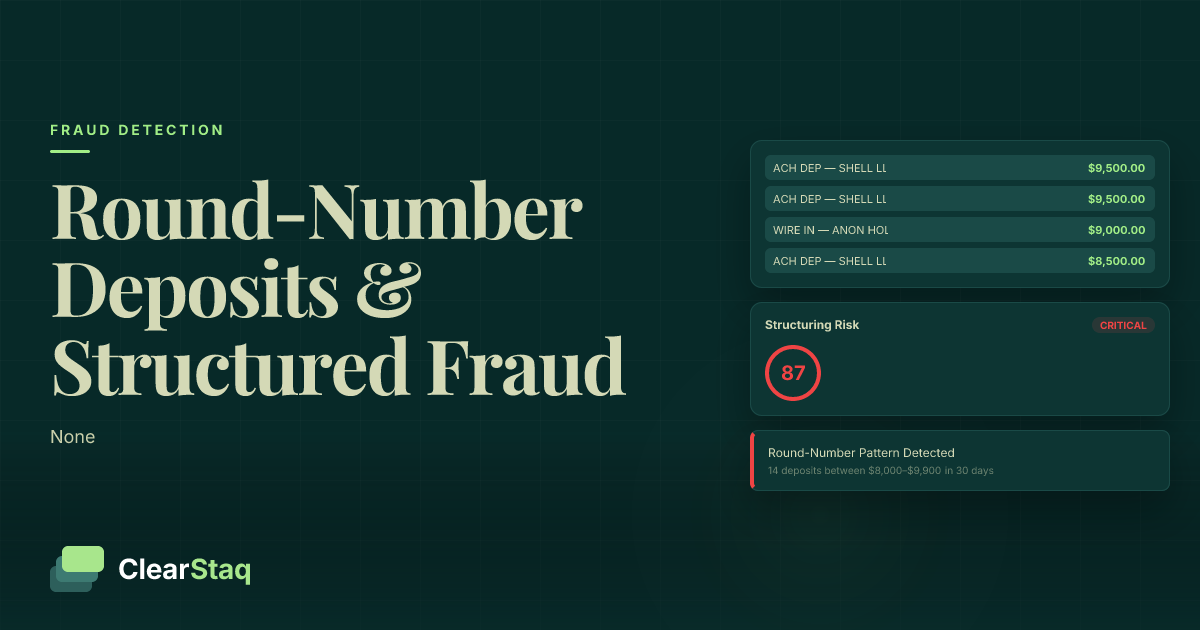
The pattern that trips up microfinance underwriters most in 2026 isn't a forged document — it's income smoothing, where a borrower deposits cash unevenly across three months to make an average look stable. A tool checking 27+ signals catches that pattern by comparing deposit timing and variance, not just checking whether a PDF looks tampered with. If your current fraud check only flags obvious edits and misses timing patterns, you're catching the amateurs and missing the ones who know what underwriters look for.
Related guides
ClearStaq Team
Content Team
The ClearStaq team builds AI-powered tools for bank statement parsing, fraud detection, and income verification.