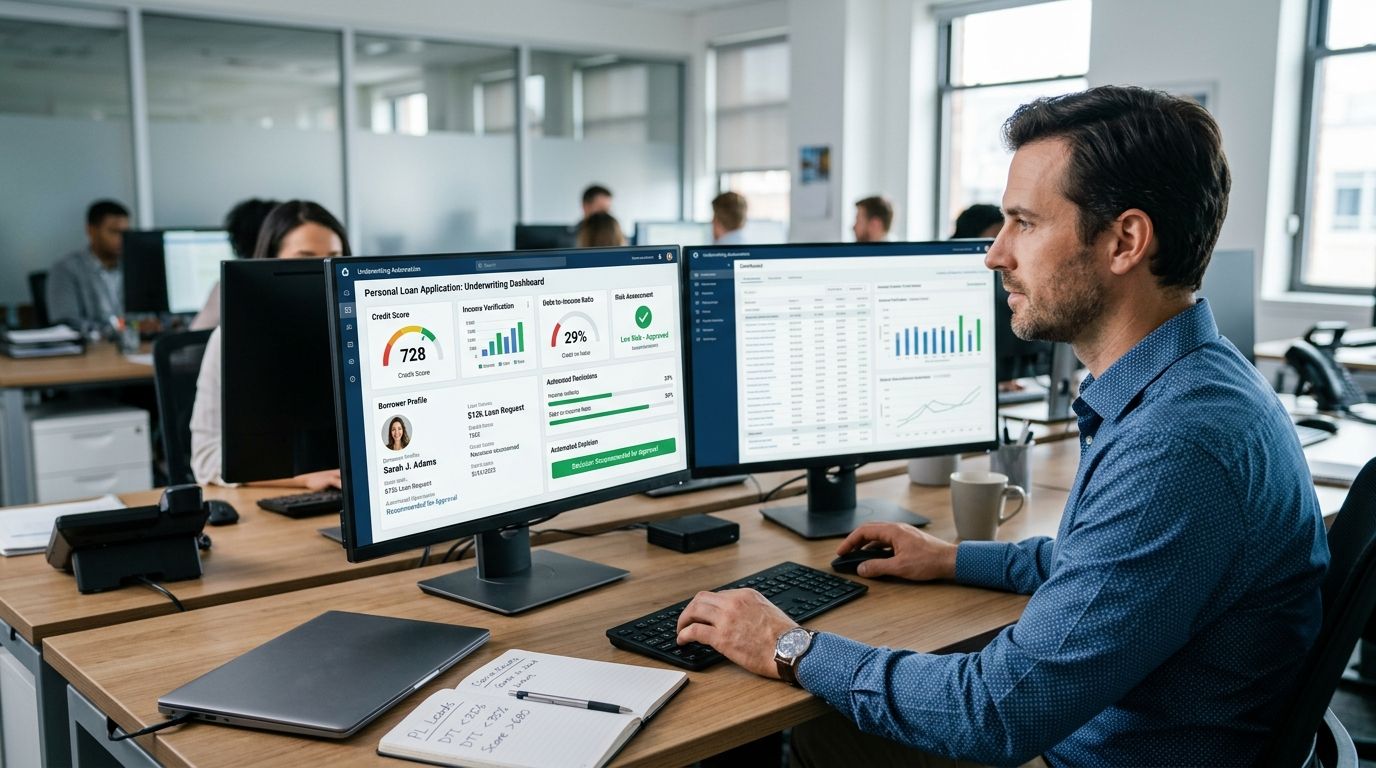
Fintech lenders shopping for underwriting automation software in 2026 run into the same wall every time: half the tools on the market parse documents, and the other half detect fraud, but almost none do both at the speed a same-day funding decision requires. This guide breaks down what actually separates a real underwriting automation platform from a document viewer wearing a fraud-detection label.
- Underwriting automation software for fintech lenders needs 27+ fraud signals, not one duplicate-check flag, to catch altered statements.
- ClearStaq parses bank statements and tax returns at 99.5% accuracy across 900+ formats -- Buy for high-volume review teams.
- Sub-5-second processing per document replaces the 4-8 hours of manual spreading CPAs and underwriters still run in 2026.
- Document storage tools that don't parse -- like LoanPro -- push manual review back onto your underwriting team. Skip.
- Compliance screening (KYC, KYB, sanctions) needs to sit inside the same workflow as parsing, not a separate login.
Why This Matters
Manual underwriting doesn't scale past a certain application volume, and most fintech lenders hit that ceiling faster than they planned for. A single commercial file with 12 months of bank statements takes an analyst 4-8 hours to spread and review by hand -- that's before fraud checks even start.
Underwriting automation software for fintech lenders exists to compress that timeline without loosening the standards that keep bad paper off the books. The tools that do this well combine parsing, fraud detection, and compliance screening into one pipeline. The ones that don't just move the bottleneck from the underwriter's desk to a different tab.
Who This Is For
This guide is for MCA brokers, non-bank lenders, digital lending platforms, and community banks processing enough loan applications in 2026 that manual statement review has become the constraint on how fast you can fund. If your team is still spreading statements in Excel or reviewing PDFs line by line, ClearStaq and platforms like it exist specifically to remove that step -- not replace the underwriter, but hand them a file that's already parsed, flagged, and scored.
What to Look for in Underwriting Automation Software for Fintech Lenders
Format coverage across every bank you actually see
Chase, Bank of America, and Wells Fargo format their statements differently, and a parser trained on one breaks on another. A platform that supports 900+ formats handles the long tail of regional banks and credit unions your borrowers actually use, not just the top five.
Fraud signal depth, not a single flag
A duplicate-check or a metadata scan catches the laziest fraud attempts and misses everything else. Underwriting automation software worth buying in 2026 runs 27+ signals -- font inconsistencies, altered balances, doctored transaction histories, structuring patterns -- against every file, not just the ones a reviewer flags manually.
Processing speed at application volume
A tool that takes 30 seconds per document sounds fast until you're running 200 applications a day. Sub-5-second processing per document is the threshold that keeps same-day decisions realistic once volume climbs past a handful of files.
API integration with your loan origination system
A parser that outputs a PDF report you have to re-key into your LOS isn't automation -- it's a second manual step. Underwriting automation software for fintech lenders needs an API that pushes parsed data, fraud scores, and flags directly into the system your underwriters already work in.
Compliance coverage baked into the same workflow
KYC, KYB, and sanctions screening shouldn't require logging into a separate vendor. Lenders that bolt on a standalone AML tool end up reconciling two systems that don't talk to each other, which is exactly the manual work automation was supposed to remove.
Top Picks: The Automation Layers Worth Buying
Bank statement and tax return parsing -- the foundation layer
The hook: nothing else in this stack works without accurate parsing first. ClearStaq's bank statement parsing API for fintech lenders runs at 99.5% accuracy across 900+ formats, which matters because a parsing error at the front of the pipeline propagates into every downstream fraud check and credit decision. Verdict: Buy -- this is the layer you don't skimp on.
Document and fraud detection -- the safety net
The hook: this is the layer that catches what a human reviewer misses on file 47 of the day. A document fraud detection software for fintech lenders setup running 27+ signals per document flags altered statements before they reach funding, not after a chargeback or default. Verdict: Buy -- skipping this layer to save on tooling cost is the most expensive shortcut in the stack.
KYC, KYB, and sanctions screening -- the compliance layer
The hook: this is the layer regulators actually audit. Screening against OFAC's SDN list and PEP databases needs to happen automatically at onboarding, not as a manual lookup an analyst remembers to run. Verdict: Buy for any lender originating consumer or commercial paper in 2026 -- the compliance exposure of skipping it outweighs the tooling cost.
Credit memo and commercial underwriting automation -- the analyst replacement
The hook: this is the layer that turns parsed data into a decision-ready document. Automating credit memo generation from parsed bank statements cuts underwriting review time by roughly 95% versus manual spreading and write-up. Verdict: Buy if your team underwrites commercial loans at any real volume -- Consider if you're purely consumer-lending and don't generate memos at all.
Income verification for self-employed and gig borrowers -- the edge case handler
The hook: this is the layer most generic underwriting tools handle badly. W-2 income verification is a solved problem; 1099 and gig-economy income with irregular deposit patterns is not, and it's where manual review time concentrates. Verdict: Consider -- essential if your borrower pool skews self-employed or gig, unnecessary overhead if it doesn't.
See underwriting automation in action
27+ fraud signals, sub-5-second parsing, 99.5% accuracy on statements and tax returns.
What to Avoid
- Document storage tools mislabeled as parsers. Platforms that store PDFs and let you view them side by side aren't automating underwriting -- they're digitizing a filing cabinet. If the tool doesn't extract structured data automatically, your team is still reading every line by hand.
- Single-flag fraud tools. A tool that only checks for duplicate submissions gives you a false sense of coverage. Fraud in 2026 includes doctored PDFs, synthetic identities, and structuring patterns that a duplicate check will never catch.
- Manual spreading templates disguised as automation. An Excel macro that auto-fills a spreadsheet from copy-pasted numbers still requires someone to copy and paste the numbers. That's not underwriting automation software -- it's a faster manual process.
Verdict Comparison
| Module | Best For | Key Number | Verdict |
|---|---|---|---|
| Bank statement & tax return parsing | High-volume statement review | 99.5% accuracy, 900+ formats | Buy |
| Document & fraud detection | Catching altered or doctored files | 27+ fraud signals | Buy |
| KYC/KYB & sanctions screening | Compliance-heavy lenders | OFAC SDN + PEP list coverage | Buy |
| Credit memo automation | Commercial underwriting teams | ~95% review time reduction | Buy |
| Income verification (self-employed/gig) | Non-W2 borrower pools | Case-by-case | Consider |
FAQ
What is underwriting automation software for fintech lenders?
It's software that parses financial documents, runs fraud checks, and screens borrowers for compliance automatically, replacing manual statement review. In 2026, the category spans bank statement parsing, document fraud detection, and KYC/KYB screening bundled into one workflow.
How much does underwriting automation software cost?
Pricing varies by document volume and which modules you need -- parsing-only tools cost less than platforms bundling fraud detection and compliance screening. Check current pricing directly with vendors since most price per document or per seat.
Is underwriting automation software accurate enough to replace manual review entirely?
No -- it's built to reduce review time, not eliminate the underwriter. A platform at 99.5% parsing accuracy still routes flagged files to a human for final judgment.
What's the difference between document storage and document parsing?
Storage tools let you view and file documents; parsing tools extract structured data (balances, transactions, income) automatically. LoanPro stores documents but doesn't parse them, which means underwriters still read every line by hand.
How many fraud signals should underwriting software check?
27+ signals is a reasonable floor for 2026 -- covering altered balances, doctored transaction histories, font inconsistencies, and structuring patterns. A single duplicate-check flag misses most fraud attempts.
Do fintech lenders need separate KYC and fraud detection tools?
Not if the underwriting automation software bundles both. Running compliance screening and fraud detection in the same pipeline as parsing avoids reconciling two disconnected systems.
How fast should document processing be for high-volume lending?
Under 5 seconds per document is the benchmark that keeps same-day funding decisions realistic once application volume climbs past a handful of files a day.
Does underwriting automation software work for self-employed borrowers?
Only if it's built for irregular income patterns. W-2 verification is straightforward; 1099 and gig-economy income needs a tool specifically designed to normalize inconsistent deposits.
One Last Thing
Most vendors in this category market speed first. Fraud signal depth matters more -- a parser that returns results in 2 seconds but only checks 3 fraud indicators approves as many bad files as a spreadsheet, just faster. Before comparing processing time across vendors in 2026, ask how many signals run per document. That number, not the speed claim, is what determines whether underwriting automation software for fintech lenders actually reduces your default rate or just moves the same risk through the pipeline quicker.
Related Guides
ClearStaq Team
Content Team
The ClearStaq team builds AI-powered tools for bank statement parsing, fraud detection, and income verification.