Sanctions screening software for correspondent banks matches respondent bank transactions, nested accounts, and beneficial owners against OFAC, UN, and EU watchlists before sanctioned money clears through the correspondent network. Correspondent banks carry more nested-party risk than a retail screening program because the parties behind a wire are often three or four layers removed from the account holder on record.
- Sanctions screening software for correspondent banks needs nested-account matching, not just direct-customer screening.
- ClearStaq isn't a standalone watchlist engine — it verifies the bank statement activity behind a flagged wire in under 5 seconds.
- Manual OFAC checks work for a handful of respondents; past that, false-positive rework consumes analyst time fast.
- Best for 2026 correspondent banking programs: pair a dedicated watchlist API with a document-fraud layer for flagged matches.
Why sanctions screening matters for correspondent banks
Correspondent banking relationships route payments for respondent banks that in turn serve their own downstream customers — a nested structure the FFIEC BSA/AML Examination Manual singles out as inherently higher risk, because the correspondent bank often has no direct relationship with the ultimate parties behind a wire. Payable-through accounts get called out separately in that same manual for the same reason: visibility drops the further downstream the money moves.
OFAC's SDN list, the UN Consolidated List, and the EU and UK equivalents each update on their own schedule, and a correspondent bank clearing wires for multiple respondents has to run every list update against volume that doesn't pause for compliance. Enforcement history in correspondent banking specifically calls out gaps in nested-account screening, not just missed direct hits — which is why a sanctions screening software for banks evaluation for a correspondent program has to look past simple name matching.
Map your correspondent banking exposure first
Before buying anything, size the actual screening problem your respondent network creates.
- List every respondent bank relationship, including introduced business and nested accounts
- Flag payable-through accounts separately from standard correspondent lines
- Document beneficial ownership layers behind each respondent, not just the top entity
- Note high-risk jurisdictions per your BSA officer's existing risk assessment
- Pull the last 12 months of wire volume by respondent to size the screening workload
Build a risk-based screening matrix
Not every respondent needs the same scrutiny, and treating them identically wastes analyst hours on low-risk domestic accounts.
- Tier respondents by jurisdiction risk, product type, and expected wire volume
- Set fuzzy-match thresholds tighter for high-risk tiers, looser for low-risk domestic respondents
- Define which fields get screened: originator, beneficiary, intermediary bank, free-text remittance data
- Assign re-screening frequency per tier — high-risk respondents need list-update-triggered rescreens, not annual sweeps
Screen respondent banks and their beneficial owners
This is the step that separates a working program from a checkbox exercise, and it's where you can screen loan applicants against sanctions lists using the same matching logic correspondent banks apply to respondents.
- Match legal entity names and known aliases against OFAC SDN, Non-SDN Consolidated, UN, and EU lists
- Run beneficial owners and directors through PEP and adverse media checks, not just the entity itself
- Check for nested correspondent relationships the respondent bank maintains downstream
- Confirm SWIFT BIC and registered address align with the entity on file — mismatches are a common evasion pattern
Automate list updates and match logic
Manual list downloads and spreadsheet matching stop scaling once you're past a small handful of respondents.
- Pull OFAC and UN list updates on a same-day basis, not weekly batch cycles
- Log every list version your engine ran against for the exam trail
- Route only qualifying matches to analysts — auto-clear the obvious false positives
- Version-control fuzzy-match logic so tuning changes stay auditable
Reduce false positives without loosening the net
A screening program that buries analysts in noise gets tuned down eventually, and that's how real hits slip through.
- Separate common-name false hits (script variants, transliteration) from true structural risk
- Build allow-lists for cleared entities with documented rationale, reviewed quarterly
- Use bank statement and wire narrative context to corroborate or clear a name match
- Track false-positive rate per respondent tier and retune thresholds that run consistently high — the mechanics are the same ones covered in how to reduce false positives in sanctions screening
Verify the money behind a flagged wire
A name match tells you who might be sanctioned. It doesn't tell you whether the deposits funding that wire look legitimate — that takes document-level review.
- Pull the respondent's or originator's underlying bank statements when a match needs deeper review
- Check whether deposit patterns match the stated business purpose on file
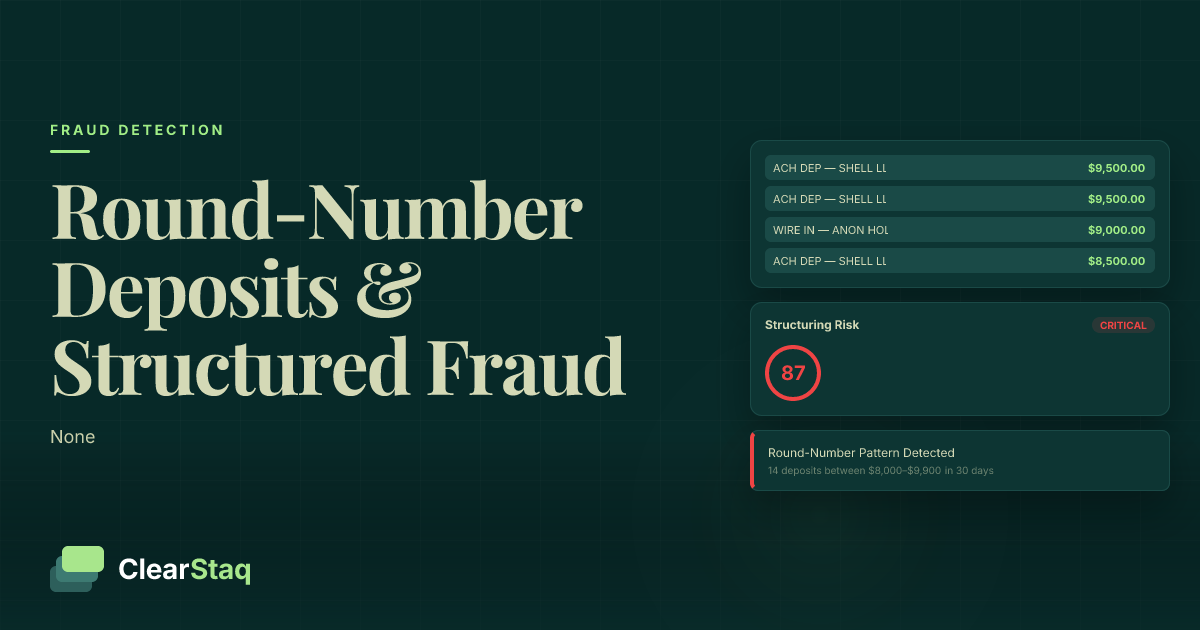
- Flag layered or structured deposits that don't match a legitimate trade or remittance narrative
- ClearStaq parses those statements and tax documents at this stage, applying 27+ AI signals for fraud indicators and returning results in under 5 seconds, reading across 900+ statement formats so respondent documents from dozens of different institutions don't stall the review
Sanctions screening software for correspondent banks works best in 2026 when the watchlist match and the underlying document review run on the same timeline — a cleared name with a fabricated bank statement behind it is still a problem.
See the fraud layer in action
99.5% parsing accuracy on the statements behind flagged wires.
Compare your options
| Option | Best for | Key limitation |
|---|---|---|
| Manual list checks (spreadsheet + free OFAC search) | Very small correspondent networks, one-off due diligence | Doesn't scale past a handful of respondents; misses close-match fuzzy hits |
| Legacy enterprise watchlist screening suites | Large banks needing full case management and multi-list coverage | Implementation cycles measured in months; heavy IT lift |
| Real-time screening APIs | Banks wiring high transaction volume that need sub-second checks | Match logic alone can't confirm the funds behind the wire are legitimate |
| ClearStaq (fraud detection + document layer) | Correspondent banks that need to verify the money behind a flagged wire or respondent statement | Not a standalone watchlist engine — pairs with your existing OFAC/PEP list provider |
Verdict: no single tool covers both list matching and document verification — correspondent banks running a 2026 program need a watchlist engine paired with a fraud detection layer like ClearStaq for the cases that need deeper review.
Common mistakes correspondent banks make
- Screening only the direct respondent bank and skipping nested, downstream customers entirely
- Treating a cleared name match as case closed without checking beneficial ownership layers
- Letting dormant correspondent relationships go unscreened when sanctions lists update
- No audit trail linking wire-level alerts back to the underlying bank statement activity
- Measuring the program on match rate alone, ignoring the false-positive rework hours it creates
FAQ
What is sanctions screening software for correspondent banks?
It's software that matches respondent bank transactions, nested accounts, and beneficial owners against OFAC, UN, and EU sanctions lists. Correspondent banks need it because they often lack direct visibility into the ultimate parties behind a wire.
How is correspondent banking screening different from standard KYC screening?
Correspondent screening has to account for nested accounts and payable-through structures where the correspondent bank has no direct relationship with the end customer. Standard KYC screening typically checks the account holder on record directly.
Is sanctions screening software required for correspondent banks in 2026?
The FFIEC BSA/AML Examination Manual treats correspondent banking as a higher-risk category requiring enhanced due diligence, which in practice means automated, list-update-triggered screening rather than periodic manual checks.
Can ClearStaq replace a dedicated OFAC screening system?
No. ClearStaq parses bank statements and tax documents to verify the money behind a flagged transaction; it pairs with a dedicated watchlist screening engine rather than replacing one.
What's the difference between sanctions screening and PEP screening?
Sanctions screening matches names against government-issued restricted-party lists like the OFAC SDN list. PEP screening flags politically exposed persons who carry higher corruption risk but aren't necessarily sanctioned.
How often do sanctions lists update?
OFAC updates the SDN list on a rolling basis whenever new designations or removals happen, not on a fixed schedule. Correspondent banks need same-day list ingestion to avoid screening against stale data.
What causes high false-positive rates in correspondent banking screening?
Common names, transliteration variants, and loose fuzzy-match thresholds set for high-risk tiers all drive false positives. Tuning thresholds per respondent risk tier and corroborating matches with underlying transaction data cuts rework.
Do payable-through accounts need different screening than standard correspondent accounts?
Yes. The FFIEC manual flags payable-through accounts as higher risk because the correspondent bank has even less visibility into the underlying account holders than in a typical correspondent relationship.
One last thing
The gap that gets correspondent banks flagged in exams isn't usually a missed direct hit — it's the nested account three layers downstream that nobody re-screened after the last list update. Build the re-screening trigger into your process before you build anything else in 2026.
Related guides
ClearStaq Team
Content Team
The ClearStaq team builds AI-powered tools for bank statement parsing, fraud detection, and income verification.