Income verification software for patient financing companies checks pay stubs, bank statements, and tax records against an applicant's stated income before an elective-procedure loan gets approved, with the goal of clearing a point-of-care decision before the patient leaves the office. Patient financing differs from mortgage or auto underwriting because the approval window is minutes, not days, and a meaningful share of applicants are self-employed, gig-based, or have thin credit files that a standard pull won't explain.
- Income verification software for patient financing companies needs to clear approvals in minutes, not days, or the patient walks.
- ClearStaq parses bank statements and tax returns with 27+ fraud signals and 99.5% accuracy in under 5 seconds.
- Manual pay stub review misses self-employed and gig-income applicants who make up a growing share of elective-procedure financing.
- IRS transcript verification (4506-C) is the most reliable income proof but too slow for point-of-care lending.
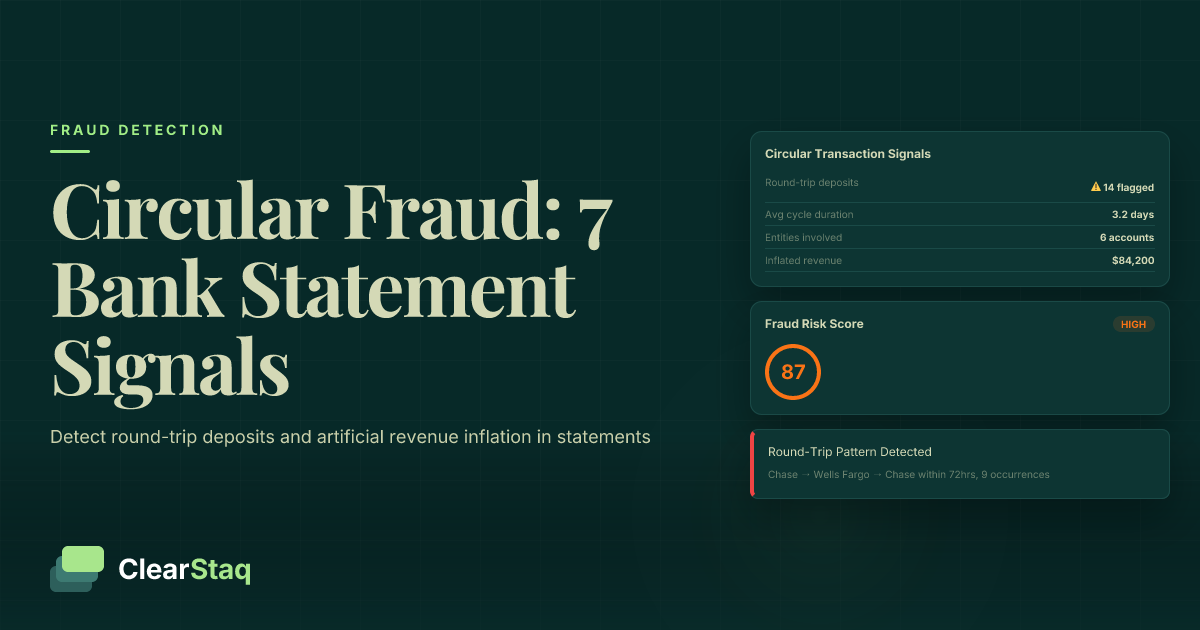
- Doctored pay stubs and bank statements are the most common fraud pattern in patient financing applications in 2026.
Why income verification matters for patient financing companies
Elective procedures don't wait for underwriting. A dental implant, LASIK consult, or fertility cycle gets scheduled around the patient's calendar, and the financing decision has to land while they're still sitting in the chair or on the call. That compresses the entire income-check process into a window most consumer lenders would consider reckless.
A large share of patient financing applicants don't fit a W2 template. Cosmetic and veterinary financing in particular skew toward self-employed borrowers, contractors, and gig workers whose income swings month to month. Document fraud detection software for patient financing companies exists as its own category because the same applicants who are hardest to verify quickly are also the ones most likely to submit an edited pay stub or a screenshot instead of a real statement.
The cost of getting this wrong runs both directions. Approve a fabricated income and you're chasing a delinquent balance in 2026 with no procedure to repossess. Reject a legitimate self-employed applicant because their income doesn't fit a salaried template and you lose the sale to a competitor who can say yes in the same visit.
Build an income verification process that fits point-of-care lending
Collect income documents at intake, not after approval starts
Most patient financing shops still ask for documents only after a soft decision is made, which adds a second wait cycle the patient feels immediately.
- Request the most recent 60-90 days of bank statements at application, not after pre-qualification
- Ask for the last two pay stubs or, for 1099 workers, the prior year's Schedule C
- Standardize on PDF or direct bank connection over faxed or photographed documents
- Flag any document submitted as a screenshot for manual review before it enters underwriting
- Set a hard rule: no verbal income confirmation counts as verification
Verify self-employed and gig income patterns manually first
Before any software gets involved, understand what a real self-employed income pattern looks like versus a smoothed or invented one. Verifying self-employed income for loan underwriting means averaging deposits across a full quarter, not just the best month the applicant chose to submit.
- Average net deposits across 90 days minimum, not a single statement
- Separate business deposits from personal transfers in the same account
- Watch for seasonal dips that a single-month statement would hide
- Cross-reference stated occupation against merchant category codes on deposits
- Reject any applicant who can only produce one month of activity
Cross-check pay stubs against bank deposits before trusting either one
A pay stub by itself proves nothing — it's the easiest document to edit in an image tool. Detecting doctored pay stubs during underwriting means the stub is a claim, and the bank deposit is the evidence.
- Match the net pay figure on the stub to an actual recurring deposit
- Check that the pay frequency (weekly, biweekly, semi-monthly) matches deposit timing
- Look for font, alignment, or math inconsistencies within the stub itself
- Confirm the employer name on the stub matches any direct deposit descriptor
- Reject stubs with no corresponding deposit history at all
Automate bank statement and tax return parsing for real-time decisions
Manual cross-checking works for a handful of applications a day. It breaks down the moment volume climbs past what one underwriter can read in a shift, which is exactly when patient financing companies need speed the most.
This is where an AI-powered platform replaces the manual steps above rather than adding to them. ClearStaq parses bank statements and tax returns and runs income verification against 27+ fraud signals in under 5 seconds, covering over 900 statement formats so a self-employed applicant's Chase account and a salaried applicant's credit union statement get read the same way. That turns steps two and three above from a 20-minute manual review into a decision the loan officer sees before the patient finishes checking in.
Screen for synthetic identity and duplicate applications
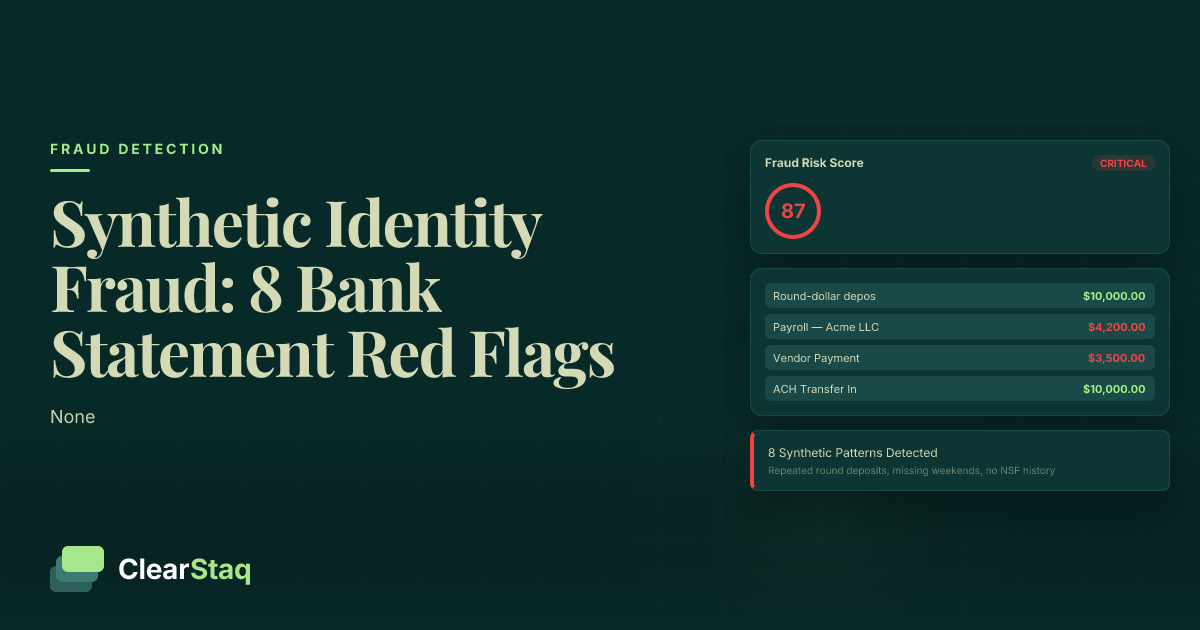
Patient financing sees a specific fraud pattern: the same identity applying at multiple clinics or practices in the same week for procedures that don't require a referral chain.
- Check for duplicate SSNs or matching bank account numbers across recent applications
- Flag applicants whose stated employer can't be verified against payroll deposit descriptors
- Watch for brand-new bank accounts opened within 30 days of the application
- Cross-reference address changes against the applicant's stated timeline
Set approval thresholds based on verified cash flow, not stated income
Once income is verified, the threshold that matters is what the applicant can actually carry monthly, not what they wrote on the form.
- Calculate debt-to-income using verified deposits, not self-reported salary
- Build separate thresholds for salaried, self-employed, and gig-income applicants
- Require a minimum average daily balance buffer for high-ticket procedures
- Re-run the calculation if verified income differs from stated income by more than 15%
Monitor for re-verification triggers after approval
Patient financing loans often fund before the full loan term begins, since many procedures require payment upfront. A short re-verification window catches problems before the balance is unrecoverable.
- Re-check income if the first payment is missed within 30 days
- Flag any post-approval change in direct deposit employer
- Set an automatic re-verification trigger for loans over a defined ticket size
Comparing income verification options for patient financing companies
| Option | Best for | Key limitation | Verdict |
|---|---|---|---|
| Manual pay stub + W2 collection | Low-volume shops verifying salaried applicants | Misses self-employed and gig income, slow at scale | Hold |
| Instant bank connection (Plaid-style) | Confirming account ownership and balance in real time | Shows balance, not verified income patterns or fraud signals | Hold |
| Soft credit pull income estimate | Quick pre-qualification before a hard pull | Estimated income only, no document verification | Wait |
| IRS 4506-C transcript verification | High-ticket procedures needing audited income proof | Turnaround of several days kills point-of-care approval | Wait |
| AI-powered bank statement & tax parsing (ClearStaq) | Point-of-care decisions across salaried, self-employed, and gig applicants | Needs a document or connected feed to run signals against | Buy |
See income verification in action
Run a real applicant statement through ClearStaq's parsing engine.
Common mistakes patient financing companies make
- Treating a soft credit pull as income verification. A credit score says nothing about current cash flow, and patient financing loans are underwritten on ability to pay monthly, not credit history alone.
- Approving based on a single pay stub. One document with no deposit match is the single easiest fraud vector in 2026 elective-procedure lending.
- Ignoring seasonal self-employed income. A landscaper or wedding photographer applying in their slow month looks like a bad risk on a single statement but not across a full quarter.
- Skipping re-verification after upfront funding. Many patient financing structures pay the provider before the loan term starts, so the window to catch a bad approval closes fast.
- Using the same threshold for salaried and gig-income applicants. Gig income needs a wider averaging window; applying a salaried DTI formula rejects good applicants and misses bad ones.
FAQ
What is income verification software for patient financing companies?
It's software that parses bank statements, pay stubs, and tax returns to confirm an applicant's income before approving a loan for an elective medical, dental, or veterinary procedure. It replaces manual document review with automated parsing and fraud checks.
How fast can income verification happen for patient financing?
AI-powered parsing platforms like ClearStaq process a bank statement in under 5 seconds, which is fast enough to clear an approval while the patient is still at the point of care. Manual review of the same document typically takes 15-20 minutes.
Does income verification work for self-employed patients?
Yes, but it requires averaging deposits across 60-90 days rather than reading a single pay stub, since self-employed income varies month to month. Software that parses full bank statement history catches this pattern automatically.
How do you catch a fake pay stub in patient financing applications?
Cross-check the stated net pay and pay frequency against actual recurring deposits in the bank statement. A stub with no matching deposit history is the most common sign of fabrication in 2026 applications.
Is a credit pull enough to verify income?
No. A credit score reflects payment history, not current income or cash flow. Patient financing companies that rely on credit pulls alone approve applicants who can't actually carry the monthly payment.
What's the difference between income verification and fraud detection?
Income verification confirms the applicant earns what they claim; fraud detection checks whether the submitted documents themselves are genuine. Both are needed, since a real income figure can still come from a doctored document.
Can income verification software integrate with an existing loan origination system?
Most bank statement parsing platforms offer an API that plugs into an existing origination workflow, so the verification step happens without changing the application flow the patient sees.
How much income documentation should a patient financing company require?
At minimum, 60-90 days of bank statements plus the most recent pay stub or prior-year tax return for self-employed applicants. A single document rarely reflects real income patterns.
One last thing
The applicants patient financing companies reject most often aren't fraudsters — they're self-employed people whose income doesn't fit a single-month template. Widening the verification window to a full quarter, instead of reading one pay stub, catches more real fraud and approves more real patients at the same time.
Related guides
ClearStaq Team
Content Team
The ClearStaq team builds AI-powered tools for bank statement parsing, fraud detection, and income verification.