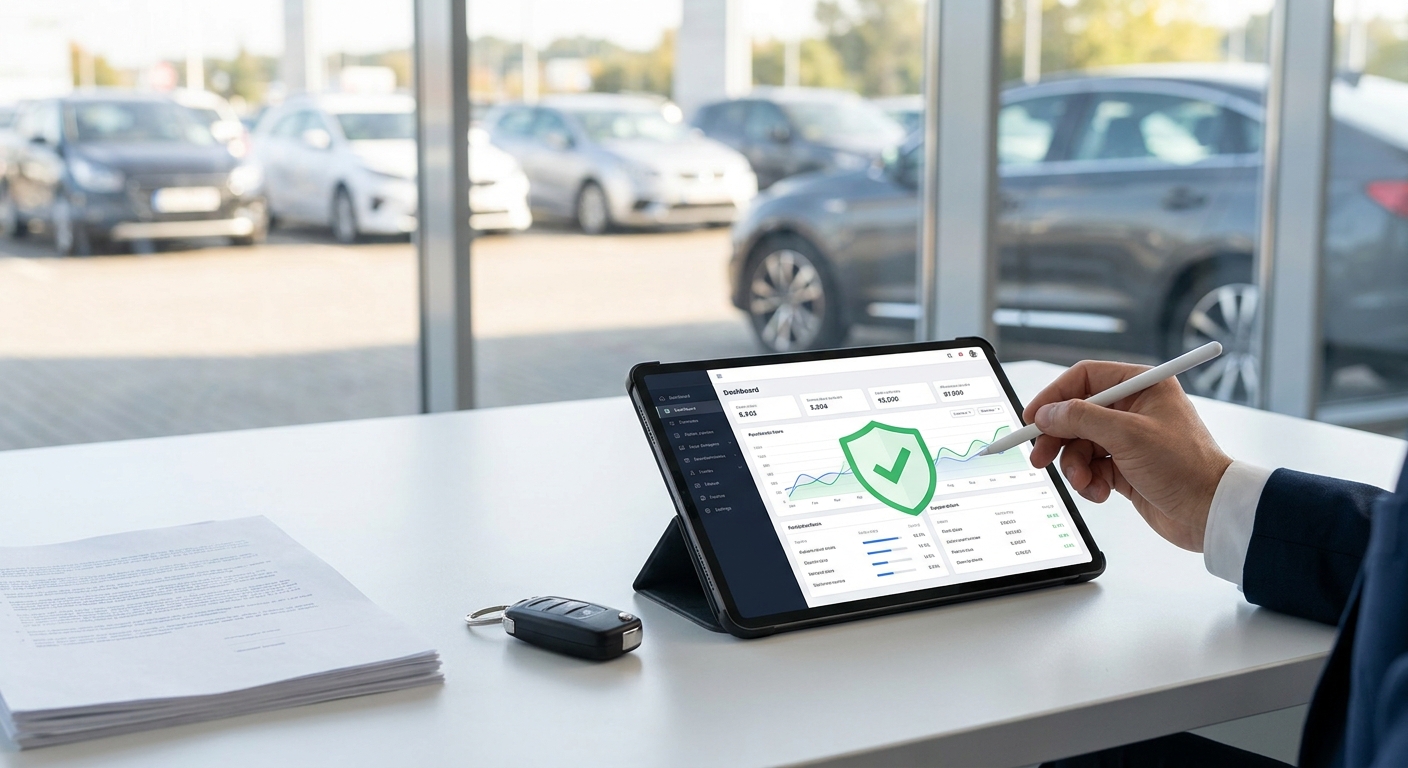
Auto lenders lose approved deals to synthetic borrowers and doctored IDs long after the credit check clears — this ranks the identity verification software worth budgeting for in 2026, and flags the fraud gap most IDV stacks never close.
- Socure wins for high-volume digital-first auto lending; Mitek wins for dealer point-of-sale ID scans in 2026.
- Alloy is the pick once you're running 3+ verification vendors and need one decision layer.
- ClearStaq isn't an identity verification tool — it catches doctored bank statements and pay stubs that IDV misses.
- Prove moves fast on phone-based checks but goes shallow on document fraud; treat it as a Wait.
Why this matters
Auto lending fraud in 2026 isn't just stolen identities anymore. Synthetic identities, doctored pay stubs, and straw purchases move through the same digital financing funnels as legitimate buyers, and they get past the front door because most identity verification software for lending platforms only answers one question.
That question is: is this person real? It checks a government ID, matches a selfie, and scores device or IP risk. It does not check whether the bank statement backing the down payment is legitimate, or whether the pay stub was edited ten minutes before upload. That's the gap where auto lenders lose money — after approval, not before it.
This guide ranks identity verification tools by fit for auto lending workflows: dealer kiosk, remote financing, and buy-here-pay-here. It also flags where you still need a document-fraud layer on top of whatever IDV tool you pick.
How we ranked
Rankings weigh three things auto lenders care about more than general KYC buyers do: dealer-network fit (can it run on a kiosk or tablet at point of sale), document coverage for the IDs auto borrowers actually present, and how each tool handles synthetic identity risk — the fastest-growing fraud category in vehicle financing heading into 2026.
Public product documentation, integration guides, and vendor capability pages are the source material here. No vendor paid for placement or ranking position on this list.
The ranked list
1. Socure — the identity graph leader
Socure built its reputation on network-based identity risk scoring, pulling signal from device, email, and phone history rather than the ID document alone. For auto lenders running remote or app-based financing at volume, that network effect matters more than a single document scan.
It fits lenders processing high application volume through digital channels where a fast yes/no identity decision needs to happen before the borrower loses interest. Verdict: Buy for high-volume digital-first auto lenders.
2. Mitek — the dealer point-of-sale specialist
Mitek's mobile capture technology is built for the exact moment a borrower hands over a driver's license at a dealer kiosk or F&I desk. Document capture and forgery detection on a phone camera is its core strength, not a bolt-on feature.
Dealer-network lenders and buy-here-pay-here operations that verify IDs in person, not just online, get more out of this than a pure remote-verification tool. Verdict: Buy for lenders with a physical dealer point-of-sale.
3. Jumio — the biometric heavyweight
Jumio pairs document verification with liveness and facial biometric matching, aimed at stopping the borrower who presents a real ID that belongs to someone else. That's a distinct fraud pattern from a fabricated document, and it needs a distinct check — see the breakdown on liveness detection for digital lending onboarding.
It fits lenders running fully remote financing where no human ever looks the borrower in the eye. Verdict: Consider if biometric matching is your primary gap, Skip if you already have strong liveness checks elsewhere.
4. Onfido (Entrust) — the global document coverage pick
Onfido's document library spans a wide range of international ID formats, which matters for auto lenders financing borrowers who hold visas, passports, or out-of-country licenses instead of a standard state ID.
Lenders with an immigrant or international borrower base get more mileage here than from a tool optimized only for U.S. state licenses. Verdict: Consider for lenders with non-standard ID volume, Skip if your borrower base is almost entirely U.S. state-issued IDs.
5. Alloy — the orchestration layer
Alloy doesn't replace an IDV vendor — it sits on top of several and routes decisions based on rules you set. That's the right answer once a lender is running Socure for one product line and Mitek for another and needs one place to see the decision logic.
It's overkill for a lender running a single verification vendor with a simple approve/deny flow. Verdict: Buy once you're managing 3 or more identity vendors, Skip below that.
6. Prove — the phone-based wildcard
Prove verifies identity using phone number and carrier data instead of a document scan, which cuts friction for borrowers applying from a phone. Speed is the selling point.
The tradeoff is depth: phone-based verification says less about document authenticity than a tool built around document forensics. Pair it with something else if document fraud is a real risk for your portfolio. Verdict: Wait as a standalone tool, Consider as a friction-reduction layer alongside a document-focused IDV product.
7. ClearStaq — the fraud layer identity verification doesn't cover
ClearStaq is not an identity verification tool, and it's worth saying plainly: it doesn't scan a driver's license or match a selfie. What it does is parse the bank statements, pay stubs, and tax documents an auto borrower submits, run them through 27+ fraud signals, and flag doctored PDFs, income smoothing, and synthetic account patterns before disbursement.
That gap matters because a borrower can pass every identity check and still submit a fabricated bank statement to inflate a down payment. Auto lenders and buy-here-pay-here dealers dealing with that pattern specifically should look at document fraud detection for auto lenders and the related work on synthetic identity fraud detection tools. Processing runs under 5 seconds per document, with accuracy benchmarked at 99.5% across 900+ statement formats. Verdict: Buy as the second layer behind whichever IDV tool you pick above.
“Identity verification tells you the person is real. It doesn't tell you the bank statement is real.”
Comparison table
| Tool | Best fit | Verification type | 2026 verdict |
|---|---|---|---|
| Socure | High-volume digital lenders | Identity graph + device risk | Buy |
| Mitek | Dealer point-of-sale | Mobile document capture | Buy |
| Jumio | Fully remote financing | Biometric + liveness | Consider |
| Onfido | International borrower base | Global document library | Consider |
| Alloy | Multi-vendor stacks | Decision orchestration | Buy (3+ vendors) |
| Prove | Friction-sensitive apps | Phone-based identity | Wait (standalone) |
| ClearStaq | Document + income fraud | Bank statement / pay stub parsing | Buy (second layer) |
Add a document fraud layer to your stack
See how bank statement and pay stub fraud slips past identity verification.
Where to buy
- Buy direct from the vendor if you're processing under roughly 500 applications a month — most IDV vendors will quote a self-serve or lightweight sales-assisted plan at that volume in 2026.
- Buy through an orchestration layer like Alloy once you're running 3 or more identity vendors across product lines; managing decision logic in one place beats managing it in three dashboards.
- Lock in contract terms before Q1 2026 renewal season — most IDV vendors reprice around calendar-year renewals, and fraud rates from the prior year get used to justify increases.
FAQ
What's the best identity verification software for auto lenders in 2026?
Socure fits high-volume digital-first auto lenders best in 2026, and Mitek fits dealer point-of-sale financing best. The right pick depends on whether borrowers apply online or in person at a dealership.
Is identity verification software enough to stop auto loan fraud?
No. Identity verification confirms the borrower is a real person but doesn't check whether submitted bank statements or pay stubs are authentic. Auto lenders need a document fraud layer alongside IDV to catch doctored financials.
How much does identity verification software cost for auto lenders?
Pricing varies by vendor and volume, and most IDV vendors quote per-verification or tiered monthly pricing rather than a flat rate. Check current pricing directly with each vendor since it changes with contract terms.
What's the difference between IDV and KYC for auto lenders?
Identity verification (IDV) confirms a person matches their ID and isn't a stolen or synthetic identity. KYC (know your customer) is the broader compliance process that includes IDV plus risk scoring, sanctions checks, and ongoing monitoring.
Does ClearStaq replace identity verification software?
No. ClearStaq doesn't scan IDs or match selfies — it parses bank statements, pay stubs, and tax documents for fraud signals. It sits alongside an IDV tool, not in place of one.
Which identity verification tool works best for buy-here-pay-here dealers?
Mitek's mobile document capture fits buy-here-pay-here dealers best because verification happens at the point of sale on a tablet or kiosk rather than through a remote app flow.
How common is synthetic identity fraud in auto lending in 2026?
Synthetic identity fraud is described industry-wide as one of the fastest-growing fraud categories in vehicle financing heading into 2026, since synthetic identities can build a thin credit history over months before applying for financing.
One last thing
The biggest fraud losses in auto lending in 2026 rarely come from a fake ID at the dealer desk — they come from a real person submitting a real ID and a fabricated bank statement to inflate the down payment past what their income supports. Identity verification software will approve that borrower every time. A document-fraud layer is the only thing that catches it before disbursement.
Related guides
ClearStaq Team
Content Team
The ClearStaq team builds AI-powered tools for bank statement parsing, fraud detection, and income verification.