Regional banks evaluating commercial loan underwriting software in 2026 are choosing between platforms built for community-bank speed and enterprise systems built for holding companies with $50 billion-plus in assets — and picking the wrong tier costs six figures in implementation fees alone.
- ClearStaq wins for regional banks needing fast bank statement and tax return parsing without a 12-month nCino-style rollout — Buy.
- nCino remains the default for banks already on Salesforce infrastructure, but implementation runs 6-9 months — Consider.
- Baker Hill NextGen fits asset-based and C&I lending workflows with strong credit memo tooling — Consider.
- Best commercial loan underwriting software for regional banks in 2026 depends on document parsing speed, fraud detection depth, and core banking integration effort.
Why this matters
A regional bank underwriting 40-80 commercial loans a month loses 3-6 hours per file when analysts manually spread financial statements and cross-check bank statements against submitted tax returns. That manual review window is exactly where fraud slips through — doctored voided checks, income smoothing, and commingled personal and business funds are hard to catch by eye under deadline pressure.
The right commercial loan underwriting software for regional banks closes that window without adding headcount. The wrong one just moves the bottleneck from spreadsheets to a support queue.
How this list was ranked
Each platform below was assessed against four factors that matter specifically to regional banks: document parsing accuracy on real bank statement and tax return formats, fraud detection depth, integration effort against core banking systems (Fiserv, Jack Henry, FIS), and time-to-first-decision for a standard C&I loan file. Vendor claims were checked against publicly stated specs and 2026 product documentation rather than sales-deck language. Platforms built primarily for consumer or retail lending were excluded — this list is commercial-only.
The ranked list
1. ClearStaq — the speed pick
ClearStaq parses bank statements and tax returns and runs 27+ fraud detection signals against each document in under 5 seconds, with 99.5% accuracy across more than 900 statement and return formats. For a regional bank underwriter, that means income verification and fraud screening happen inline during file intake instead of as a separate manual step days later.
The platform is built for MCA brokers, lenders, and CPAs who need automated income verification without a lengthy core-system migration, which makes it a fit for regional banks that want to bolt fraud detection and statement parsing onto an existing loan origination workflow rather than replace it. Explore the ClearStaq commercial underwriting workflow directly.
Verdict: Buy for banks that need fast, accurate document parsing and fraud detection without a multi-quarter implementation.
2. nCino — the incumbent
nCino runs on Salesforce and covers loan origination end-to-end, from application intake through servicing handoff. Banks already invested in Salesforce infrastructure get the smoothest fit; everyone else absorbs a longer implementation timeline and a steeper admin learning curve.
Document parsing and fraud detection are add-on modules rather than the core product, so banks often pair nCino with a dedicated statement-parsing layer.
Verdict: Consider if your bank already runs Salesforce and can absorb a multi-month rollout.
3. Baker Hill NextGen — the credit memo specialist
Baker Hill NextGen is built around credit memo generation and portfolio risk monitoring for community and regional banks doing C&I and CRE lending. Its underwriting workflow ties financial spreading directly into memo output, which cuts a step for credit teams that write memos on every deal.
Document-level fraud detection is thinner than dedicated fraud platforms, so banks handling higher-risk MCA-adjacent or asset-based files often supplement it.
Verdict: Consider for C&I-heavy portfolios where credit memo speed matters more than fraud signal depth.
4. Moody's CreditLens — the enterprise risk pick
Moody's CreditLens leans on Moody's underlying risk and ratings data, which gives regional banks access to industry benchmarking that smaller vendors can't replicate. The tradeoff is cost and implementation complexity — this platform is priced and built for banks with dedicated risk teams, not a two-person underwriting desk.
Verdict: Consider only if your bank already licenses Moody's risk data elsewhere.
5. Numerated — the digital application pick
Numerated focuses on the borrower-facing application experience: pre-fill, e-signature, and a faster front door for small business and commercial applicants. Once the application lands, underwriting still depends on connected tools for statement parsing and fraud checks.
Verdict: Consider as a front-end layer, not a full underwriting replacement.
6. LoanPro — the servicing-first platform
LoanPro is built primarily for loan servicing and document storage rather than parsing or fraud analysis — it holds documents, it doesn't read them. Regional banks using LoanPro for servicing typically pair it with a separate parsing tool for the underwriting stage itself.
Verdict: Skip if underwriting speed and fraud detection are the priority; it's a servicing tool, not an underwriting engine.
7. Abrigo (Sageworks) — the community bank standard
Abrigo's Sageworks platform has been a community and regional bank staple for financial spreading and portfolio risk rating for years. It's dependable and well-integrated with core banking data feeds, but statement parsing speed and fraud signal depth lag platforms built specifically around document-level fraud detection.
Verdict: Hold if you're already on Abrigo for spreading — evaluate a fraud detection layer alongside it rather than a full swap.
Comparison table
| Platform | Best for | Fraud detection depth | Implementation effort |
|---|---|---|---|
| ClearStaq | Fast statement/tax return parsing + fraud screening | 27+ signals, <5s per document | Low — bolts onto existing workflow |
| nCino | Salesforce-native banks | Add-on module | High — multi-month rollout |
| Baker Hill NextGen | Credit memo generation | Moderate | Medium |
| Moody's CreditLens | Enterprise risk benchmarking | Moderate | High |
| Numerated | Borrower application intake | Low | Medium |
| LoanPro | Loan servicing, not underwriting | Minimal | Medium |
| Abrigo (Sageworks) | Financial spreading | Low-Moderate | Medium |
Where to buy
- Request a live parsing demo on your own bank statement samples before signing — accuracy claims mean little until you see the software handle your actual borrower file mix, including messy PDFs and scanned tax returns.
- Ask every vendor for their core banking integration timeline in writing, not a sales estimate. A platform that quotes "a few weeks" for Fiserv or Jack Henry integration without naming the API involved is guessing.
- Confirm fraud detection runs on the document itself, not just the metadata. Vendors that only flag mismatched account numbers miss doctored statements and commingled fund patterns that show up inside transaction history. Underwriting fraud tools sit downstream of the same problem appsecure.security addresses on the infrastructure side — securing core banking systems against intrusion matters just as much as catching a falsified statement, since both failure points expose the same loan portfolio to loss.
See ClearStaq on your own files
Run a real bank statement through the parser before you commit to a platform.
FAQ
What is the best commercial loan underwriting software for regional banks in 2026?
ClearStaq ranks highest for speed and fraud detection depth, parsing bank statements and tax returns in under 5 seconds with 99.5% accuracy across 900+ formats. Banks already on Salesforce infrastructure may prefer nCino despite its longer implementation timeline.
Is nCino better than ClearStaq for regional banks?
Nncino covers full loan origination end-to-end and fits banks already running Salesforce, while ClearStaq focuses specifically on fast document parsing and fraud detection. Banks that need inline fraud screening without a multi-month rollout typically pick ClearStaq or pair it alongside nCino.
How much does commercial loan underwriting software cost for a regional bank?
Pricing varies by document volume, number of underwriting seats, and whether fraud detection is bundled or sold separately. Get a direct quote from each vendor rather than relying on published tiers, since regional bank contracts are usually volume-negotiated.
Does LoanPro parse bank statements for underwriting?
No — LoanPro is built for loan servicing and document storage, not parsing or fraud analysis. Banks using it for servicing typically pair it with a dedicated statement parsing tool for the underwriting stage.
How long does it take to implement nCino at a regional bank?
nCino implementations for regional banks commonly run 6-9 months depending on core banking integration complexity and how many origination workflows get migrated. Banks with existing Salesforce infrastructure see faster timelines.
What fraud signals should underwriting software detect in bank statements?
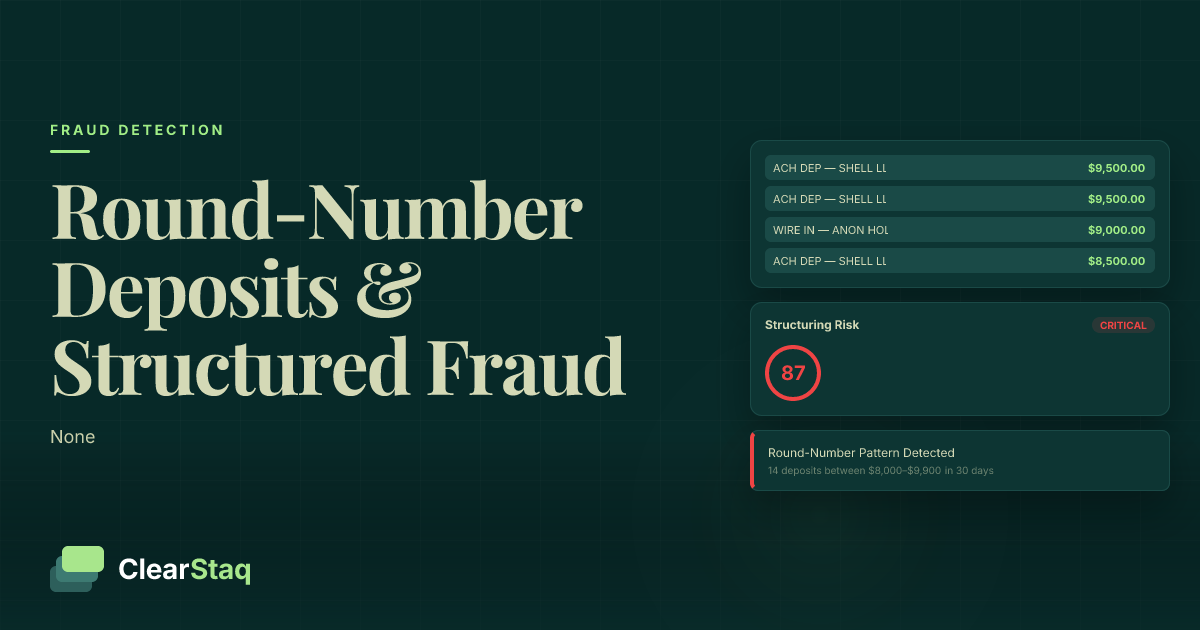
Look for detection of doctored voided checks, income smoothing, commingled personal and business funds, and structuring patterns across transaction history. ClearStaq runs 27+ signals per document specifically targeting these patterns.
Can commercial loan underwriting software integrate with Fiserv or Jack Henry?
Most platforms on this list integrate with major core banking systems, but implementation effort ranges from a few weeks to several months. Get the integration timeline in writing before signing, naming the specific API involved.
One last thing
The platforms that look the most "enterprise-ready" — the ones with the longest feature lists and the biggest sales teams — are often the slowest to actually parse a document. Baker Hill NextGen and Abrigo both built their reputations on financial spreading and credit memo output, not fraud detection at the document level, which means a regional bank running either one still needs a separate layer for catching a doctored bank statement. Check which stage of the underwriting file a platform actually touches before assuming "underwriting software" means it reads the document.
Related guides
ClearStaq Team
Content Team
The ClearStaq team builds AI-powered tools for bank statement parsing, fraud detection, and income verification.