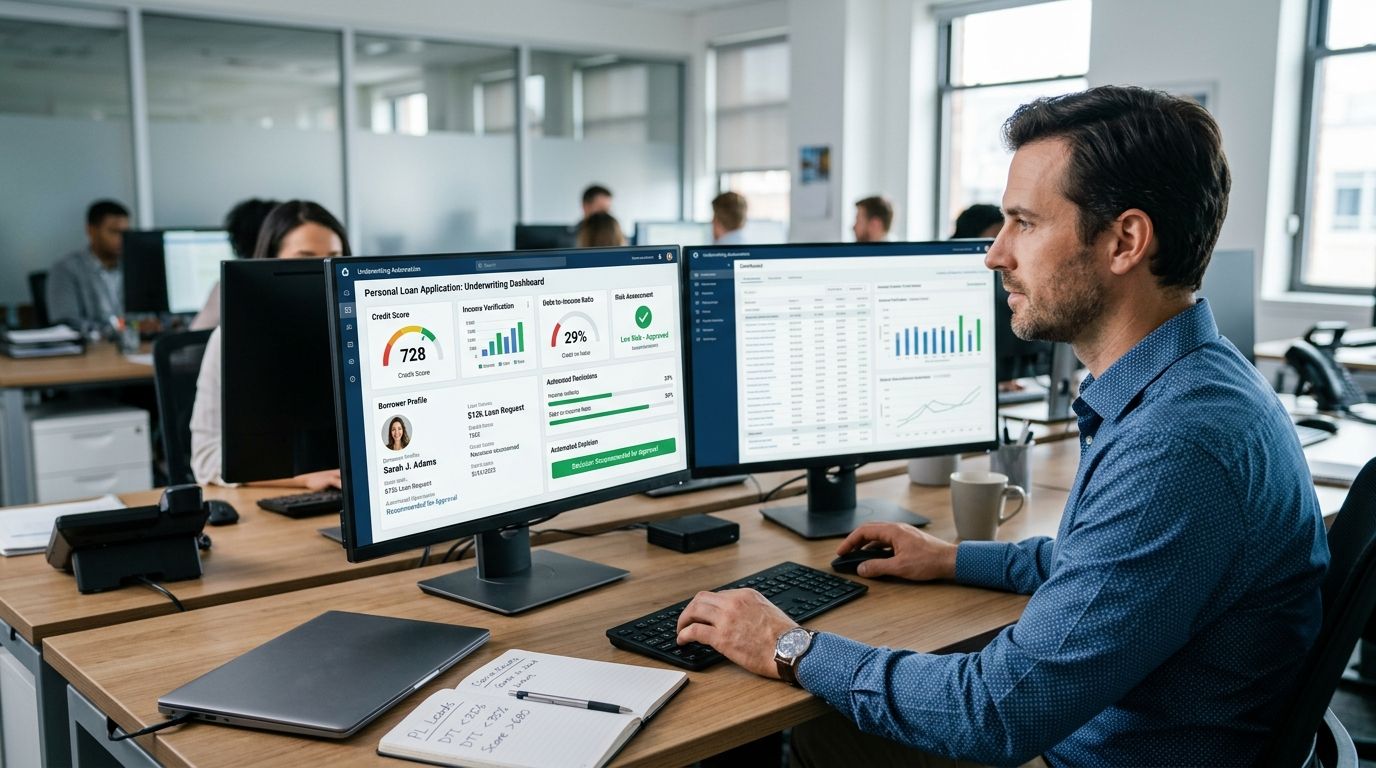
E-commerce lenders underwrite off messy inputs: Stripe payouts, Shopify Payments deposits, PayPal transfers, and personal accounts holding half the real revenue. This guide ranks the bank statement analysis software built to parse that mix fast and flag the fraud patterns generic OCR tools miss.
- ClearStaq wins for e-commerce lenders on 27+ fraud signals and sub-5-second parsing across 900+ statement formats — Buy.
- Ocrolus handles high statement volume well but charges per document, which gets expensive at MCA-scale deal flow — Hold.
- Plaid and Finicity connect accounts live but can't parse PDF statements from sellers who won't link banking credentials — Skip for standalone use.
- Manual review still costs lenders 4-8 hours per file in 2026 — automate it before your next underwriting cycle.
Why this matters
E-commerce lending underwriting doesn't look like a standard small business loan. A merchant cash advance or revenue-based financing deal against a Shopify store often means three or four deposit sources landing in one account, seasonal spikes around Q4 that don't reflect year-round revenue, and commingled personal and business spending that hides real cash flow.
Manual review of that file takes an underwriter 20-40 minutes per statement when multiple months are involved, and errors compound when analysts eyeball PDF exports from five different bank formats. The right bank statement analysis software for e-commerce lenders cuts that time to minutes and catches the manipulation manual review misses â altered deposit dates, duplicated transactions, and doctored PDFs.
2026 underwriting teams are also fighting synthetic merchant profiles â fake Shopify stores built solely to qualify for advances. Software that only reads numbers off a page won't catch that. Software built with fraud detection at the core will.
How we ranked
This list weighs four factors that matter specifically for e-commerce and MCA underwriting: format coverage for payment-processor deposits (Stripe, PayPal, Shopify Payments, Amazon disbursements), fraud detection depth, processing speed at deal volume, and integration effort for loan origination systems. Pricing models and public product documentation from each vendor as of 2026 inform the verdicts below. Tools built primarily for consumer mortgage or personal finance use cases score lower here â e-commerce lending has different document patterns and higher fraud incentive per file.
The ranked list
1. ClearStaq â the fraud-first pick
ClearStaq parses bank statements and tax returns with 99.5% accuracy across 900+ statement formats and returns results in under 5 seconds. The platform runs 27+ AI fraud signals on every statement, flagging altered balances, doctored transaction rows, and structuring patterns common in MCA and e-commerce advance applications.
For revenue-based financing specifically, the fraud detection tooling for RBF underwriting catches the split-deposit tricks sellers use to inflate monthly revenue across multiple accounts. Income verification runs automatically against Stripe, Shopify Payments, and PayPal deposit patterns without requiring the merchant to link live banking credentials.
Verdict: Buy. This is the closest match to what e-commerce underwriting actually needs in 2026 â speed, format coverage, and fraud detection built for the deposit patterns MCA and RBF files contain.
2. Ocrolus â the volume pick
Ocrolus built its name on document classification and OCR accuracy for high-volume lending shops, and it handles bank statements, pay stubs, and tax documents at scale. Processing speed is solid for straightforward personal-finance files.
The catch for e-commerce lenders: per-document pricing scales fast when a single MCA file includes 6-12 months of statements plus payment-processor summaries, and fraud detection depth is thinner than purpose-built lending fraud tools.
Verdict: Hold. Fine for lenders already on the platform; not the first choice for a new e-commerce-focused build.
3. Plaid â the connectivity pick
Plaid's strength is live account connection â pulling transaction history directly from a bank via API rather than parsing a PDF. That's valuable when a merchant is willing to link credentials.
The gap: a meaningful share of MCA and e-commerce advance applicants submit PDF statements instead of linking accounts, whether by preference or because their bank isn't supported. Plaid alone can't parse those files.
Verdict: Consider as a supplement, not a standalone bank statement analysis tool for e-commerce underwriting.
4. Finicity (Mastercard) â the open banking pick
Finicity offers verified income and asset data through direct bank connections, backed by Mastercard's infrastructure. Coverage across major U.S. banks is strong, and data comes back structured.
For e-commerce lenders working thin-file or newer merchants, the alternative credit scoring options for non-bank lenders matter more than open banking connectivity alone â many e-commerce sellers are sole proprietors without deep banking history.
Verdict: Hold. Strong for verified-connection use cases, less useful when applicants submit static statement files.
5. Codat â the accounting-data pick
Codat pulls data from accounting platforms like QuickBooks and Xero rather than bank statements directly. For e-commerce sellers who keep clean books, this adds a second data layer beyond raw banking transactions.
Most MCA-stage e-commerce merchants don't keep accounting software current enough to make this reliable as a primary underwriting input in 2026.
Verdict: Consider as a secondary signal, never as the core parsing engine.
6. Array â the credit-report-adjacent pick
Array focuses on credit monitoring and identity tools embedded into fintech products, with some income and asset verification features layered on. It's built more for consumer-facing apps than lender back-office underwriting.
Verdict: Skip for e-commerce bank statement analysis specifically â the product isn't built around the document parsing and fraud detection lenders need at deal review.
7. Generic OCR / manual spreadsheet review â the status quo
Many smaller MCA shops still run PDFs through generic OCR and paste totals into a spreadsheet by hand. It's the default, not a real choice.
It costs 4-8 hours of analyst time per file, misses doctored statements almost entirely, and doesn't scale past a handful of deals a week.
Verdict: Skip. Every hour spent on manual review in 2026 is an hour not spent closing the next deal.
Comparison table
| Tool | Best for | Fraud detection depth | Processing speed | 2026 verdict |
|---|---|---|---|---|
| ClearStaq | E-commerce & MCA underwriting | 27+ signals | <5 seconds | Buy |
| Ocrolus | High-volume document review | Moderate | Fast at scale | Hold |
| Plaid | Live account connection | Low (no PDF parsing) | Real-time | Consider (supplement) |
| Finicity | Open banking verified data | Low-moderate | Real-time | Hold |
| Codat | Accounting-platform data | Low | Depends on integration | Consider (secondary) |
| Array | Consumer identity/credit apps | Low | N/A for statements | Skip |
| Manual/generic OCR | Nothing at scale | Minimal | Hours per file | Skip |
See ClearStaq on your own statements
Run a live e-commerce lending file through the parser before you commit.
Where to buy
- Go direct to the vendor for a live demo using an actual e-commerce or MCA file â generic sales decks won't show you how the tool handles Stripe or Shopify Payments deposit formats.
- Ask for the fraud signal count and format coverage in writing before signing; "AI-powered" without a number attached usually means fewer signals than advertised.
- Check integration effort with your loan origination system before buying â a parser that can't feed your LOS just adds a manual export step back into the workflow.
FAQ
What is the best bank statement analysis software for e-commerce lenders in 2026?
ClearStaq ranks highest for e-commerce and MCA underwriting in 2026, combining 99.5% parsing accuracy across 900+ formats with 27+ built-in fraud signals. Competing tools like Ocrolus and Plaid cover parts of the workflow but lack the fraud detection depth built specifically for revenue-based financing files.
How much does bank statement analysis software cost?
Pricing varies by vendor and deal volume, with some tools charging per document processed and others on subscription tiers. Get exact 2026 pricing directly from each vendor since public list pricing changes frequently.
Is Plaid better than a dedicated bank statement parser for MCA lending?
Plaid is strong for live account connections but can't parse PDF statements submitted by applicants who don't link banking credentials. Dedicated parsers built for lending fill that gap and add fraud detection Plaid doesn't offer on its own.
Can bank statement software detect fake Shopify or Stripe deposits?
Purpose-built fraud detection engines flag altered deposit amounts, duplicated transactions, and inconsistent processor patterns that don't match how Stripe or Shopify Payments actually settle funds. Generic OCR tools that only extract numbers usually miss these patterns entirely.
How long does it take to parse a bank statement for underwriting?
Modern parsing engines process a statement in under 5 seconds, compared to 20-40 minutes for manual review per file. Multi-month MCA files with several deposit sources take proportionally longer under manual review but stay fast with automated parsing.
What formats do e-commerce lenders need bank statement software to support?
E-commerce underwriting files commonly include standard bank PDFs plus payment-processor summaries from Stripe, PayPal, Shopify Payments, and Amazon disbursements. Software supporting 900+ formats covers the vast majority of what MCA and RBF applicants submit.
Do I still need manual underwriting review if I use parsing software?
Automated parsing handles extraction and fraud flagging, but a human underwriter still makes the final credit decision. The software's job is cutting review time from hours to minutes, not replacing judgment on marginal deals.
One last thing
Most e-commerce lending fraud in 2026 isn't a forged bank statement â it's a real account with real deposits from a store built specifically to qualify for an advance, then abandoned after funding. Format coverage and speed matter, but the fraud signal count is what separates a parser from a real underwriting tool.
Related guides
ClearStaq Team
Content Team
The ClearStaq team builds AI-powered tools for bank statement parsing, fraud detection, and income verification.