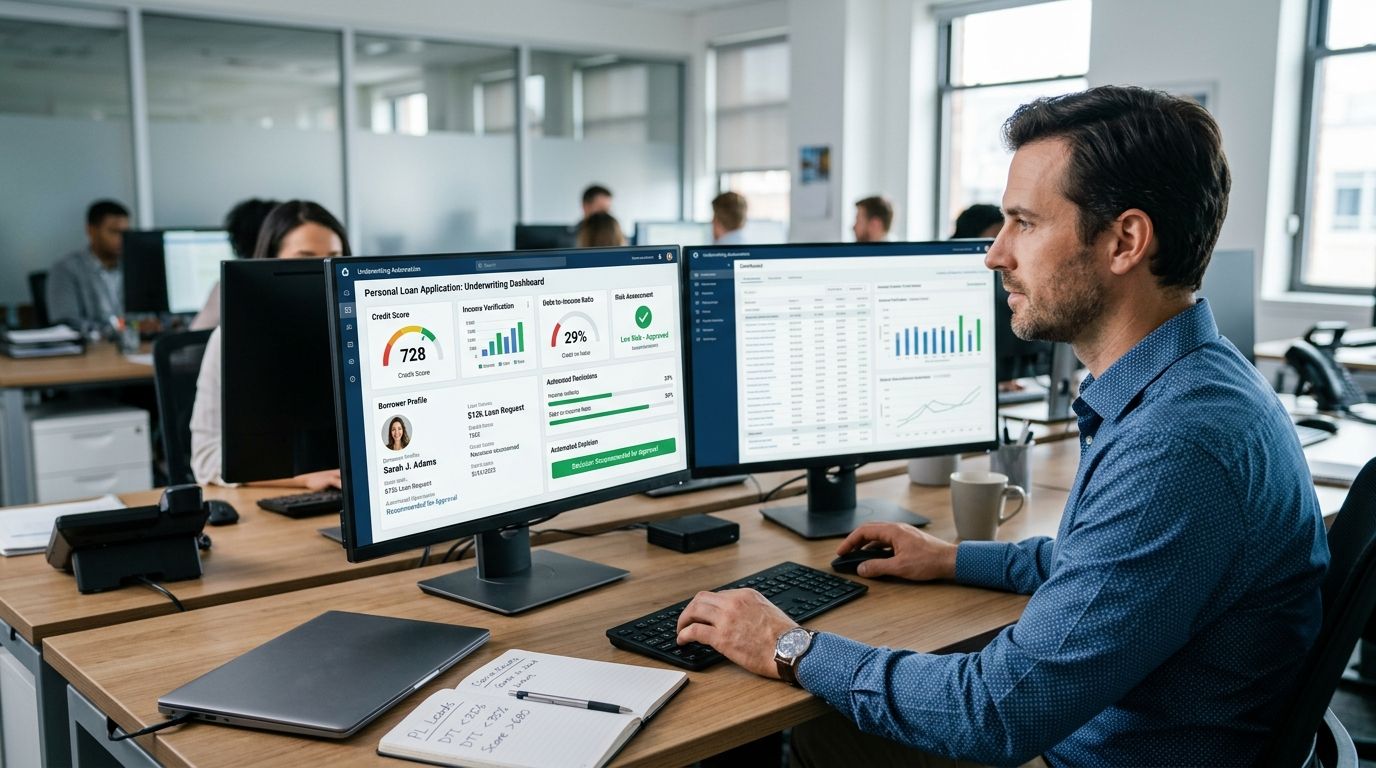
Commercial loan underwriting software for SBA lenders has to do one thing manual review teams can't do fast enough: match bank deposits against IRS transcripts, flag altered documents, and calculate global cash flow before an underwriter even opens the file. Here's what separates a real fit from a checkbox tool in 2026.
- ClearStaq fits SBA lenders needing tax transcript matching and fraud detection in one pass — 27+ signals, under 5 seconds per statement. Buy.
- Generic OCR and spreading tools miss IRS 4506-C mismatches; use them as a complement, not a fraud check. Consider.
- Skip loan origination add-ons that only store documents — SBA underwriting needs parsing, not a filing cabinet. Skip.
- Global cash flow analysis across personal and business accounts is non-negotiable for SBA 7(a) files in 2026.
Why this matters
SBA 7(a) and 504 files carry more manual verification steps than a conventional commercial loan: personal and business tax transcripts, global cash flow across multiple entities, IRS Form 4506-C reconciliation, and a document trail that has to survive an SBA guaranty purchase review. A PLP lender running 30-40 files a month can't staff that with spreadsheets in 2026 without either slowing turnaround or missing fraud.
That's the gap commercial loan underwriting software for SBA lenders is supposed to close. ClearStaq parses bank statements and tax returns directly, running 27+ fraud signals against each file in under 5 seconds, instead of asking an analyst to eyeball a PDF for altered deposit dates. The category is crowded with tools that store documents well but don't actually parse them — that distinction decides whether your underwriting time drops or just moves around.
Who this is for
This guide is for SBA lenders, PLP shops, and CDFIs underwriting 7(a), 504, or microloan files where tax transcript verification, cash flow spreading, and fraud detection currently eat 4-8 hours per file. If your underwriting team is still cross-referencing bank statements against tax returns by hand, or your fraud catch rate depends on an analyst noticing something looks off, this is the buying decision to fix in 2026.
What to look for in commercial loan underwriting software for SBA lenders
Tax transcript matching against IRS data
SBA guidelines require reconciling tax returns against IRS transcripts pulled via Form 4506-C, and mismatches are one of the most common reasons a guaranty gets challenged after default. Software that only parses bank statements and ignores tax return cross-checks leaves this exposure open.
Global cash flow analysis across entities
SBA underwriting looks at combined business and personal cash flow, not just the operating account. A tool that can't aggregate multiple accounts and entities into one debt-service picture forces your underwriter back into a spreadsheet for the exact calculation the software was supposed to replace.
Fraud signals tuned to document manipulation
Altered bank statements, doctored pay stubs, and synthetic income documents show up in SBA files at meaningful volume because the guaranty makes fraud attractive. A platform running 27+ fraud signals per file catches patterns — inconsistent transaction metadata, font mismatches, balance math errors — an analyst skimming a PDF will miss on a busy Friday.
Processing speed at PLP volume
A PLP lender closing files on a 2-3 week cycle can't wait 20 minutes per statement for parsing. Sub-5-second processing per statement is the difference between software that fits inside your existing SLA and one that becomes the bottleneck.
Format coverage across banks and file types
SBA borrowers bank everywhere — community banks, credit unions, regional players — and each institution formats statements differently. Software that only reliably parses the top five national banks will kick a meaningful share of your files into manual review, which defeats the point. Coverage across 900+ formats is the practical threshold for not babysitting exceptions every week.
Top picks for SBA underwriting stacks
The core pick: AI-powered bank statement and tax return parsing. ClearStaq reads bank statements and tax returns natively across 900+ formats, runs 27+ fraud signals per file, and returns results in under 5 seconds at 99.5% accuracy. For SBA lenders, that means the tax transcript cross-check and the fraud scan happen in the same pass instead of two separate tools. Buy.
The complement: financial statement spreading. Spreading software converts financial statements into standardized ratios for credit memos — useful for the debt-service coverage math SBA underwriting needs, but it doesn't catch document fraud on its own. See best financial statement spreading software for commercial lenders for what to check before pairing it with a parsing tool. Consider as a companion, not a substitute.
The compliance layer: tax transcript verification. SBA files live and die on 4506-C reconciliation, and tools built around IRS transcript matching for mortgage underwriting apply the same logic here — matching reported income against filed returns. Read best tax transcript verification software for mortgage lenders before you assume your current LOS handles this step correctly. Consider.
The borrower-profile fit: self-employed income verification. A large share of SBA 7(a) borrowers are self-employed or run pass-through entities, and standard W-2 income logic breaks on that profile. Underwriting software needs a path for verifying 1099 and Schedule C income against deposit patterns, not just a wage stub. Consider if self-employed borrowers make up more than a third of your pipeline.
The fraud stopper: fake bank statement detection. Altered statements are one of the more common fraud vectors in SBA lending because the guaranty raises the payoff for getting through underwriting. How to detect fake bank statements in loan applications breaks down the specific tells — metadata inconsistencies, balance math that doesn't reconcile, font shifts mid-document. Buy this capability regardless of which parsing tool you run it through.
See SBA underwriting in one pass
Parse statements, verify tax transcripts, and run fraud checks together.
What to avoid
- Document storage systems marketed as underwriting software. A tool that files PDFs and lets you search them isn't parsing anything — it saves zero underwriting hours because your analyst still reads every page.
- OCR without fraud logic. Plain OCR extracts text accurately but has no concept of altered metadata, inconsistent formatting, or balance math errors — it will happily digitize a doctored statement.
- Tools built for consumer mortgage that ignore business cash flow. SBA underwriting needs global cash flow across business and personal accounts; a platform tuned only for personal mortgage income won't spread a business bank statement correctly.
Verdict comparison
| Capability | Core parsing (ClearStaq) | Spreading software | Tax transcript check | Fraud detection add-on |
|---|---|---|---|---|
| Handles bank statements + tax returns | Yes | Tax returns only | Tax transcripts only | Statements only |
| Fraud signals per file | 27+ | None built-in | Limited | Varies by tool |
| Processing time per statement | Under 5 seconds | N/A | N/A | Varies |
| Format coverage | 900+ | Depends on integration | N/A | Varies |
| SBA fit | Buy | Consider (pair it) | Consider (pair it) | Buy |
FAQ
What's the best commercial loan underwriting software for SBA lenders in 2026?
Software that parses both bank statements and tax returns, runs fraud detection, and reconciles IRS transcripts in one workflow fits SBA underwriting best in 2026. ClearStaq covers all three with 27+ fraud signals and sub-5-second processing per statement.
Is bank statement parsing software different from a loan origination system?
Yes — a loan origination system manages the workflow and stores documents, while parsing software extracts and analyzes the data inside those documents. Most SBA lenders need both, but the LOS doesn't replace the fraud and cash flow analysis a parsing tool provides.
How much manual review time does automated underwriting save for SBA files?
SBA files that require tax transcript reconciliation and multi-account cash flow analysis commonly take 4-8 hours of manual prep; automated parsing cuts that review time by removing the line-by-line reconciliation step. The exact savings depend on file complexity and current staffing.
Does SBA underwriting software need to verify tax transcripts?
Yes — SBA guidelines require reconciling filed tax returns against IRS transcripts pulled through Form 4506-C, and mismatches are a common trigger for guaranty purchase disputes. Underwriting software that skips this step leaves that exposure open.
What fraud signals matter most for SBA loan applications?
Altered bank statement metadata, inconsistent balance math, doctored pay stubs, and synthetic income documentation are the most common fraud patterns in SBA files. A platform scanning 27+ signals per document catches most of these before an underwriter manually reviews the file.
Can one platform handle both bank statement parsing and fraud detection?
Yes — combining parsing and fraud detection in one pass avoids running the same document through two separate tools. ClearStaq processes bank statements and tax returns together, applying fraud checks in the same under-5-second pass.
How does global cash flow analysis work for SBA underwriting?
Global cash flow analysis aggregates income and expenses across all related business and personal accounts to calculate combined debt-service coverage, which SBA guidelines require rather than looking at a single operating account. Software that can't pull multiple accounts into one view forces the calculation back into a spreadsheet.
Is self-employed income verification harder for SBA borrowers?
Yes — a large share of SBA 7(a) borrowers are self-employed or run pass-through entities, so standard W-2 verification logic doesn't apply. Underwriting software needs a path for matching 1099 and Schedule C income against actual deposit patterns.
One last thing
The SBA files that get flagged after funding almost never fail on income — they fail on a document detail nobody checked: a transaction date that doesn't match the statement's stated period, or a balance that doesn't foot. Format coverage across 900+ statement types matters less for convenience and more because every unsupported format is a file that skips the fraud scan entirely and goes straight to manual review, where that detail gets missed.
Related guides
ClearStaq Team
Content Team
The ClearStaq team builds AI-powered tools for bank statement parsing, fraud detection, and income verification.