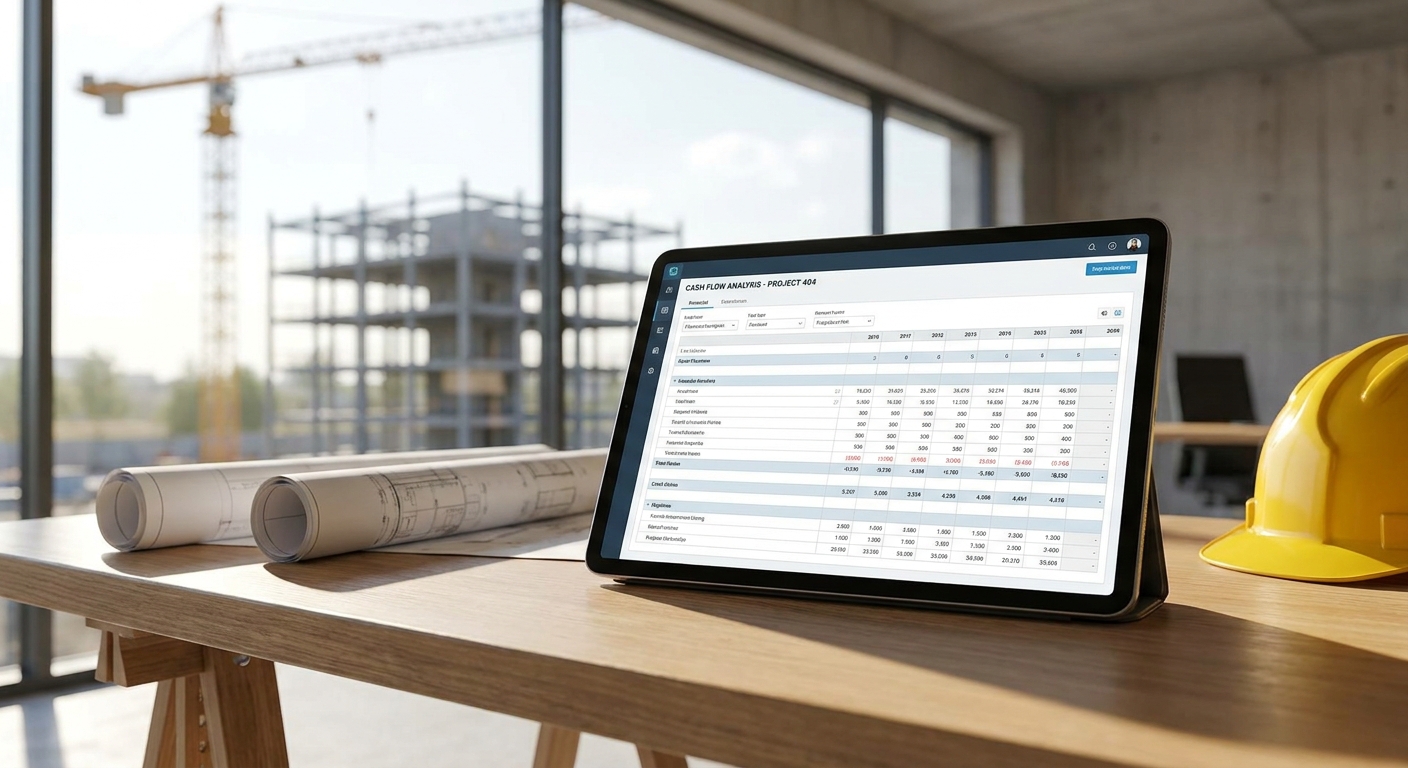
Construction lenders underwrite cash flow that moves in bursts — draws, progress billing, retainage releases — not steady monthly deposits, and most generic bank statement tools were never built to read that pattern. This guide breaks down what cash flow underwriting software for construction lenders actually needs to do, who needs it, and which approaches to skip in 2026.
- Cash flow underwriting software for construction lenders must read draw schedules, not just deposit totals — generic parsers miss this pattern.
- Purpose-built bank statement parsing hits 99.5% accuracy and under 5 seconds per statement across 900+ formats in 2026 — Buy for GC pipelines.
- Manual spreadsheet spreading for contractor cash flow: Skip — it can't flag commingled job-account funds or doctored deposits.
- 27+ fraud signals matter more in construction lending than most verticals, since irregular project cash flow hides doctored statements easily.
Why this matters
A general contractor's bank statement doesn't look like a retail business's. Deposits arrive as draw disbursements from the lender itself, progress payments from the owner, and the occasional insurance or change-order check — all irregular in timing and size. Underwriting software built for steady SMB cash flow reads that volatility as risk when it's actually the normal shape of a construction business.
The cost of getting this wrong runs both directions. Flag every construction borrower as high-risk and you decline good pipeline. Miss the pattern of a doctored statement dressed up to look like steady revenue, and you fund a fraud that looks clean on paper. Cash flow underwriting software for construction lenders in 2026 has to do both jobs at once: read project-based cash flow correctly and still catch the statements built to fool a human reviewer.
Who this is for
This is written for underwriters and credit teams at construction and hard money lenders, MCA brokers financing general contractors and subcontractors, and CPAs prepping loan packages for builders who need bank statement analysis software for construction lenders that doesn't choke on draw-based cash flow. If you're underwriting a GC, a residential builder, or a subcontractor with multiple job-specific bank accounts, the criteria below apply directly to your stack.
What to look for in cash flow underwriting software for construction lenders
Draw-schedule-aware parsing
Software that treats every large deposit the same way will flag a routine draw disbursement as an anomaly. Look for parsing that separates draw payments, progress billing, and retainage releases from operating revenue, because lumping them together produces average monthly revenue figures that don't reflect the borrower's real capacity.
Multi-account and commingled-fund detection
Builders often run separate accounts per job, and money moves between them constantly — job-to-job transfers, owner draws, subcontractor pass-throughs. A parser that can't trace transfers across accounts will either miss commingling or misclassify legitimate job funding as suspicious. This is one of the highest-value checks in construction underwriting, and it's covered in detail in detecting commingled funds in business underwriting.
Seasonal revenue normalization
Construction revenue swings with weather, permitting cycles, and project starts. Twelve months of statements from a residential builder in a cold-weather market can show a 3x swing between peak and trough months. Underwriting software that averages a single trailing period without normalizing for seasonality will either overstate or understate real capacity, depending on which months land in the window.
Fraud signal depth on doctored statements
Irregular, lumpy cash flow is exactly the cover a fraudulent statement needs — a doctored deposit blends in far more easily against a background of legitimate draw payments than it would against flat SMB revenue. Software running fewer than a handful of fraud checks (formatting, font, metadata, balance-continuity signals) will pass documents that a deeper signal set catches immediately.
Format coverage across regional and community banks
Contractors bank locally more often than SMBs in other verticals, and that means statement formats from regional and community banks, not just the top five national names. A parser certified against a narrow set of major-bank formats will kick out exceptions constantly on a construction portfolio, pushing work back to manual review.
Turnaround speed tied to draw cycles
Draw requests move on tight timelines — a GC waiting on a progress payment can't absorb a two-day underwriting delay. Software that takes minutes per statement instead of seconds becomes the bottleneck in a draw-funded pipeline, especially during peak building season.
The approaches, ranked
Purpose-built bank statement parsing for construction cash flow. This is software built specifically to separate draw disbursements, progress billing, and job-account transfers from baseline revenue, paired with fraud signal checks tuned to catch doctored deposits hidden in irregular cash flow. Bank statement analysis software for construction lenders covers the format and signal requirements specific to this vertical. At 99.5% accuracy and sub-5-second processing across 900+ formats in 2026, this is the only approach on this list built for the actual shape of construction cash flow. Buy.
Manual spreadsheet spreading. An underwriter pulling numbers into Excel line by line, categorizing deposits by eye. It works on a handful of loans a month, but it doesn't scale, and it has no fraud detection layer at all — a well-doctored statement passes because nobody's cross-checking metadata or balance continuity. On a construction portfolio with multi-account borrowers, this approach adds hours per file and misses the commingling patterns that matter most. Skip.
Generic OCR bolted onto a loan origination system. These tools extract text and numbers reasonably well but weren't trained on draw-based cash flow patterns, so they classify every large irregular deposit the same way — as either normal or anomalous, with no middle ground for "this is a draw payment." They also tend to run a thin fraud check, if any. Fine for document intake, not sufficient as the underwriting layer for construction cash flow. Consider only as a front-end to a purpose-built parser, never as the sole decision engine.
Cash flow underwriting software built for a different vertical. Some platforms are strong for other lending categories but weren't tuned for project-based revenue. Cash flow underwriting software for small business lenders is a good comparison point — the underlying logic assumes steadier monthly revenue than a GC or subcontractor produces, so applying it directly to construction loans without adjustment for draw cycles and seasonality produces skewed average revenue figures. Consider, but only if it's been re-tuned for draw-based cash flow, otherwise Skip for this vertical.
See construction-specific parsing in action
Review the fraud signals and formats built for draw-based cash flow.
What to avoid
- Tools that report a single average monthly revenue figure with no seasonality breakdown. A flat average across a 12-month window hides the peak-to-trough swing that defines construction revenue and can overstate capacity for a borrower coming off a slow winter.
- Fraud detection limited to a document authenticity check alone. A statement can pass a basic authenticity scan and still contain manipulated transaction data — depth of signal count matters more than a single pass/fail check.
- Format coverage advertised as "major banks" without naming regional or community bank support. Construction borrowers bank locally more than most verticals, and a parser tuned only to the top national banks will exception out constantly.
Verdict comparison
| Approach | Draw-schedule aware | Fraud signal depth | Speed | Verdict |
|---|---|---|---|---|
| Purpose-built construction parsing | Yes | 27+ signals | Under 5 seconds | Buy |
| Manual spreadsheet spreading | No | None | Hours per file | Skip |
| Generic OCR + LOS bolt-on | No | Minimal | Minutes | Consider (intake only) |
| Cash flow underwriting for other verticals | Partial | Varies | Varies | Consider with re-tuning |
FAQ
What is cash flow underwriting software for construction lenders?
It's software that parses a borrower's bank statements to separate draw disbursements, progress billing, and retainage from baseline operating revenue, then screens the document for fraud signals. Generic underwriting tools average deposits without this separation, which distorts capacity for project-based businesses.
How does cash flow underwriting differ from balance sheet underwriting for GCs?
Balance sheet underwriting looks at assets and liabilities at a point in time, while cash flow underwriting reads actual transaction history to see how money moves in and out. For construction borrowers, cash flow underwriting catches the draw-cycle volatility that a balance sheet snapshot misses entirely.
Can cash flow underwriting software detect doctored bank statements from contractors?
Software running 27+ fraud signals can catch formatting inconsistencies, metadata mismatches, and balance-continuity errors that a doctored statement introduces. The irregular deposit pattern in construction cash flow makes manipulation harder to spot with fewer signals, so signal depth matters more here than in steadier-revenue verticals.
How fast should bank statement parsing be for construction loan approvals?
Sub-5-second processing per statement is achievable with purpose-built parsers in 2026, which matters because draw requests move on tight funding timelines. Anything measured in minutes per statement becomes a bottleneck once volume picks up during peak building season.
Does cash flow underwriting software handle seasonal construction revenue?
Software built for this vertical normalizes revenue across a full 12-month window instead of reporting a single trailing average, which accounts for weather-driven and permitting-cycle swings. Without normalization, a slow winter month can drag down an otherwise healthy borrower's average revenue figure.
What bank statement formats do construction lenders need covered?
Coverage across regional and community bank formats matters as much as the major national banks, since contractors and subcontractors bank locally more often than other SMB borrowers. A parser certified against 900+ formats in 2026 reduces the exception rate that pushes files into manual review.
Is manual spreadsheet spreading still viable for construction loans in 2026?
No — manual spreading has no fraud detection layer and can't trace transfers across a builder's multiple job-specific bank accounts. It works at low volume but adds hours per file and misses commingling patterns that matter most in construction underwriting.
What is a draw schedule and why does underwriting software need to read it?
A draw schedule is the payment plan tied to project milestones that determines when a lender releases construction funds. Underwriting software needs to recognize draw payments as separate from operating revenue, or it will misclassify normal project funding as unexplained deposit volatility.
One last thing
The single biggest miss in construction cash flow underwriting isn't fraud detection — it's treating a draw disbursement the same way you'd treat a random large deposit from an unrelated business. Fix that classification problem first, and the fraud signals matter far more because they're no longer buried under false-positive noise from legitimate draw payments.
Related guides
ClearStaq Team
Content Team
The ClearStaq team builds AI-powered tools for bank statement parsing, fraud detection, and income verification.