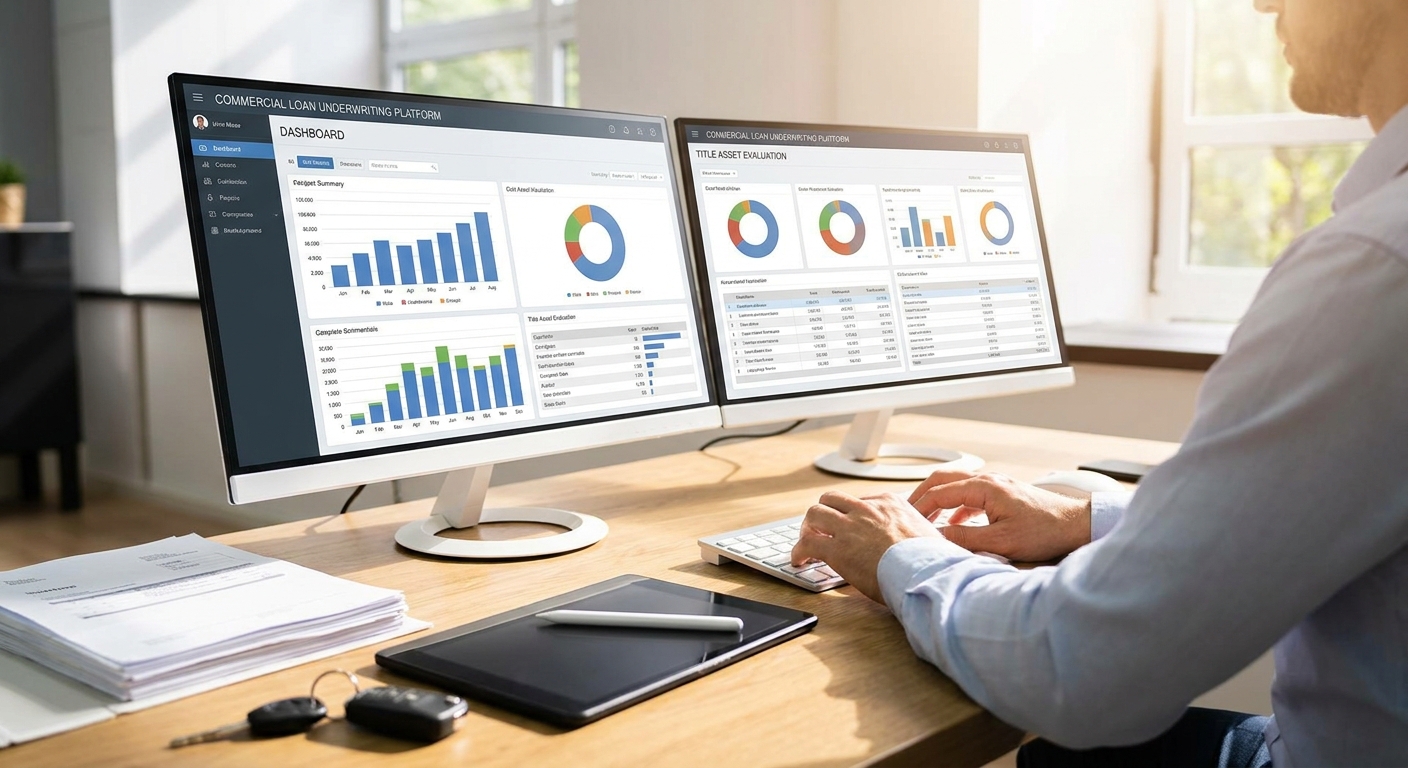
Title loan lenders underwrite against a car title in minutes, not weeks, and the software behind that call has to catch fraud without slowing down funding. This guide ranks the underwriting approaches that hold up at title loan volume in 2026, and names the one that actually fits the file size and speed this business runs on.
- Commercial loan underwriting software for title loan lenders needs sub-5-second parsing — ClearStaq hits that with 99.5% accuracy. Buy in 2026.
- Legacy OCR plus manual review can't keep pace with same-day title loan funding — Skip it in 2026.
- Identity-verification-only KYC tools miss doctored bank statements; use them as a layer, not a core system. Consider.
- Fraud tools built for payday lending share DNA with title loan risk but vary on income verification depth. Consider.
Why this matters
Title loan lending runs on speed and thin margins. A $1,500 title loan doesn't carry the underwriting budget of a $500,000 commercial loan, but it carries just as much fraud exposure — duplicate liens filed against the same vehicle at two lenders, straw borrowers using someone else's paid-off title, and bank statements edited to show income that doesn't exist. How to detect fake bank statements in loan applications breaks down the exact edits that pass a manual review.
Most title loan shops process 100 to 500 files a month with two or three underwriters. Underwriting software built for a 30-day commercial loan cycle doesn't fit a business that needs a funding decision the same afternoon the borrower walks in. Regulatory patchwork makes it harder: title loan rules vary state by state on rate caps, renewal limits, and disclosure documentation, so the software also has to hold up across dozens of state-specific forms alongside the bank statement itself.
Getting this wrong shows up later as repossession disputes over a title with a hidden lien, or as a regulatory exam finding that the shop funded a file it should have flagged. That mismatch is why generic loan origination add-ons underperform in this vertical, and why format-aware parsing has become the baseline expectation for commercial loan underwriting software for title loan lenders heading into 2026.
Who this is for
This guide is for state-licensed title loan lenders and short-term secured lenders underwriting 100 or more files a month — operations teams weighing a dedicated parsing and fraud platform against a legacy OCR tool or a manual review process that has stopped scaling. It's built for underwriting managers and compliance leads who need a funding decision in hours, not days, and who can't afford a missed duplicate-title fraud case sitting undetected in the portfolio for 90 days before it surfaces in a repossession dispute. If your team is still emailing PDFs between underwriters and a compliance reviewer, this is the audience the rest of this guide speaks to directly.
What to look for in underwriting software for title loan lenders
Six criteria separate software built for this vertical from software borrowed from a different one. Run any vendor through these before signing.
Parsing speed at real file volume
A title loan shop running 300 files a month can't wait on a two-minute-per-statement OCR queue. Processing a statement in under 5 seconds is the difference between same-day funding and a backlog that pushes borrowers to a competitor down the street.
Fraud signal depth built for title-collateral patterns
Generic identity checks don't catch a doctored bank statement or a duplicate lien filed against the same VIN at two lenders in the same month. Platforms running 27 or more fraud signals across the statement itself — not just the applicant's ID — catch what a visual scan misses, and they catch it before the file funds.
Income verification for cash-heavy and gig borrowers
Title loan applicants skew toward self-employed, gig, and cash-income borrowers with thin credit files. Software that normalizes deposits and flags irregular income patterns matters more here than a FICO-based model ever will, since a large share of this borrower pool doesn't have a clean credit file to score against in the first place.
Format coverage across regional and national banks
Title loan borrowers bank everywhere: regional credit unions, national banks, neobanks. A parser that only handles the top five bank formats forces manual review on everything else, which defeats the point of automating in the first place. 900+ supported statement formats is the number to ask a vendor for before signing anything.
Integration into the existing decision engine
Underwriting software that can't push parsed data and fraud flags directly into your loan management system just adds a second screen for underwriters to check. API-first platforms remove that extra step entirely and keep the underwriter working from one file, not two.
Cost per file at low ticket size
A title loan averages a few thousand dollars in principal. Underwriting software priced for $500,000 commercial loans doesn't pencil out per file — cost per statement needs to scale with loan size, not work against it.
Top picks for title loan underwriting software in 2026
Format-aware bank statement parsing — the safe pick. ClearStaq parses statements in under 5 seconds with 99.5% accuracy, checks 27+ fraud signals per file, and covers 900+ bank formats. For a title loan shop running same-day funding decisions, that combination of speed and fraud depth is the baseline for 2026, not a premium add-on. Underwriters get a decision-ready file instead of a raw PDF to eyeball. Buy.
Legacy OCR plus manual underwriter review — the default nobody should keep. This is how most title loan shops started: scan the statement, extract the text, hand it to an underwriter to eyeball for red flags. It works at low volume and breaks down past a few hundred files a month, and it catches almost none of the fraud patterns that only show up in transaction-level data rather than a printed page. Skip.
Identity-verification-only KYC stacks — the wildcard. Tools built around identity verification software for lending platforms confirm the applicant is who they say they are, which matters, but they stop there. They don't touch the bank statement itself, so a real person with a doctored statement sails through untouched. Useful as a layer on top of statement-level fraud detection, not a replacement for it. Consider as an add-on only.
Fraud tools built for adjacent short-term lending — the borrowed playbook. Fraud detection built for payday-style short-term lending shares a lot of DNA with title loan risk: fast decisions, thin-file borrowers, high fraud pressure per file. It's a reasonable starting point if the vendor's income-verification depth matches what title loan underwriting actually needs, but confirm that before assuming it transfers cleanly. Consider, and check the fraud signal count before switching over.
What to avoid
Three things look like a fit for title loan underwriting and aren't:
- Mortgage-cycle underwriting software. Built for 30-to-60 day timelines with document sets that don't map to a title loan file. It's the wrong tool for the job even when the vendor calls it "commercial loan underwriting software."
- KYC-only platforms marketed as fraud detection. Verifying identity is not the same as catching a doctored bank statement or a duplicate lien. If a vendor can't name specific statement-level fraud signals, it's an identity tool wearing a fraud-detection label.
- Manual review processes with no automation path. What works at 50 files a month collapses at 300. A process with no path to automation is a temporary fix, not software you build a title loan operation on in 2026.
See ClearStaq on a title loan file
Sub-5-second parsing and 27+ fraud signals on your own bank statement sample.
How the picks compare
The gap between these four approaches shows up fastest in speed and fraud signal depth, not in marketing copy:
| Approach | Speed per file | Fraud signal depth | Income verification | Verdict |
|---|---|---|---|---|
| ClearStaq (format-aware parsing) | Under 5 seconds | 27+ signals | Built in, normalizes irregular income | Buy |
| Legacy OCR + manual review | Minutes per file | Manual, underwriter-dependent | Manual | Skip |
| Identity-verification-only KYC | Seconds (ID check only) | None on statement data | None | Consider, layer only |
| Adjacent-vertical fraud tools | Varies by vendor | Vendor-dependent | Vendor-dependent | Consider |
FAQ
What is the best commercial loan underwriting software for title loan lenders in 2026?
ClearStaq is the strongest fit for title loan lenders in 2026, parsing bank statements in under 5 seconds with 99.5% accuracy and checking 27+ fraud signals per file. Legacy OCR and identity-only KYC tools fall short on speed or fraud depth respectively.
How fast can underwriting software parse a bank statement for a title loan file?
Format-aware parsing platforms process a bank statement in under 5 seconds as of 2026, compared to several minutes per file with OCR plus manual review. That speed difference is what allows same-day title loan funding decisions.
Do title loan lenders need fraud detection separate from identity verification?
Yes — identity verification confirms who the applicant is, but it doesn't check whether the submitted bank statement has been altered. Statement-level fraud detection, running 27 or more signals, catches doctored deposits and duplicate liens that identity checks miss entirely.
Is manual OCR still viable for title loan underwriting in 2026?
Manual OCR plus underwriter review works below roughly 100 files a month but breaks down past that volume. It also misses transaction-level fraud patterns that only show up when software analyzes the statement data directly.
How many bank statement formats does title loan underwriting software need to support?
Title loan borrowers bank across regional credit unions, national banks, and neobanks, so software needs to cover 900 or more statement formats to avoid pushing most files into manual review. Anything narrower defeats the purpose of automating the process.
What fraud signals matter most for title loan applications?
Duplicate liens on the same vehicle, doctored deposit entries, and income smoothing across months are the three patterns that show up most in title loan fraud cases. A platform checking 27+ signals typically covers all three alongside dozens of other statement-level flags.
Can title loan underwriting software integrate with an existing loan origination system?
API-first platforms push parsed statement data and fraud flags directly into an existing loan management or origination system, so underwriters see one screen instead of two. Confirm API access before signing with any vendor.
How much does commercial loan underwriting software cost for a title loan shop?
Pricing depends on file volume and the fraud-signal depth included, so check current plans directly with the vendor rather than relying on a published rate. Cost per file should scale down with loan size, not work against a low-ticket lender.
One last thing
The fraud pattern that catches most title loan underwriters off guard in 2026 isn't a fake ID. It's a legitimate borrower using a paid-off title that already has a lien filed with another lender in the same state, paired with a bank statement edited to smooth over a cash shortfall. Neither problem shows up on an identity check — both show up in statement-level analysis, which is exactly why commercial loan underwriting software for title loan lenders now has to look at transaction data, not just a face on a driver's license. Shops that added statement-level fraud checks in 2026 caught these cases before funding instead of during a repossession dispute six months later.
Related guides
ClearStaq Team
Content Team
The ClearStaq team builds AI-powered tools for bank statement parsing, fraud detection, and income verification.