Correspondent banks screen every respondent relationship for adverse media before wire one ever clears — and in 2026, regulators expect that screening to run continuously, not just at onboarding. Best overall: LSEG World-Check One. Best for API-first onboarding automation: ComplyAdvantage. Best budget-friendly option for mid-market correspondent banks: Napier AI. The rest of this guide breaks down six adverse media screening platforms by data coverage, false-positive handling, and integration fit so your compliance team picks the right tool instead of the most-marketed one.
- LSEG World-Check One wins for correspondent banks that need the broadest global news and watchlist data in one query.
- ComplyAdvantage is the best adverse media screening software for correspondent banks running API-first onboarding.
- Napier AI is the strongest budget-friendly pick for mid-market correspondent banks watching false-positive volume.
- Adverse media screening catches reputational risk that sanctions lists alone miss entirely.
- Pair adverse media screening with dedicated fraud detection — the two layers catch different risk types.
Why this matters for correspondent banks
A correspondent bank isn't screening one customer — it's screening a respondent bank's entire book of underlying clients, often across jurisdictions with thin public records. Sanctions screening software for correspondent banks catches the named-list matches. Adverse media screening catches the reputational exposure that never makes a sanctions list at all: an executive named in a fraud investigation, a shell entity tied to an unresolved AML enforcement action, a respondent bank flagged in local press for correspondent-relationship terminations elsewhere.
Banking regulators in 2026 treat adverse media as a standing requirement for correspondent due diligence, not a one-time check at onboarding. Miss it once and the exam finding writes itself. That's why the tool matters as much as the policy — a platform that buries real hits under noise costs your team hours it doesn't have.
What makes the best adverse media screening software
- Global news source breadth — coverage across English and non-English language media, not just US and UK outlets
- AI-driven relevance scoring — separates a genuine hit from a namesake false positive without manual triage on every result
- Sanctions and PEP data in the same query — correspondent banks need adverse media, sanctions, and PEP status returned together, not as three separate lookups
- Ongoing monitoring, not point-in-time — re-screens the respondent relationship on a schedule, flagging new hits automatically
- Audit trail depth — every disposition decision logged for the next regulatory exam
- API and case management integration — screening results need to land inside the workflow your analysts already use
At a glance
| Tool | Best for | Standout feature | Key limitation |
|---|---|---|---|
| LSEG World-Check One | Correspondent due diligence overall | Broadest combined watchlist + adverse media dataset | Enterprise implementation timeline |
| Dow Jones Risk & Compliance | Regulatory audit-trail depth | Deep historical news archive | Steeper learning curve for new analysts |
| ComplyAdvantage | API-first onboarding automation | Real-time API screening at account opening | Less mature case management than legacy incumbents |
| LexisNexis Bridger Insight XG | Single-call sanctions + adverse media | Combines watchlist and media screening in one query | UI feels dated next to newer entrants |
| NICE Actimize | Large banks with existing AML case management | Deep integration with existing Actimize modules | Overkill for banks without Actimize already installed |
| Napier AI | Mid-market, false-positive reduction | AI risk-scoring cuts manual review volume | Smaller global media dataset than LSEG or Dow Jones |
1. LSEG World-Check One: best adverse media screening for correspondent due diligence
LSEG World-Check One (formerly Refinitiv World-Check) is the incumbent most correspondent banks already run somewhere in their compliance stack. It combines sanctions, PEP, and adverse media data sourced from thousands of media outlets and regulatory publications into a single screening query.
LSEG World-Check One pros:
- Broadest combined dataset across sanctions, PEP, and adverse media
- Long track record with correspondent banking compliance teams specifically
- Strong non-English media coverage for cross-border respondent relationships
LSEG World-Check One cons:
- Enterprise-grade implementation takes longer than newer API-first tools
- Case management add-ons are typically separate licensing
Best for: correspondent banks that want one dataset covering sanctions, PEP, and adverse media without stitching together multiple vendors. Verdict: Buy.
2. Dow Jones Risk & Compliance: best for audit-trail depth
Dow Jones Risk & Compliance leans on the Dow Jones news archive, giving compliance teams a historical record that goes back further than most competitors for legacy adverse media hits tied to older enforcement actions.
Dow Jones Risk & Compliance pros:
- Deep historical archive useful for long-tenured respondent relationships
- Strong documentation trail for regulatory exam prep
- Configurable risk categories for correspondent-specific rulesets
Dow Jones Risk & Compliance cons:
- Configuration complexity means a longer ramp for new analysts
- Pricing structure tied to query volume can get complicated at scale
Best for: compliance teams that get examined frequently and need a defensible historical paper trail. Verdict: Buy for larger institutions with dedicated compliance staff.
3. ComplyAdvantage: best for API-first onboarding automation
ComplyAdvantage built its product around the API call rather than the analyst dashboard, which matters for correspondent banks trying to screen respondent applications in real time during onboarding instead of batching checks overnight.
ComplyAdvantage pros:
- Real-time API screening built for automated onboarding pipelines
- Machine-learning risk scoring reduces manual review queue size
- Faster implementation than legacy enterprise platforms
ComplyAdvantage cons:
- Case management workflow is thinner than what NICE Actimize or LSEG offer natively
- Smaller correspondent-banking-specific track record than the older incumbents
Best for: correspondent banks automating respondent onboarding through APIs rather than manual analyst review. Verdict: Buy for teams building automated pipelines.
4. LexisNexis Bridger Insight XG: best for single-call sanctions and adverse media
Bridger Insight XG returns sanctions, PEP, and adverse media results from one query, which cuts the number of separate lookups an analyst has to reconcile manually during respondent bank reviews.
LexisNexis Bridger Insight XG pros:
- Combines multiple screening types in one call
- Established presence in US correspondent banking compliance
- Configurable match thresholds by risk category
LexisNexis Bridger Insight XG cons:
- Interface feels dated compared to newer AI-first entrants
- Non-English media coverage lags the LSEG and Dow Jones datasets
Best for: compliance teams that want fewer separate screening calls to reconcile per respondent review. Verdict: Hold — solid if already licensed, not the first pick for a fresh deployment.
5. NICE Actimize: best for banks already running Actimize case management
NICE Actimize's adverse media module plugs directly into the broader Actimize AML suite, which matters if your correspondent bank already runs Actimize for transaction monitoring or case management.
NICE Actimize pros:
- Deep integration with existing Actimize AML modules
- Enterprise-grade workflow and escalation routing
- Strong fit for banks with large in-house compliance operations
NICE Actimize cons:
- Not worth adopting standalone if Actimize isn't already in the stack
- Implementation and configuration require dedicated technical resources
Best for: correspondent banks that already run NICE Actimize for AML case management. Verdict: Buy only if Actimize is already installed.
6. Napier AI: best budget-friendly option for mid-market correspondent banks
Napier AI positions itself around AI-driven risk scoring that cuts false-positive review volume, aimed at mid-market institutions that can't staff a large manual-review team.
Napier AI pros:
- AI risk scoring reduces manual review load for smaller compliance teams
- Faster deployment than the legacy enterprise incumbents
- Configurable rulesets without heavy professional-services overhead
Napier AI cons:
- Smaller global media dataset than LSEG World-Check One or Dow Jones
- Less correspondent-banking-specific track record than the older platforms
Best for: mid-market correspondent banks that need to control false-positive volume without enterprise-level licensing. Verdict: Buy for smaller compliance teams.
How we ranked these
Each platform above got scored against the six criteria listed earlier: data breadth, false-positive handling, sanctions/PEP integration, ongoing monitoring, audit-trail depth, and API/case-management fit. No two entries share a "best for" slot — a correspondent bank picking between these six is choosing a use case, not just a brand.
Which adverse media screening software should you choose?
If your correspondent bank needs one dataset that covers sanctions, PEP, and adverse media with the deepest global coverage, LSEG World-Check One is the default pick for 2026. If your onboarding is API-driven and speed matters more than dataset breadth, ComplyAdvantage fits better. Smaller correspondent operations watching headcount should look at Napier AI first.
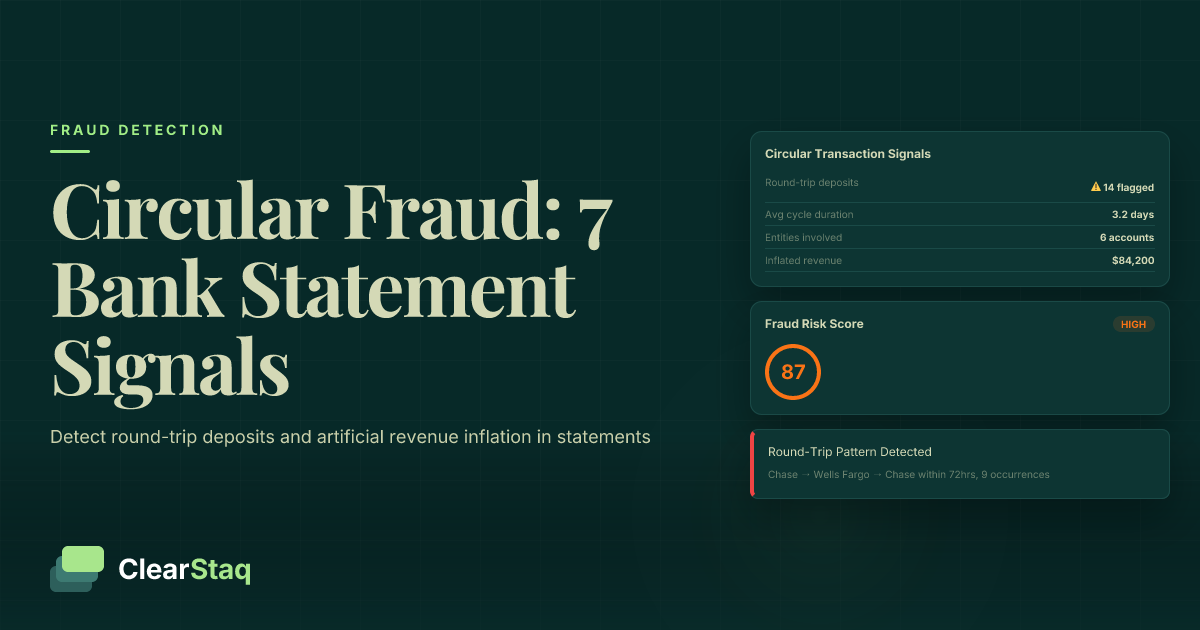
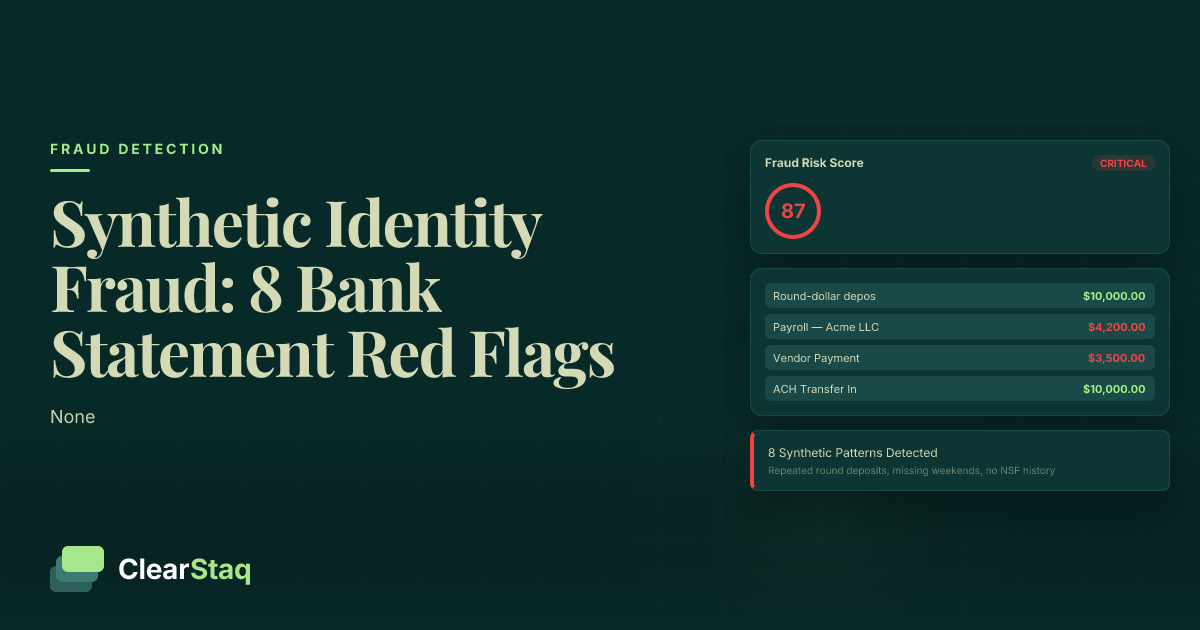
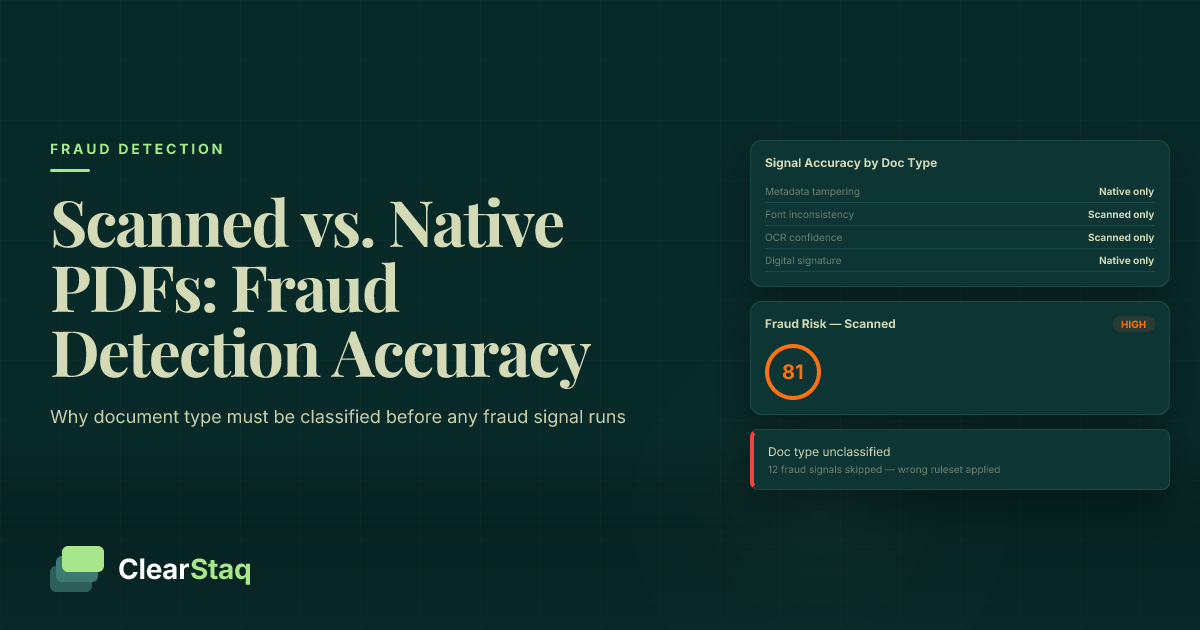
Whichever adverse media screening tool you pick, it only covers reputational and watchlist risk — it doesn't touch the financial-document side of correspondent due diligence. That's a separate layer: verifying that the bank statements and financials a respondent institution submits are genuine and not manipulated. ClearStaq handles that layer with 27+ AI fraud signals, sub-5-second processing per document, and 99.5% parsing accuracy across bank statement and tax return formats — it doesn't replace adverse media screening, it closes the gap the screening tool leaves open.
See ClearStaq's fraud detection layer
27+ AI signals catch document fraud adverse media tools can't see.
FAQ
What is adverse media screening for correspondent banks?
Adverse media screening checks a respondent bank's owners, executives, and related entities against negative news coverage — fraud allegations, enforcement actions, litigation — that wouldn't show up on a sanctions or PEP list. Correspondent banks run it during onboarding and on an ongoing basis for every respondent relationship.
Is adverse media screening legally required in 2026?
Regulators expect correspondent banks to include adverse media checks as part of enhanced due diligence for respondent relationships. It's treated as a standing compliance requirement, not a one-time onboarding step, in most 2026 examination frameworks.
What's the difference between adverse media screening and sanctions screening?
Sanctions screening matches names against official government and international watchlists. Adverse media screening scans news and public records for reputational risk that never reaches a formal sanctions list, such as unresolved fraud investigations.
Is ComplyAdvantage better than LSEG World-Check One for correspondent banks?
ComplyAdvantage wins on API-first automation and faster deployment. LSEG World-Check One wins on dataset breadth and correspondent-banking track record. The right pick depends on whether onboarding speed or data depth matters more to your team.
Can adverse media screening run continuously instead of only at onboarding?
Yes — most platforms on this list, including LSEG World-Check One and ComplyAdvantage, support scheduled re-screening that flags new adverse media hits on existing respondent relationships automatically.
Does ClearStaq do adverse media screening?
No. ClearStaq parses bank statements and tax returns, detects lending fraud across 27+ signals, and automates income verification. It sits alongside adverse media screening tools rather than replacing them, covering the financial-document fraud layer those tools don't check.
How do false positives affect adverse media screening at correspondent banks?
High false-positive volume forces analysts to manually clear common-name matches, slowing respondent onboarding. AI risk-scoring tools like Napier AI and ComplyAdvantage are built specifically to reduce that manual review load.
What data sources do adverse media screening tools check?
Global news outlets, regulatory publications, court records, and enforcement action databases, in both English and non-English languages depending on the vendor's coverage depth.
One last thing
A respondent bank can be completely clean on every sanctions and PEP list and still be a correspondent risk — adverse media is often the only signal that catches an unfolding fraud investigation before it hits an official watchlist. That's the gap the six tools above exist to close, and it's also why compliance teams in 2026 are pairing adverse media screening with document-level fraud detection instead of treating either one as sufficient on its own.
Related guides
ClearStaq Team
Content Team
The ClearStaq team builds AI-powered tools for bank statement parsing, fraud detection, and income verification.